Bioinformatics Master of Science Degree


Bioinformatics
Master of Science Degree
A bioinformatics master’s degree prepares you to tackle complex problems in biology using big data, data mining, machine learning and modeling.
30%
Merit Scholarship
$1M+
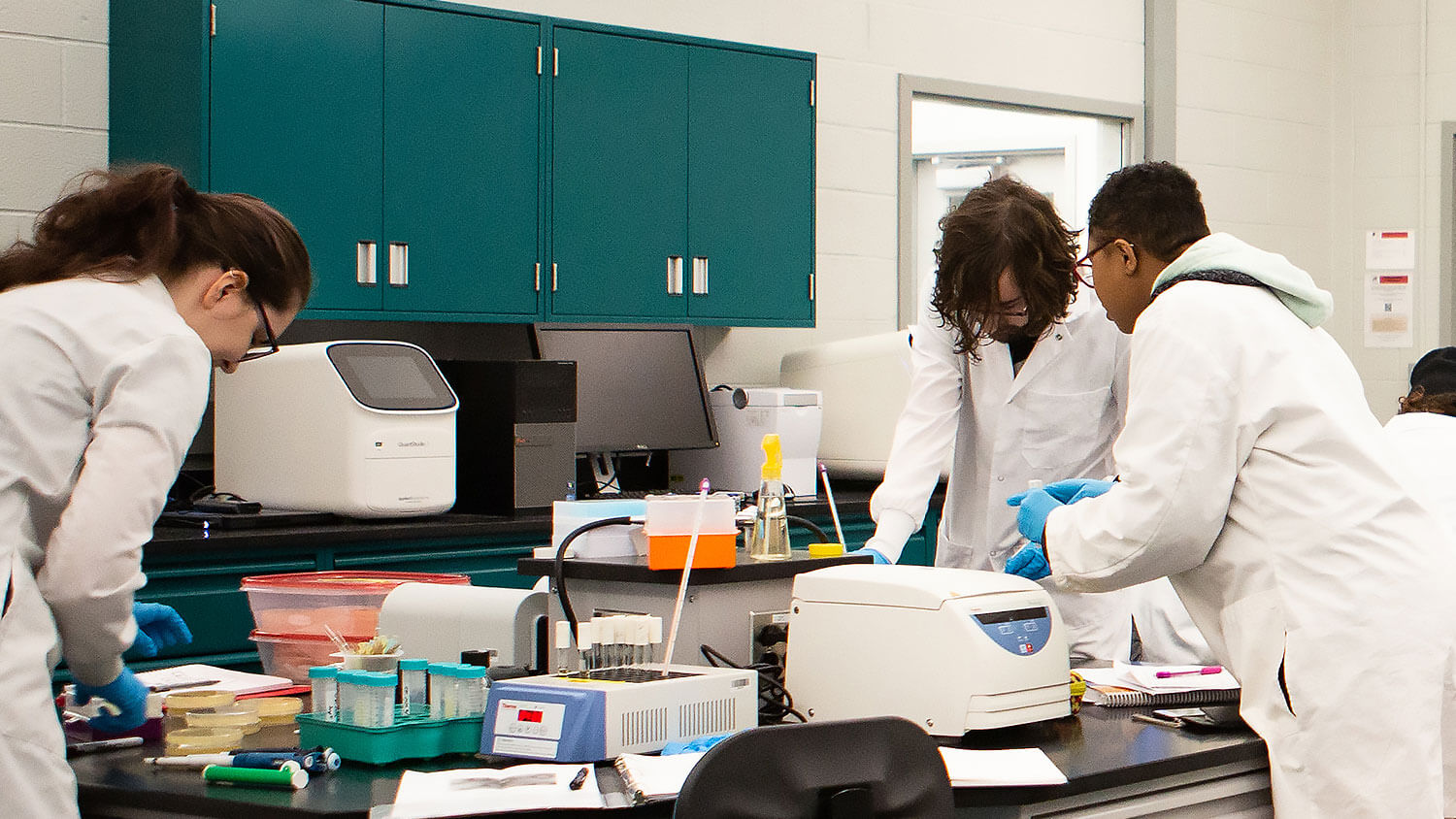
Equipment in Genomics Lab
Overview for Bioinformatics MS
- Recent bioinformatics graduates are employed at Pacific Northwest National Laboratory, Personal Genome Diagnostics, University of Rochester Genomics Research Center, and Asuragen, Inc.
- A comprehensive bridge program supplements students’ previous education.
- Customized curriculum provides a strong foundation in biotech and computer programming.
- Current faculty research includes molecular evolution, ecological modeling, cancer chromatin, machine learning, genomics, and forensic science.
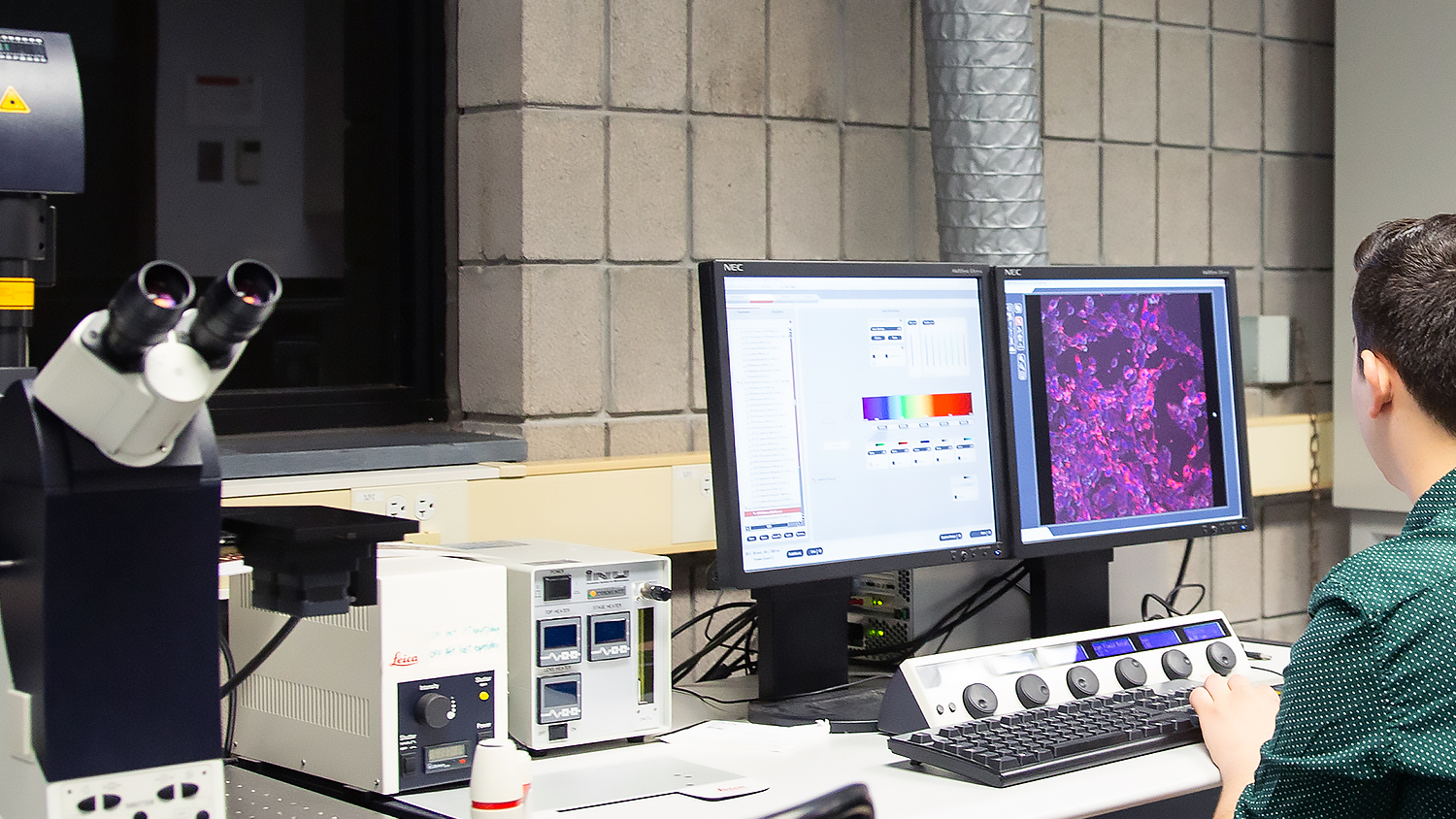
- Genomics Lab includes an Illumina MiSeq where students sequence and annotate whole-genomes of a variety of organisms
RIT’s bioinformatics master’s degree combines biotechnology, computer programming, and computational mathematics to prepare you to utilize and create technologies that discover, treat, and cure a range of medical illnesses. With a strong foundation in biotechnology, computer programming, computational mathematics, statistics, and database management, you will be well-prepared for academia and careers in the biotechnology, bioinformatics, pharmaceutical, and vaccine industries.
RIT’s Bioinformatics Master’s Degree
Bioinformatics is a field that has been developing over the last thirty years. It is a discipline that represents a marriage between biotechnology and computer technologies and has evolved through the convergence of advances in each of these fields. Today bioinformatics is a field that encompasses all aspects of the application of computer technologies to biological data. Computers are used to organize, link, analyze, and visualize complex sets of biological data to discover, treat, and cure a range of medical illnesses.
RIT’s bioinformatics master’s degree is focused on cutting-edge computational techniques, such as data mining, to understand biomedical data. In laboratory exercises and assignments, you will learn to sequence DNA and use computer programs to analyze DNA sequences and predict molecular models. You are also encouraged to pursue cooperative education opportunities to gain hands-on career experience in industry.
Current bioinformatics students have worked on projects including:
- Database development
- Cancer vaccine design
- Literature mining
- Molecular dynamics simulation
The program provides you with the capability to enter the bioinformatics workforce and become a leader in the field. The curriculum is designed to fulfill the needs of students with diverse educational and professional backgrounds. Individuals entering the program typically have degrees in biology, biotechnology, chemistry, statistics, computer science, information technology, or a related field. To prepare applicants from various backgrounds, the curriculum includes a comprehensive bridge program that includes courses in biology, mathematics, computer science, statistics, or other related fields. The program offers two tracks, one for students with backgrounds in the life sciences and one for those with backgrounds in the computational sciences.
Careers in Bioinformatics
With the advent of high-throughput technologies such as Next Generation Sequencing and proteomics, bioinformatics has become essential to the biological sciences in general. In the past, laboratories were able to manage and analyze their experimental data in spreadsheets. Many research labs now require the expertise of dedicated bioinformatics core centers or their own in-house bioinformaticists.
Graduates of the bioinformatics master’s program have entered such laboratories, both in industry and academia, as bioinformaticists. Some have also gone on to leverage their biotechnology experiences as wet lab experimentalists. The diversity of skills you will cultivate in the program give you access to a wide range of career choices.
The job market is rich with opportunities for those with graduate degree in bioinformatics, particularly when coupled with research as thesis work. This research provides exposure to real-world problems—and their solutions—not otherwise attainable in an academic setting.
Graduates of the bioinformatics master’s degree currently work senior analysts/programmers, associate systems analysts, bioinformaticist, bioinformatics analysts, bioinformatics engineers, computational biologists, and software engineers.
Students are also interested in: Information Technology and Analytics MS

Join us for Fall 2024
Many programs accept applications on a rolling, space-available basis.
30% Tuition Scholarship for NY Residents and Graduates
Now is the perfect time to earn your Master’s degree. If you’re a New York state resident with a bachelor’s degree or have/will graduate from a college or university in New York state, you are eligible to receive a 30% tuition scholarship.
Careers and Experiential Learning
Typical Job Titles
| Researcher | Business Intelligence Developer |
| Computational Biologist | Bioinformatics Software Engineer |
| RD Bioinformatics and Laboratory Researcher | Innovation Consultant |
| Associate Software Engineer |
Cooperative Education
What makes an RIT science and math education exceptional? It’s the ability to complete science and math co-ops and gain real-world experience that sets you apart. Co-ops in the College of Science include cooperative education and internship experiences in industry and health care settings, as well as research in an academic, industry, or national lab. These are not only possible at RIT, but are passionately encouraged.
What makes an RIT education exceptional? It’s the ability to complete relevant, hands-on career experience. At the graduate level, and paired with an advanced degree, cooperative education and internships give you the unparalleled credentials that truly set you apart. Learn more about graduate co-op and how it provides you with the career experience employers look for in their next top hires.
National Labs Career Events and Recruiting
The Office of Career Services and Cooperative Education offers National Labs and federally-funded Research Centers from all research areas and sponsoring agencies a variety of options to connect with and recruit students. Students connect with employer partners to gather information on their laboratories and explore co-op, internship, research, and full-time opportunities. These national labs focus on scientific discovery, clean energy development, national security, technology advancements, and more. Recruiting events include our university-wide Fall Career Fair, on-campus and virtual interviews, information sessions, 1:1 networking with lab representatives, and a National Labs Resume Book available to all labs.
Featured Work
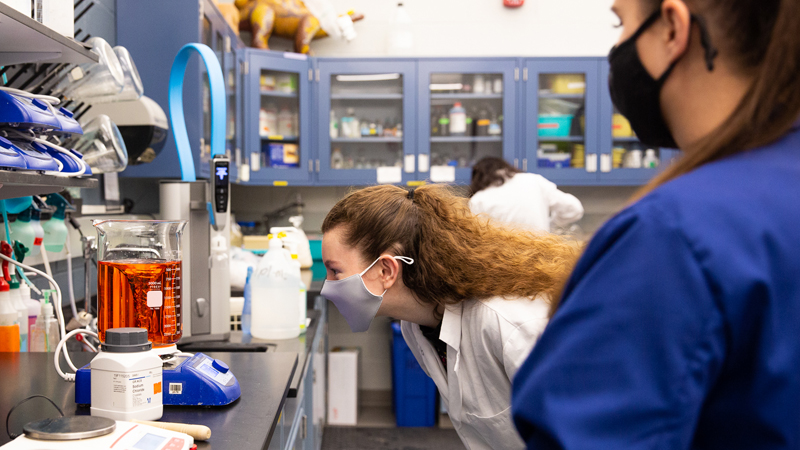
A Team Experience That Pays Off In More Ways Than One
The Laboratory Support Team (or BioPrep) is a unique team that gets hands-on lab experience while helping the many teaching labs in the Thomas H. Gosnell School of Life Sciences at RIT.
Featured Profiles
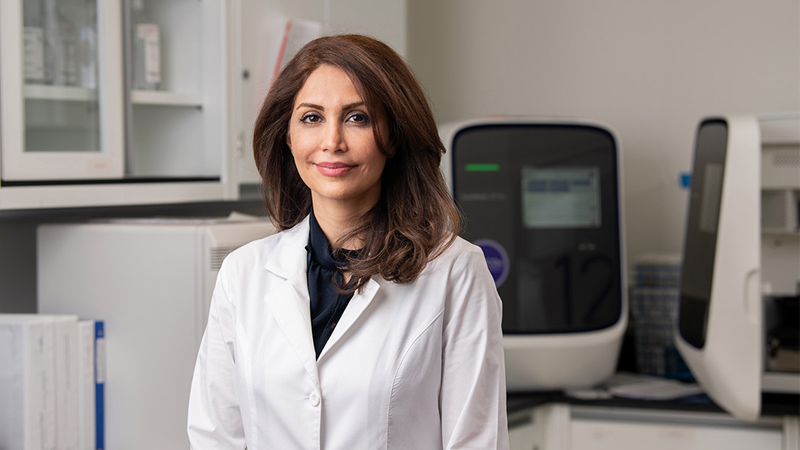
Dadgar Works to Make Medicine Personal
Sherry Dadgar ’08 (bioinformatics)
Sherry Dadgar launched PMCDx in 2020 to deliver advanced clinical genomic diagnostic testing to patients and their physicians. Today, PMCDx has more than 20 employees.

Love Biology? Hate Formaldehyde? Try Bioinformatics.
Jeselle Clark ’19 (bioinformatics)
Jeselle Clark realized there are biology career paths outside of medicine or ecology. Today she’s a bioinformatics software engineer working at Essex Management, LLC as a contractor for the National...

Bioinformatics: The Intersection of Biology and Computer Science
Spencer Richman ‘20 (bioinformatics)
Spencer Richman ‘20 switched majors when he discovered the bioinformatics program at RIT combined the two things he loved—computer science and biology.
Curriculum for 2023-2024 for Bioinformatics MS
Current Students: See Curriculum Requirements
Bioinformatics, MS degree, typical course sequence
| Course | Sem. Cr. Hrs. | |
|---|---|---|
| First Year | ||
| BIOL-625 | Ethics in Bioinformatics This course will be focused on individual and organizational responsibilities in bioinformatics research, product development, product commercialization and clinical and consumer genetic testing. (This course is restricted to students in the BIOINFO-MS, BIOINFO-BS/MS program.) Lecture 3 (Fall). |
3 |
| BIOL-630 | Bioinformatics Algorithms Bioinformatics Algorithms will focus on the types of analyses, tools, and databases that are available and commonly used in Bioinformatics. The labs will apply the lecture material in the analysis of real data through computer programming. (This course is restricted to students in the BIOINFO-MS, BIOINFO-BS/MS program.) Lab 3, Lecture 2 (Fall). |
3 |
| BIOL-635 | Bioinformatics Seminar The course provides opportunities for students and faculty to develop and share professional interests while discussing current trends and developments in bioinformatics. Material for this course will be drawn from the current scientific literature. (This course is restricted to students in the BIOINFO-MS, BIOINFO-BS/MS program.) Lecture 3 (Fall). |
3 |
| BIOL-672 | Computational Statistics and Data Science Methods This course will introduce traditional multivariate statistical methods and multi-model inference, as well as iterative computational algorithms (i.e. Bayesian methods and machine learning) appropriate for graduate students conducting or planning to conduct a graduate research project. The course will focus on the proper application of methods to a sample data sets using statistical programming software and graphics and will forego the more in-depth analytical mathematical exposition that you might see in a math course, so that we can cover a larger variety of methods and spend more time implementing them in code. Practical examples will often derive from the fields of biology, environmental science, or medicine, however the statistical methods we cover will also have much broader application within modern data science. The ultimate goal will be to learn when and where to correctly apply a given method to real questions about real data. Class time will be devoted to introductory lecture, programming language demonstrations with a common dataset, and open discussions of potential applications, including in-class studio hours to help with homework. Students should be prepared to learn to write code scripts that will manipulate statistical tests and graphical output. However, no background experience with programming is assumed. All software used in the course is open-source and students will be required to set up and run weekly assignments on their own laptop computer or on a computer borrowed from the library or RIT’s computer lab. (Prerequisites: STAT-145 or equivalent course or graduate student standing.) Lecture 2, Studio 2 (Fall, Spring). |
3 |
| BIOL-694 | Molecular Modeling and Proteomics This course will explore two facets of protein molecules: their separation and their structure. The structure component will build upon information from earlier bioinformatics courses. Protein separation techniques will be addressed in lectures with descriptions of 2D gel electrophoresis and chromatography. Algorithms of protein secondary structure prediction will be implemented. Experimental techniques for tertiary structure determination such as NMR will be covered. The course will also include the analysis of inter-molecular interactions, such as ligand/receptor pairing, by employing software that permits modeling of molecular docking experiments. (Prerequisite: BIOL-327 or equivalent course or student standing in BIOINFO-MS.) Lab 2, Lecture 2 (Spring). |
3 |
| BIOL-790 | Research and Thesis Masters-level research by the candidate on an appropriate topic as arranged between the candidate and the research advisor. (This course requires permission of the Instructor to enroll.) Thesis (Fall, Spring, Summer). |
2 |
Graduate Electives* |
9 | |
| Second Year | ||
| BIOL-790 | Research and Thesis Masters-level research by the candidate on an appropriate topic as arranged between the candidate and the research advisor. (This course requires permission of the Instructor to enroll.) Thesis (Fall, Spring, Summer). |
4 |
| Total Semester Credit Hours | 30 |
|
* Any graduate-level course deemed related to the field of Bioinformatics by the Program Director.
Admissions and Financial Aid
This program is available on-campus only.
| Offered | Admit Term(s) | Application Deadline | STEM Designated |
|---|---|---|---|
| Full‑time | Fall or Spring | Rolling | Yes |
| Part‑time | Fall or Spring | Rolling | No |
Full-time study is 9+ semester credit hours. Part-time study is 1‑8 semester credit hours. International students requiring a visa to study at the RIT Rochester campus must study full‑time.
Application Details
To be considered for admission to the Bioinformatics MS program, candidates must fulfill the following requirements:
- Complete an online graduate application.
- Submit copies of official transcript(s) (in English) of all previously completed undergraduate and graduate course work, including any transfer credit earned.
- Hold a baccalaureate degree (or US equivalent) from an accredited university or college in biology, biotechnology, biochemistry, chemistry, computer science, information technology, statistics, or a related discipline.
- A recommended minimum cumulative GPA of 3.2 (or equivalent).
- Submit a current resume or curriculum vitae.
- Submit a personal statement of educational objectives.
- Submit two letters of recommendation.
- Entrance exam requirements: GRE required for individuals with degrees from international universities. No minimum score requirement.
- Writing samples are optional.
- Submit English language test scores (TOEFL, IELTS, PTE Academic), if required. Details are below.
English Language Test Scores
International applicants whose native language is not English must submit one of the following official English language test scores. Some international applicants may be considered for an English test requirement waiver.
| TOEFL | IELTS | PTE Academic |
|---|---|---|
| 79 | 6.5 | 56 |
International students below the minimum requirement may be considered for conditional admission. Each program requires balanced sub-scores when determining an applicant’s need for additional English language courses.
How to Apply Start or Manage Your Application
Cost and Financial Aid
An RIT graduate degree is an investment with lifelong returns. Graduate tuition varies by degree, the number of credits taken per semester, and delivery method. View the general cost of attendance or estimate the cost of your graduate degree.
A combination of sources can help fund your graduate degree. Learn how to fund your degree


Research
Faculty in the College of Science receive research grant awards from organizations such as the National Science Foundation and the National Institutes of Health, which provide you with unique opportunities to conduct cutting-edge graduate-level thesis research. Using modern computational tools and approaches the bioinformatics faculty conduct research on a broad variety of topics including:
- molecular evolution
- ecological modeling
- cancer biology
- genomics
Learn more by exploring our life science research areas.
Latest News
-
April 25, 2023
![two researchers looking at a large, white gear.]()
RIT graduate programs rank among best in nation in ‘U.S. News & World Report’ survey
RIT graduate degree programs are among the best in the nation, according to the U.S. News & World Report annual statistical survey of graduate programs.
-
December 2, 2022
![a bat flying.]()
Study by RIT scientists indicates SARS-CoV-2 variants are still transmissible between species
Scientists believe bats first transmitted SARS-CoV-2 to humans in December 2019, and while the virus has since evolved into several variants such as delta and omicron, a new study by scientists at RIT indicates the virus is still highly transmissible between mammals.
-
May 9, 2022
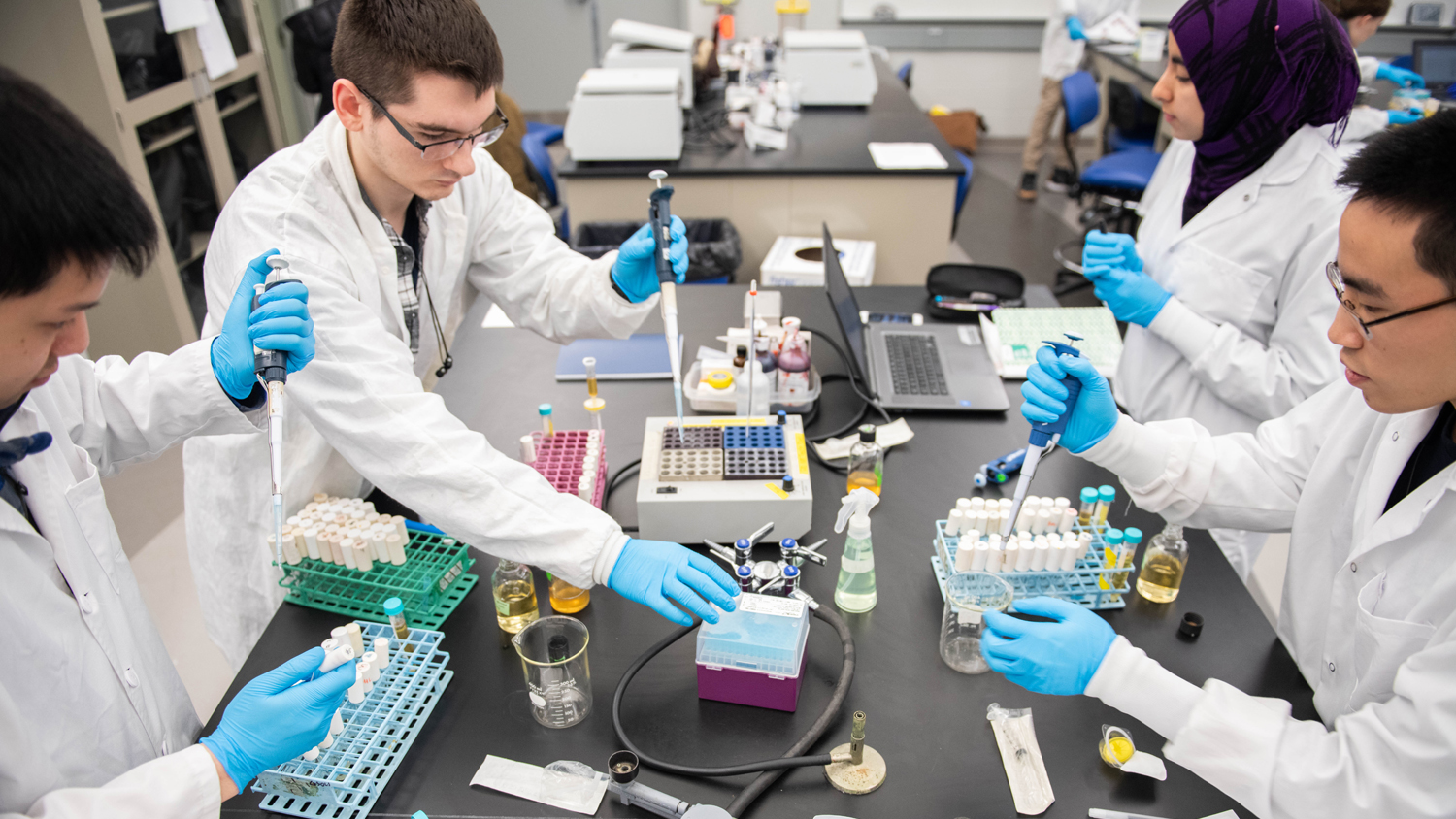
![portrait of Sherry Dadgar.]()
Dadgar works to make medicine personal
Sherry Dadgar ’08 MS (bioinformatics) wants the future of medicine to empower patients. Dadgar, a clinical assistant professor of medicine at George Washington University, launched her company, Personalized Medicine Care Diagnostics (PMCDx), in 2020 with a goal of delivering advanced clinical genomic diagnostic testing to patients and their physicians.


