

Umer Javed
Assistant Professor of Mechanical Engineering
Mechanical Engineering
RIT Dubai
Umer Javed
Assistant Professor of Mechanical Engineering
Mechanical Engineering
RIT Dubai
Currently Teaching
MECE-104
Engineering Design Tools
3 Credits
This course combines the elements of Design process, Computer Aided Design (CAD), and Machine Shop Fabrication in the context of a design/build/test project. You will learn how to work in a team and use a formalized design process to justify and support design choices, competently use a CAD package (CREO) to create three-dimensional models and assemblies, and how to safely fabricate metal parts using vertical mills and lathes.
MECE-117
Introduction to Programming for Engineers
3 Credits
This course provides the student with an overview of the use of computer programming for solving problems encountered in engineering. Students will learn how to develop an algorithm for solving a problem and to translate that algorithm into computer code using fundamental structured programming techniques. The programming language(s) employed are selected to support computational problem-solving in higher-level mechanical engineering courses.
MECE-210
Fluid Mechanics I
3 Credits
This course investigates the physical characteristics of a fluid: density, stress, pressure, viscosity, temperature, vapor pressure, compressibility. Descriptions of flows include Lagrangian and Eulerian; stream-lines, path-lines and streak-lines. Classification of flows include fluid statics, hydrostatic pressure at a point, pressure field in a static fluid, manometry, forces on submerged surfaces, buoyancy, standard and adiabatic atmospheres. Flow fields and fundamental laws are investigated including systems and control volumes, Reynolds Transport theorem, integral control volume analysis of basic equations for stationary and moving control volumes. Inviscid Bernoulli and the Engineering Bernoulli equation are utilized when analyzing fluid systems. Other concepts studied include incompressible flow in pipes; laminar and turbulent flows, separation phenomenon, dimensional analysis.
MECE-320
System Dynamics
3 Credits
This required course introduces the student to lumped parameter system modeling, analysis and design. The determination and solution of differential equations that model system behavior is a vital aspect of the course. System response phenomena are characterized in both time and frequency domains and evaluated based on performance criteria. Laboratory exercises enhance student proficiency with model simulation, basic instrumentation, data acquisition, data analysis, and model validation.
MECE-350
Strengths II
3 Credits
This course provides a continuation of concepts pertaining to the mechanics of deformable media and their relation to the failure of materials. Failure topics pertaining to yielding, buckling, fracture, and fatigue for structures under static and dynamic loading conditions are discussed. A function-constraints-objective approach to the mechanical design process is introduced.
MECE-499
Cooperative Education
0 Credits
Nominally three months of full-time, paid employment in the mechanical engineering field.
Featured Work
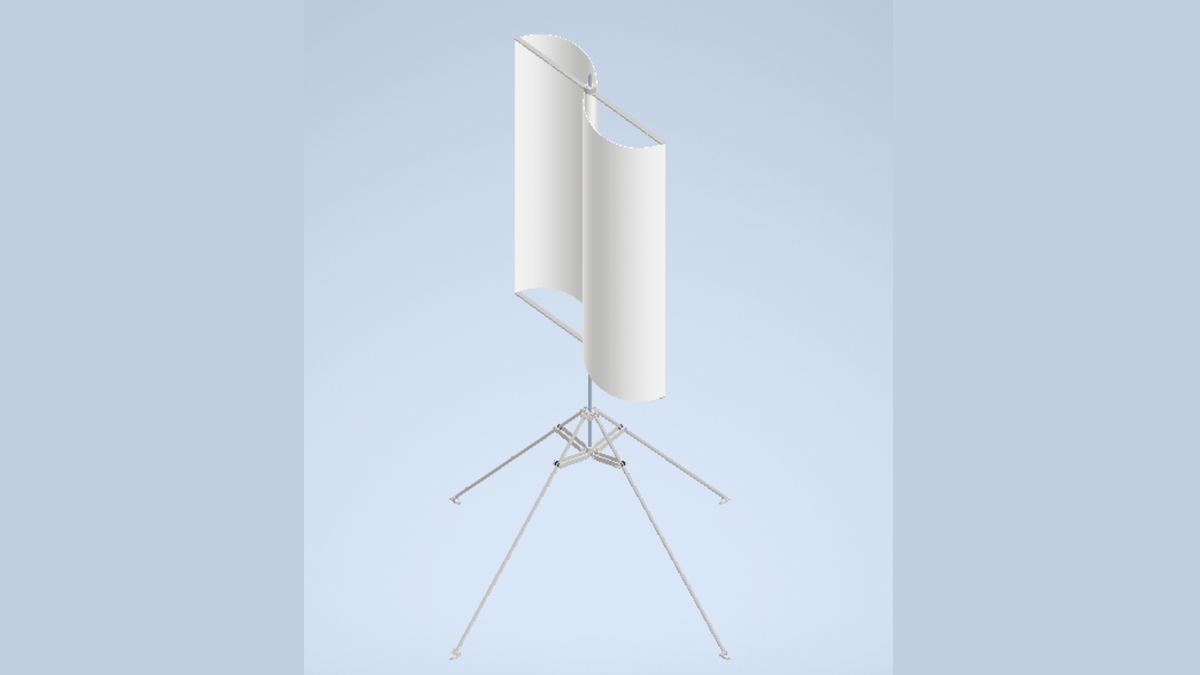
Design and Fabrication of a Savonius Wind Turbine for a Design Wind Speed
Multidisciplinary Senior Design Project ’25
Designing and testing a Savonius vertical axis turbine for efficient energy generation