
Robo Soccer
Overview
Ignite your passion for innovation and engineering at the RIT Dubai Robotic Competition.
All competitions should be prepared in advance and conducted on the day of the competition.
Deadline to register: October 10, 2025
The RIT Dubai Robotic Competition is designed for high school students in Grades 11, and 12 who have an interest in Computer Engineering or Electrical Engineering studies. This exciting event provides students with the opportunity to participate and compete in a friendly, informative, and professional atmosphere. Participants will not only test their innovative ideas but also explore and learn from other teams, broadening both their knowledge and their perspectives.
The Theme
This year’s challenge is Rob Soccer – an exciting RoboCup-style event where students will design and build a soccer-playing robot. Each team’s robot will compete against another team’s robot with the objective of scoring as many goals as possible within the match duration.
Match Format:
- Each match will last 10 minutes.
- The team whose robot scores the most goals within this time is declared the winner.
- If the score is tied at the end of the match, the result will be recorded as a draw (or optionally, a short tie-breaker round can be held)
Technical Specifications
Playground Specifications
- The playing field will be a circular ring with a diameter of 4 meters.
- The field is surrounded by a black strip, 0.5 meters wide, which serves as the goal area.
- Beyond the black strip, there is an additional red strip, 0.5 meters wide, marking the out-of- bounds area (no robot land).
- If any part of the robot touches or enters the red strip, it is considered to be in the ‘No Robot Land’ zone.
- There will be a golden zone about 10% the size of the black strip. Scoring in the area will result in additional bonus points
- There will be two obstacles, black in color, placed randomly in the field
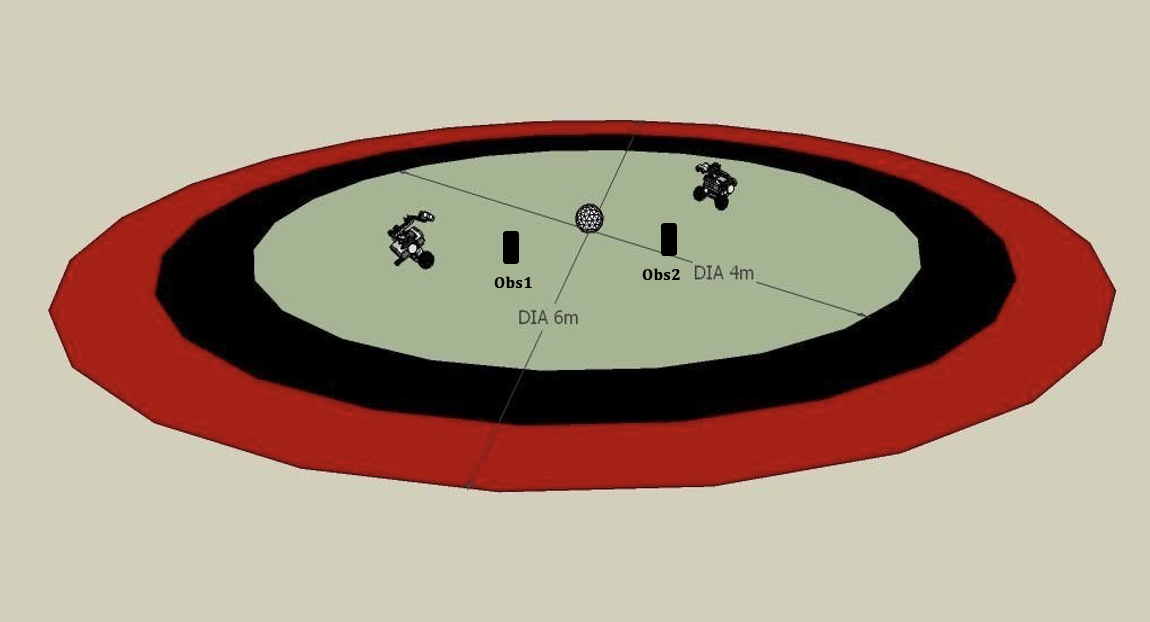
The Game Ball
All the information about the Game-ball that will be used for this competition, which will be the organizers’ responsibility to provide on the day of the competition, can be found on this link.
The Robot
The robot maximum size should be within the following dimensions: width: 25 cm, length: 30 cm, and height: 40 cm. The robot must be completely self-contained and must receive no outside assistance. Furthermore, all Robots should be fitted with:
- At least one ball detection sensor (e.g., infrared, ultrasonic, or camera, etc).
- At least one boundary detection sensor (e.g., light, color, or distance sensor etc).
- A signal device (such as LED, buzzer, or display) to indicate when scoring a goal or completing a task.
- Moreover, the robot must be able to function for at least 10 minutes without the need to recharge (or refuel).
Constrains and Requirements
- Robots are encouraged to use any suitable combination of sensors, depending on team preference and availability.
- Robots may ideally be capable of completing three consecutive matches without recharging (bonus points for energy efficiency).
- Bonus points will also be awarded for creative robot personalities (e.g., lights, sounds, or a celebration action after scoring).
Game Life Scenario
- Place the robot on your team base. (No physical contact after this point.)
- Robot should remain idle until the jury gives a start signal (sound, light flash, or countdown). After this, it must start moving autonomously.
- Robot should autonomously search for and approach the ball using its chosen detection method (e.g., IR, ultrasonic, camera).
- Once the robot controls the ball, it must navigate around any obstacles and search for the goal zone (black strip or golden zone).
- To complete the task, the robot must place or push the ball into the goal zone.
- The robot must provide a signal confirmation (LED flash, buzzer, or display) when it scores successfully.
- The game field will contain two (2) designated obstacles, placed randomly, each clearly marked in blue.
- Bonus Rule: If the robot scores within the first 2 minutes, it earns efficiency bonus points +2.
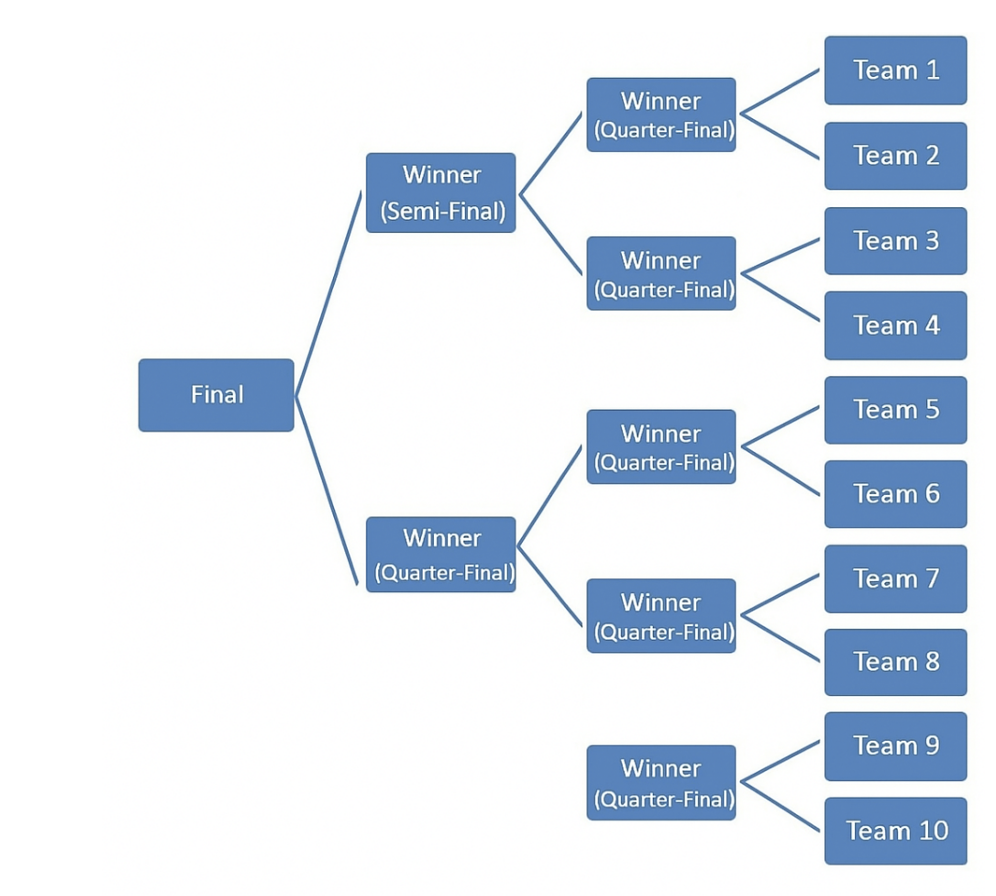
Evaluation
Grading Rubrics:
- Goals on Black Strip: +10 each
- Goals in Golden Bonus Zone: +15 each
- Ball Reaches Red Strip: -5 each
- Double Goal Bonus: ≥4 goals = +5 next match
- Avoids Obstacles Entire Match: +10
- Physical Contact with Robot: -5 each
- Robot Reconfiguration: max 3, –5 each
- Obstacle Handling: 0–5, tie-breaker
- Ball Movement Attempts: 0–5, tie-breaker
- Overall Strategy/Control: 0–5, tie-breaker
- Total Score: Goals + Bonuses – Penalties
- Tie-Breaker Score: if used
In case of a tie:
- An extra 5 minutes will be given
- First team to score a goal wins (“golden goal”).
- If both teams still fail to score, the higher performance score (obstacle handling, ball movement attempts, etc.) will decide the winner instead of both teams being disqualified. (New fairness rule.)
Scoring:
- 10 points – Goal scored on the black strip.
- 15 points – Goal scored in the golden bonus zone
- Double Goal Bonus – If a robot scores more than four goals in one match, it earns
- +5 bonus points for the next game.
- If the ball reaches the red strip, it will not count as a goal. Instead, 5 points will be deducted. (Updated rule.)
- If the robot successfully avoids the two obstacles that are randomly placed for the entire duration of the game, an additional bonus of ten (10) points will be awarded to the team, regardless of whether they score a goal. If they touch the obstacles, no points will be deducted.
Penalties:
- –5 points for any physical contact between a team member and the robot (Participants are permitted to reconfigure or adjust their robot a maximum of three
- 3 times during the course of the game, from the start to the final round. Each instance of reconfiguration will incur a penalty of 5 points, which shall be deducted from the team's total score.
- Contestants may use any programming language to program their robot or any software.