
Robotics Competition
Design, build, and race an autonomous robot through a challenging course where speed, precision, and engineering come together.
Point of Contact
Prepared Competition
This competition requires thorough advanced preparation. While the actual judging and live performance will take place onsite on the day of the event, participants must design, practice, and finalize their entries beforehand according to the provided guidelines.
Autonomous Line Following Robot Endurance Race (ALFRED) is a single-day, timed robotics competition in which student teams design, build, and program an autonomous robot to follow a black line as quickly and accurately as possible. The course includes sharp turns, S-curves, cross-intersections, line gaps, and 3D-printed obstacles. Teams are rewarded for combining speed with reliable steering and obstacle handling.
The competition introduces students to embedded electronics, programming, motor control, sensor calibration, and iterative engineering design. Teams may use conventional line-following control approaches such as PID control, while advanced teams may explore an optional computer-vision extension using OpenCV.
Competition Sponsor and Support
- Official Sponsor: vfrog
- Prize Support: One SO101 robotic arm for the winning team.
- Technical Support: Two vfrog technical staff members will be available on event day for equipment, operations, and general technical coordination. Sponsor staff will not provide team-specific coding, debugging, or performance-tuning assistance.
- Participant Support: Career support for all participants and a company-signed award for each participant.
Objectives and Learning Outcomes
Tune PID gains or equivalent control logic to maximize speed while maintaining stability through straights, curves, and sharp turns.
Develop hands-on C++/Arduino control logic for motor response and decision-making without relying on AI code generators.
Process infrared sensor data and calibrate thresholds to distinguish black tape from a white surface under different ambient-light conditions.
Interface microcontrollers and motor drivers using Pulse-Width Modulation (PWM) for differential speed and steering control.
Use distance sensing to identify and avoid obstacles while minimizing the effect on race time.
Diagnose hardware and software issues and balance raw speed against steering stability under competition conditions.
Competition Rules
Students in Grades 11 and 12 are invited to participate.
Each school may register only one team, with a maximum of three students per team.
The robot must operate autonomously. No remote control or manual input is permitted once a run begins.
Each run begins using the competition-provided digital remote start switch. A three-second countdown will be displayed, and the robot is expected to start when the switch circuit is completed.
The competition is divided into three sectors of increasing difficulty. All teams compete in Sector 1; the top 50% by cumulative score advance to Sector 2; the top 25% advance to Sector 3. The top three teams are recognized at the end of the event.
Each team starts every race run with 500 points. One point is deducted for each second of elapsed race time.
−20 points per incident. An obstacle hit occurs when the robot moves an obstacle from its marked position, even slightly.
−10 points per incident. A derailment occurs when the robot stops following the black line and remains off course for more than two seconds. Temporarily leaving the line while legitimately avoiding an obstacle is not counted. More than five derailments results in disqualification.
−30 points per incident. If more than 50% of the robot exits the arena, it is considered out of bounds. The timer is paused while the robot is returned to the starting position. More than three incidents results in disqualification.
The race timer continues to run during derailments and obstacle collisions. Judges positioned around the arena determine these incidents.
No restart is provided for a programming, battery, or mechanical failure attributable to the team. Such a failure results in disqualification from that run.
If two or more teams achieve the same score, each tied team completes one additional run on the same track. The team with the highest score in the tie-break run prevails. Tie-break points are not added to the cumulative score.
Technical Specifications
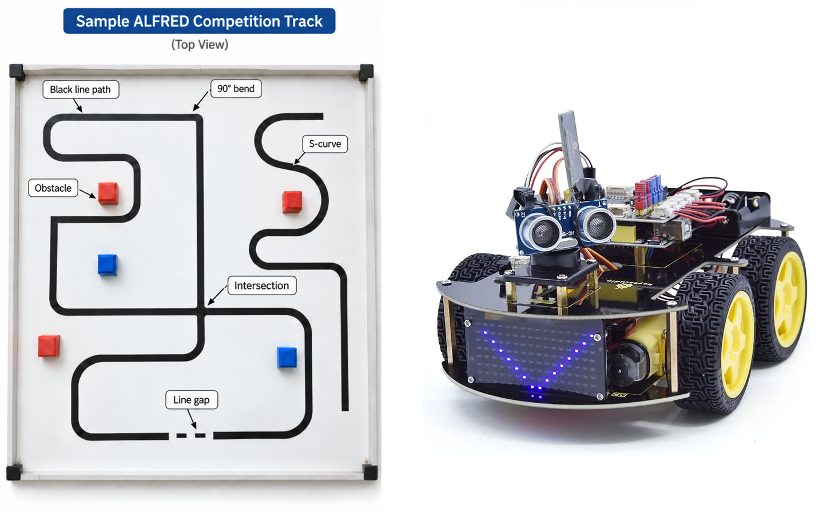
One autonomous challenge.
The course progressively increases in difficulty, testing speed, steering accuracy, sensor response and obstacle handling.
Batteries must have no swelling, cracks, bent terminals, or leakage.
The robot must operate within the specified 6–9 V input range. Supplies exceeding 9 V are not permitted.
Charging is permitted only in the designated pit area and must be supervised. LiPo batteries must be charged inside a fire-resistant bag or box.
No exposed electrical conductors are permitted. Fused or current-limited circuits should be used where applicable.
Competition Flow
All teams compete in three matches.
Qualifying teams compete in three rounds.
Qualifying teams compete in two rounds.
Evaluation
Alfred is scored primarily through race performance rather than a subjective project grade. The following scoring rubric will be used for each race run.
Not added to cumulative score
Specialty Awards (Judges’ Choice)
Main Awards