Working with 2D-PRISM

Designing Chemistry for Manufacturing

2D-PRISM (2D Polymer Roll-to-Roll Integration and Scalable Manufacturing) is built to work with you. Whether you’re a company, a researcher, or a partner with a promising idea, we’ll help you take your materials further. In our 2D-PRISM facility, our benchtop scale-up lab and a roll-to-roll slot die coating pilot line sit under one roof in a dry room environment, so we can scale your ideas together, step by step.  When you’re ready, our manufacturing experience and industry contacts can help you move from pilot to production.

Scaling Talent with your Materials

Commercialization isn’t just about moving materials into production—it’s about growing the talent to match your expanding needs. Through RIT’s nation-leading co-op program, our students gain hands-on manufacturing experience working alongside you, and they become the workforce that helps this field grow.
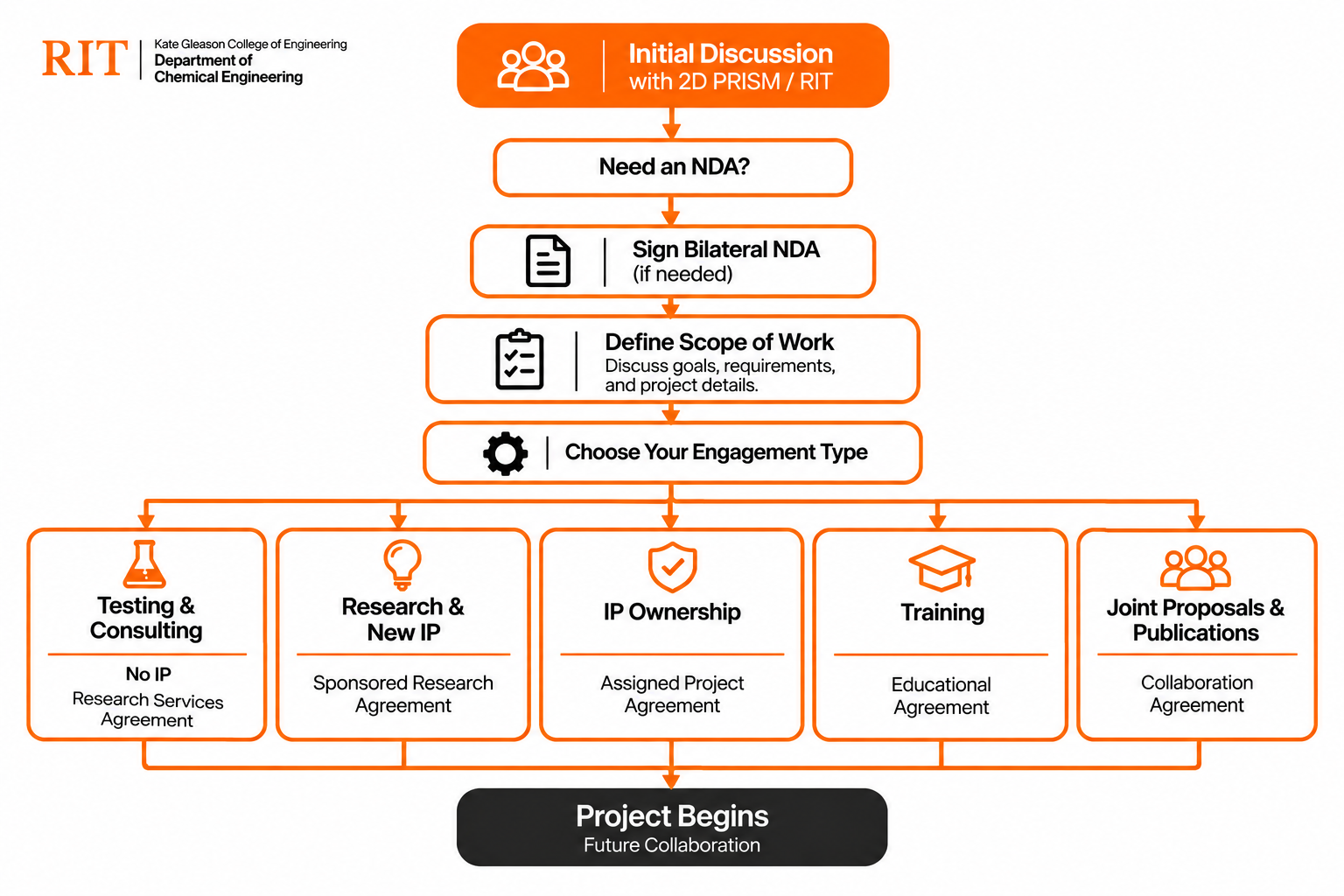
Initial Discussion with 2D Prism/RIT Flowchart

An initial discussion with customers can take place without an NDA in place. Depending on the scope of work, one may not be needed.

  • If solutions/dispersions/emulsions will be provided and have appropriate safety sheets, we do not need to know compositions of existing materials. Provided we focus on the solvent for evaporative properties and solution physical properties (surface tension, viscosity), we can examine on benchtop and coat materials.

If more sensitive info needs to be shared, and if the partner does not have experience with coating and designing materials/fluids for manufacturing and requires more guidance, a bilateral NDA can be created to protect any information shared. RIT has standard forms and can negotiate as need be with legal departments.

  • Use this if there is NO chance that new discoveries or inventions will be made under the project.
  • Use this for benchtop work to assess suitability for coating, adjustments, and reformulations of existing materials (same materials, different amounts of solvent or surfactant additives), material testing, or other focused projects.
  • This can also be used in cases where specified consulting services are provided to a company over a longer-term period.
  • Agreements are already available.  Just attach a statement of work (Appendix A) and budget (Appendix B).
  • This can be a good way to get started with 2D-PRISM.  We work together on a smaller project and demonstrate that we can deliver.  Easy to show management that the relationship bears fruit with tangible results.

View Research Services Agreement (Doc)

  • Use this for projects in which new intellectual property will result from the research.
  • Usually, this will arise in a longer-term collaborative project. 
  • Coating technology is a known art, so it is unlikely that process patents will arise except if there are innovations in coating machine design.  New materials may require very specific processing conditions and combinations of processing steps.  The latter may be patentable when coupled with a new material, or if the combination of steps is unique and leads to an unexpected result.
  • A sponsored research agreement has a provision to license an invention or technology at the conclusion of the project to work with the Institute's Intellectual Property Management Office, which will negotiate licensing terms with the company.
  • Note that you will need to attach a scope of work (Appendix A) and budget (Appendix B). If you want help with these, contact us.

View Sponsored Research Agreement (Doc)

  • This is a fixed price agreement for projects where the sponsor is seeking IP ownership.
  • Use only for projects where it is possible to transfer IP ownership to a partner.
  • The RIT  Intellectual Property Management Office reviews each proposed agreement before final approval.
  • Generally, an IP release fee of $5,000 or 10% of the total project cost (whichever is greater) will be added to the budget.

View Assigned Project Agreement (Doc)

  • Use this for training activities, whether they be one day/one time or cover an entire multiple year program.
  • Training can occur at RIT or off-site.
  • In many cases, training is rolled into a sponsored research agreement (item 2) as a component of another project.

View Educational Agreement (Doc)

  • We are happy to entertain joint grant proposals with interested academics and industrial partners
  • RIT Sponsored Research services will work directly with your institutions to work out such collaborative agreements.
  • Collaborative publications develop interest in 2DP technology and provide a basis for further grant proposals by providing preliminary data and theory.  Grants are more competitive when teams submitting grants have a record of joint publications, and there are vetted facilities in which to accomplish proposed work.