RIT partners with Gallaudet University to launch research traineeship program in Universal AI
Universities receive $4.5 million NSF award to jumpstart next generation of AI professionals
Carlos Ortiz/RIT
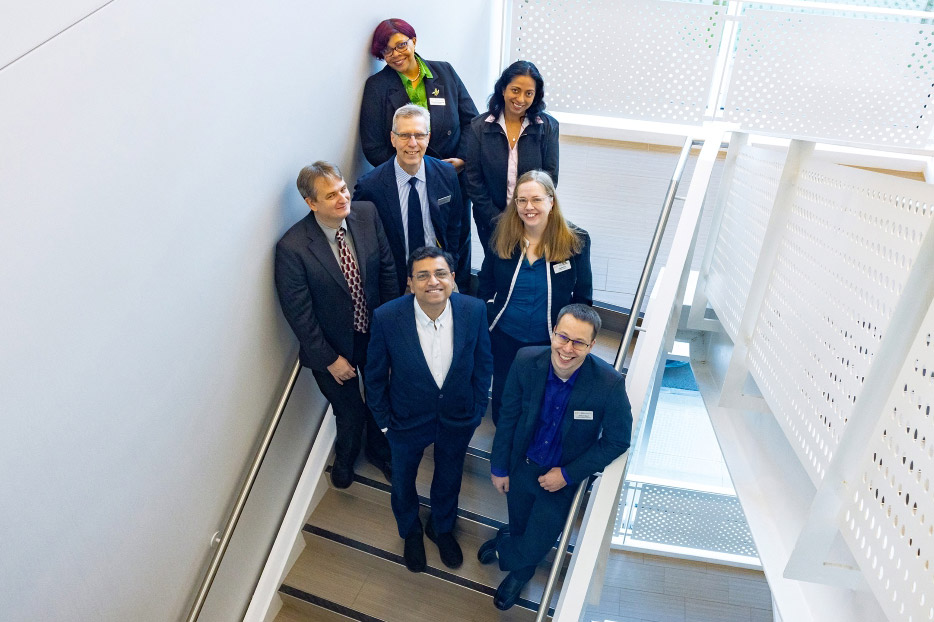
RIT and Gallaudet University are partnering on a $4.5 million National Science Foundation grant focused on developing AI that can be used by everyone. Some members of the project include, from top, Angelique Armstrong, project coordinator at RIT; Charmaine Mendonsa project coordinator at Gallaudet; Esa Rantanen, RIT associate professor; Cecilia Alm, RIT professor; Christian Vogler, Gallaudet professor; Raja Kushalnagar, Gallaudet professor; Jamison Heard, RIT assistant professor.
RIT is teaming up with Gallaudet University to prepare the next generation of artificial intelligence (AI) researchers and practitioners who will develop AI for everyone.
The universities received a $4.5 million award from the National Science Foundation (NSF) to launch a Universal AI Graduate Research Traineeship Program. The team is creating new interdisciplinary training curricula that will address gaps in graduate training to ensure that future AI developers consider all users of AI systems and their full range of sensory abilities.
The five-year NSF Research Traineeship Institutional Partnership Pilot (NRT-IPP) grant comes at a time when the investment and development of AI is ramping up worldwide.
RIT
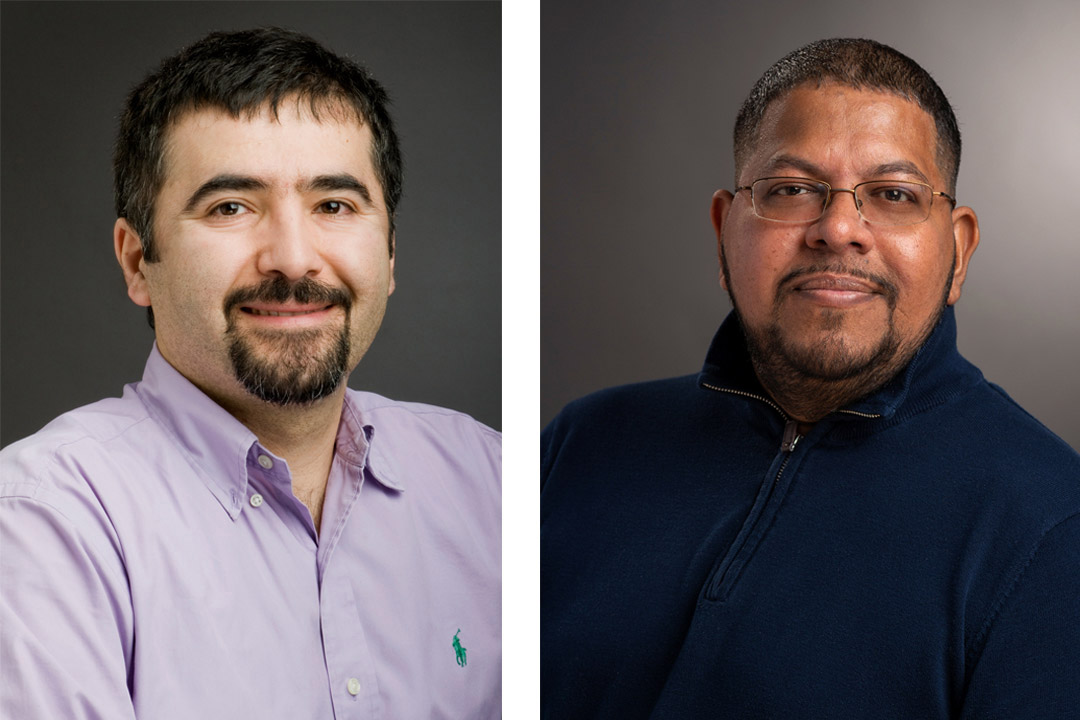
RIT Professors Ferat Sahin, left, and Reynold Bailey are also collaborating on the Universal AI project.
“This is a critical moment for cultivating the next generation of AI researchers,” said RIT Professor Reynold Bailey, a co-principal investigator on the project. “As AI rapidly advances and reshapes nearly every field, there is an urgent need for graduate students who not only possess deep technical expertise across disciplines but also grasp the ethical and societal implications of the technologies they develop.”
The program is modeled on the AWARE-AI NSF Research Traineeship program at RIT. AWARE AI provides training to cross-disciplinary future research leaders developing responsible, human-aware AI technologies. The program has already trained more than 60 Ph.D. and master’s students through four cohorts at RIT.
“The goal of the Universal AI initiative is also to create pathways into the AI research workforce,” said RIT Professor Cecilia Alm, co-principal investigator and RIT team lead who is also director of AWARE-AI.
The traineeship program will allow RIT and Gallaudet to partner in human-centered AI research and knowledge transfer, in addition to expanding collaborations with industry.
“The Universal AI program equips students with this broader perspective—preparing them to become leaders who collaborate effectively and design human-centered AI systems that deliver meaningful benefits to society,” said Alm.
The grant will provide tuition, stipends, and health benefits for 25 graduate trainees studying in Gallaudet’s accessible human-centered computing and policy (AHCP) master’s degree program. In year three of the grant, the AHCP program will add a new AI and accessibility track. The grant will also help deliver training opportunities for an additional 75 Gallaudet graduate students between 2025 and 2030. The team launched a pilot trainee program this fall.
At RIT, Gallaudet master’s and RIT doctoral students will interact in summer lab rotations. The rotations will help trainees broaden their research horizons, spark new collaborations and ideas, expand their professional networks, and experience how different lab teams approach research challenges. They will include fundamental and applied AI projects spanning AI software and algorithms, AI hardware and robotics, human-computer interaction for AI, and cognitive and brain-inspired modeling for AI.
Students will also benefit from AI hackathons, mentor cafés, workshops, seminar talks, seed grant opportunities, internship experiences with industry, and training in team science skills. Training components will be adapted from AWARE-AI.
The project is led by principal investigator Raja Kushalnagar, professor at Gallaudet’s School of Science, Technology, Accessibility, Mathematics, and Public Health (STAMP). Co-PIs include Christian Vogler, professor in Gallaudet’s STAMP; Bailey, professor in RIT’s Department of Computer Science; and Alm, affiliated with both RIT’s Department of Psychology and School of Information and joint program director of RIT’s master’s in AI.
Other leaders on the project include Ferat Sahin, department head of RIT’s electrical and microelectronic engineering programs; Jamison Heard, assistant professor of electrical and microelectronic engineering at RIT; Esa Rantanen, associate professor of psychology at RIT; Matthew Seita, research scientist at Gallaudet; Jonah Winninghoff, data analyst at Gallaudet; and Abraham Glasser, assistant professor at Gallaudet.
Glasser is also a 2018 computer science alumnus and 2022 computing and information sciences Ph.D. alumnus from RIT/NTID.
“It is very exciting for me to be able to work directly with RIT again, especially on such an important and impactful project like this,” said Glasser. “Overall, there is a lot of advancement in AI, but its potential to be universal and accessible while remaining safe, accountable, fair, and ethical—SAFE—has not been realized. This grant will train future researchers and developers of AI to do so while advocating its safety.”