Bleed
Manifests as: Loss of line sharpness and color fringing
Primarily caused by: high humidity or high heat
Bleed is the undesired migration of colorants. Bleed can be lateral across the surface of the print, internal potentially migrating all the way through to the reverse side (also called bleed-through), or across to adjacent surfaces (transfer) such as to the backs of other prints in a stack, the faces of other prints in a photo-album or photo-book, or enclosure materials such as envelopes.
Bleed of inkjet prints can be caused by exposure to high moisture levels (high relative humidity and/or water) and can be accelerated when both the relative humidity and temperature are elevated. Dye inkjet prints are most susceptible to bleed, while pigment inks are much less prone to bleed. Dye sublimation prints can bleed due when exposed to exposure to high temperature. Electrophotographic prints do not bleed. There are some dyes used for outdoor applications, such as signage, that are solvent soluble and not prone to bleed, but these types of prints may be rare in cultural heritage collections.
The image comparison below shows a significant loss in sharpness – the right image looks blurry – due to bleed. Significant detail has been lost in the hair, eyes, and anywhere along edges of high contrast (red dress to yellow blouse for example).

Original Image

Image Showing Bleed
The following illustration shows how the magenta dye has migrated away from its original position in the image. The top line was exposed to high humidity while the bottom line was not.
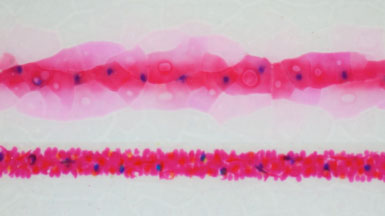
Effect of bleed on line quality
The two images below show the effect bleeding has on text. Note how the black text on white shows how the letters have broadened and are less sharp due to the migration of the colorant. Likewise, the migration of the black background colorant into the white letters has the detrimental effect of filling in the letters and reducing the contrast or obliterating them entirely. At the smallest font size the text is almost unreadable.
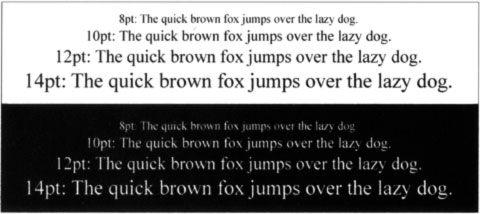
Original Text
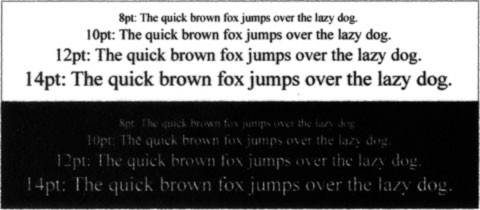
Text Exposed to High Humidity
This image pair below shows magenta colorant migration down through the print all the way to the back.

Back of print before exposure to high humidity
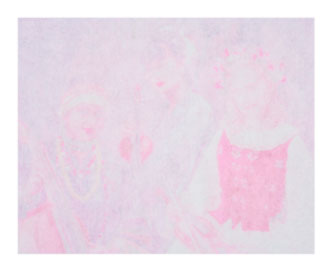
Back of print after exposure to high humidity
Bleed can also be caused by exposure to water. The two dye-based inkjet images below show extreme bleed caused by direct contact with water from a flood.
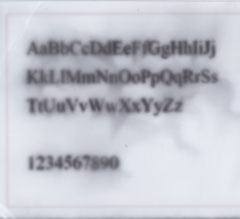
Dye-inkjet text exposed to water
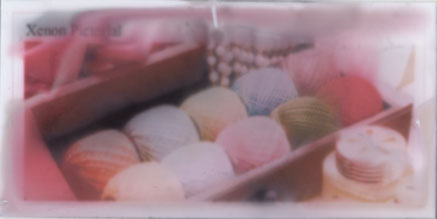
Dye-inkjet image exposed to water