Illustrated Glossary: Dot Shape
Inkjet and digital electrophotography are both halftone processes that rely on printed dots of varying size and/or distance to create the illusion of tone. The shapes of these dots, when viewed under magnification, can aid in the identification of the process.
These variations in dot shapes are produced by the mechanics of the printing process, as well as interactions between the applied colorants and the paper surface. Because of the extremely large number of possible technology, colorant, and paper combinations on the market, vast and subtle variations in dot appearances are inevitable.
Inkjet Dots
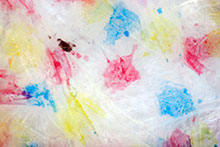
Amorphous dots on uncoated plain paper
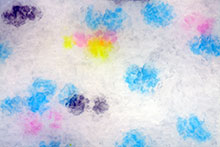
Amorphous dots on matte porous-coated fine art paper

Round dots on glossy porous-coated RC paper
With inkjet, the dot shapes are determined primarily by the paper’s surface such as whether it is uncoated or coated, and if coated what type. When an ink droplet impacts the surface of an uncoated paper during printing, it will spread laterally, especially along the paper fibers, creating a feathered dot edge. With matte porous-coated fine art papers, the colorants spread across the rough surface filling in the gaps between the mineral particles, producing a “rocky” dot edge. Both of these print types have dots with amorphous shapes. However, when an ink droplet contacts a coated glossy or semi-gloss paper the liquid is immediately absorbed into the surface coating and is not allowed to spread. This results in a very round dot shape.
Electrophotographic Dots
In electrophotography, the colorant has a much greater effect on dot characteristics than the paper. Dots formed by dry-toner are the easiest to detect as they have a distinct dusty appearance. This is because the toner is a powder whose grains are melted into the surface of the paper. With liquid toner, however, the tiny droplets applied during printing can coalesce into larger dots. This results in a very round shape. Unfortunately, this makes them very similar in appearance to offset lithographic dots, making it hard to distinguish between the two.
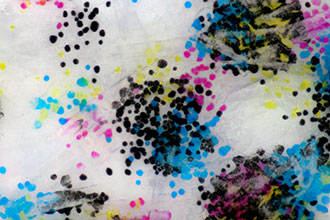
Dry–toner electrophotography
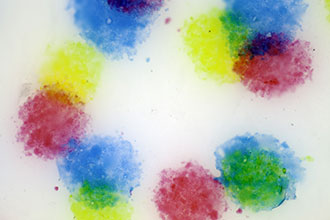
Liquid–toner electrophotography