Cost-Efficient Preservation Methods for Preparing Paper-Based Objects for Transit and Display
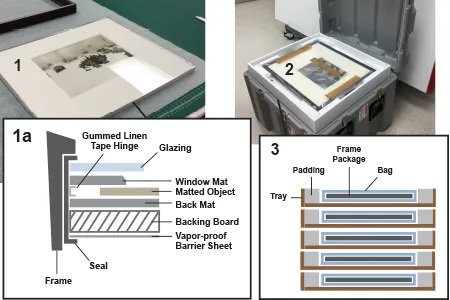
Figure 1
The Institute of Museum and Library Services awarded the Image Permanence Institute $429,409 in funding to support a three-year research project designed to identify the most cost-efficient and environmentally responsible methods of preparing paper-based collection objects for transit and display while maintaining preservation standards.
In many museums, paper-based collection objects are given multiple “layers” of protection when preparing them for traveling exhibitions and loans (Figure 1). This is done in order to safeguard collections from damage while in transit. A typical approach includes the following process: 1. Each object is placed in a sealed frame package which is then inserted into a frame (1a illustrates the cross section of materials used to create a sealed frame package); 2. The frame package is then wrapped in a plastic bag (the bag in the image above is taped closed with brown packaging tape); and then 3. Packages are placed into closely packed trays organized vertically or horizontally with multiple objects in a single shipping crate, leaving limited air space. There has never been a comprehensive study on the environmental conditions experienced by paper-based objects during transit prepared in this manner.
Led by IPI Research Scientist Al Carver-Kubik, this project will include both field and laboratory research, and will be the first research project to collect environmental data from multiple museums’ shipping crates simultaneously. Data will be collected from a variety of shipping crate and packing configurations traveling through a range of regional climates. Laboratory experimentation will include testing the safety and relative humidity buffering capacity of crate packing materials and methods, as well as different microenvironment sealed frame package designs used to protect objects during transit and display.
Results will be used to determine which methods are most effective and cost-efficient while producing the least amount of disposable waste. The combined field and laboratory research components will provide IPI with the information necessary to create data-driven guidelines for museums to make research-based, informed, sustainable, and cost-efficient decisions for maintaining preservation standards when traveling and displaying framed paper-based collection objects.
Recommended News
-
September 11, 2026
-
September 25, 2025
-
May 8, 2025
-
February 6, 2024