11,038,181
FUEL CELLS WITH A NON-PARALLEL GAS FLOW CHANNEL CONFIGURATION AND METHODS THEREOF
Patent Number
Issue Date
Inventor(s)
Licensed/Under Negotiation
Document
Download PDF for patent 11,038,181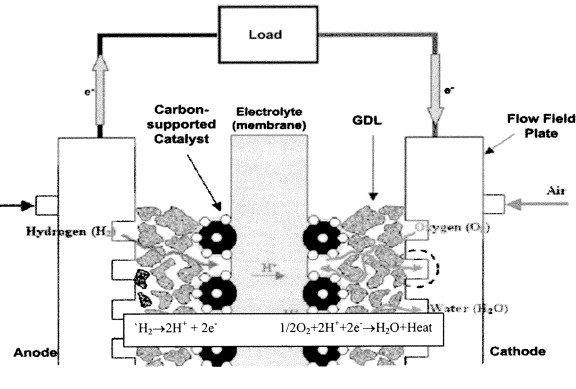
Synopsis
Patent US 11,038,181 B2 describes fuel cells with a non-parallel gas flow channel configuration and related methods. The invention addresses the critical need to improve the efficiency and performance of fuel cells, particularly by optimizing the flow of reactant gases within the cell. Traditional fuel cell designs often suffer from inefficiencies due to uneven gas distribution, which can lead to localized depletion of reactants and reduced overall power output.
A key novel aspect of this patent is the design of gas flow channels that are explicitly non-parallel to each other. This configuration contrasts with conventional fuel cell designs that typically utilize parallel flow channels. By employing non-parallel channels, the invention aims to create a more uniform distribution of reactant gases (e.g., hydrogen and oxygen) across the electrode surfaces. This improved distribution minimizes areas of stagnant flow or reactant depletion, ensuring that the entire active area of the fuel cell contributes effectively to power generation. The patent details various non-parallel arrangements, such as diverging or converging channels, or a combination thereof, tailored to optimize gas delivery and product removal (e.g., water in proton exchange membrane fuel cells). This strategic channeling enhances mass transport, which is a significant factor in fuel cell performance, leading to higher current density and improved power output.
The commercial potential of this invention is substantial within the rapidly growing clean energy and transportation sectors. As the world transitions towards more sustainable energy solutions, fuel cells are becoming increasingly important for various applications due to their high efficiency and low emissions.
Possible applications include:
Automotive Industry: Enhancing the efficiency and range of fuel cell electric vehicles (FCEVs). Improved fuel cell performance can make FCEVs more competitive with traditional internal combustion engines and battery electric vehicles, accelerating their adoption.
Portable Power Generation: Developing more compact and powerful fuel cells for portable electronic devices, backup power systems, and remote power sources. The enhanced efficiency would extend operating times and reduce the size and weight of these systems.
Stationary Power Generation: Improving the efficiency and reliability of fuel cell systems used for residential, commercial, and industrial power generation. This can lead to lower operating costs and a reduced carbon footprint for distributed power solutions.
Material Handling Equipment: Powering forklifts and other industrial vehicles with more efficient fuel cells, leading to longer operational periods and reduced refueling downtime.
Aerospace and Defense: Developing more efficient and durable fuel cells for unmanned aerial vehicles (UAVs), specialized military equipment, and potentially even aircraft, where high power-to-weight ratios and extended endurance are crucial.
Backup Power Systems: Providing reliable and long-duration backup power for critical infrastructure, such as telecommunication towers, data centers, and hospitals, where continuous operation is essential.
This patent offers a fundamental advancement in fuel cell design, providing a pathway to more efficient, powerful, and reliable fuel cell systems across a wide array of energy-related applications.