7,444,027
Methods, Devices, and Systems for Creating and Compressing Multi-Level Halftones
Patent Number
Issue Date
Inventor(s)
Peter Anderson
Document
Download PDF for patent 7,444,027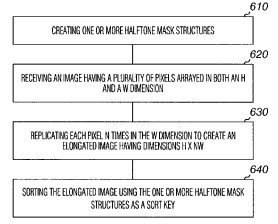
Synopsis
Patent US 7,444,027 B2 describes innovative methods, devices, and systems for creating and compressing multi-level halftones. This invention provides a transformative solution for efficiently handling large image files, particularly in high-resolution digital printing environments, by enabling lossless data compression of halftone images.
A core novel aspect of this invention is the use of unique halftone mask structures with non-repeated threshold values. These masks serve as a sort key to reversibly rearrange image pixels into groups with a highly skewed distribution. This rearrangement is crucial because it allows the application of compression coding techniques, such as Huffman coding, to achieve significant compression ratios, ranging from 3:1 to 10:1. Unlike previous methods that often resort to "lossy compression" by converting halftone images back to continuous-tone images (which results in a loss of image information and quality), this invention provides a lossless compression method, preserving the original image quality.
The invention also introduces an approach to multi-level halftoning that simplifies the conversion process. Instead of applying multiple masks to each pixel, which is computationally intensive, the disclosed method involves elongating the image by replicating each pixel a specific number of times (N, based on the desired bit depth for the multi-level image). This elongated image is then sorted using the halftone mask structures. This streamlined process reduces the computational burden while maintaining image quality.
The commercial potential of this lossless halftone image compression technology is substantial across industries that rely on high-resolution image processing and printing. Possible applications include:
-
High-Resolution Digital Printing: Manufacturers of digital printers, especially electrophotographic and inkjet printers, can integrate this technology to significantly reduce the size of halftone image files, leading to faster data transmission, reduced storage requirements, and quicker print times without compromising image quality. This is particularly beneficial for high-volume printing operations and printing-on-demand services where efficiency is paramount.
-
Graphic Arts and Pre-press Industry: Professionals in graphic design, publishing, and pre-press can benefit from reduced file sizes for large-format prints, intricate designs, and high-quality publications. The lossless nature ensures that the fidelity of the original image is maintained throughout the workflow.
-
Medical Imaging: In applications where image detail is critical, such as medical diagnostics and telemedicine, this technology can enable efficient storage and transmission of high-resolution medical images that utilize halftoning, while guaranteeing no loss of diagnostic information.
-
Archiving and Digital Asset Management: Organizations dealing with vast archives of high-resolution images can utilize this compression method to reduce storage costs and improve retrieval speeds, making large digital asset libraries more manageable.
-
Cloud-Based Image Processing and Printing Services: Cloud service providers offering image processing, rendering, and printing solutions can leverage this invention to optimize their infrastructure, reduce bandwidth consumption, and provide faster services to their clients.
This patent offers a disruptive technology that addresses a critical need for efficient and lossless compression of halftone images, providing a compelling opportunity for licensees to enhance product performance, reduce operational costs, and deliver superior image quality in various digital imaging and printing applications.