7,936,019
Nano and MEMS Power Sources and Methods Thereof
Patent Number
Issue Date
Inventor(s)
Ryne Raffaelle; David Wilt
Document
Download PDF for patent 7,936,019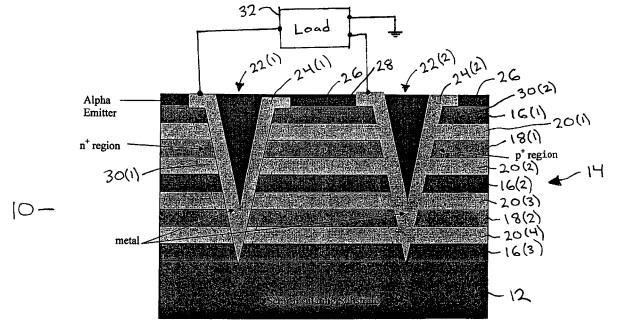
Synopsis
Patent 7,936,019 B2 describes groundbreaking nano and MEMS power sources and methods for their fabrication. This invention offers a revolutionary approach to generating electrical power at the micro and nanoscale, providing compact, exceptionally long-lasting, and maintenance-free energy solutions for miniaturized electronic devices.
A core novel aspect of this invention is its innovative design, which leverages the direct conversion of nuclear radiation into electrical energy within a highly efficient "pin diode" structure. This structure is ingeniously comprised of two or more elements, typically semiconductor materials like silicon, continuously stacked upon each other. Crucially, the structure features at least two strategically placed openings that extend into its body, with a first conductive contact precisely disposed on the inner surface of each opening. A source of radiation, such as a radioisotope emitting alpha or beta particles, is then positioned on at least one of these conductive contacts within the openings. This unique configuration significantly increases the surface area exposed to the emitted radiation, thereby maximizing the interaction between the particles and the active material and dramatically improving power conversion efficiency. The ability to vary doping profiles and material properties across the stacked elements further optimizes performance for different types of radiation sources, ensuring adaptability and high output in a minimal form factor.
The commercial potential for this self-sustaining power technology is immense, poised to transform numerous industries by eliminating the limitations imposed by conventional battery life, size, and maintenance requirements. Possible applications include:
-
Implantable Medical Devices: This technology is ideal for powering critical long-term implantable medical devices, such as pacemakers, neurostimulators, and continuous glucose monitors. It drastically reduces the need for invasive battery replacement surgeries, improving patient quality of life and reducing healthcare costs.
-
Wireless Sensor Networks: For remote and autonomously operating sensor networks deployed in inaccessible or harsh environments. This includes infrastructure monitoring (e.g., bridges, pipelines), environmental sensing, industrial automation, and smart agriculture, where periodic battery replacement is impractical or impossible, enabling decades of uninterrupted operation.
-
Microelectromechanical Systems (MEMS) and Nanosystems: Provides autonomous and continuous power for a new generation of tiny robots, advanced micro-sensors, and other MEMS devices that require consistent, low-power operation for extended durations without external energy input.
-
Space Exploration and Remote Sensing: Essential for powering long-duration missions to distant planets or for sensors deployed in extreme extraterrestrial environments where solar power is not feasible, and traditional batteries would rapidly degrade.
-
Defense and Security Systems: For powering long-life remote surveillance devices, unattended ground sensors, and other critical defense and security applications that demand extreme reliability and minimal logistical footprint in the field.
-
Specialized Consumer Electronics: While requiring careful regulatory navigation, future advancements could lead to ultra-long-lasting power solutions for highly specialized portable electronic devices where battery life is a significant constraint, offering unprecedented convenience.
This patent offers a disruptive innovation in micro-power generation, presenting a compelling opportunity for licensees to develop and commercialize next-generation products that require durable, self-sustaining energy solutions for the most demanding and miniaturized applications.