8,353,833
Low-cost Device For C-scan Photoacoustic Imaging
Patent Number
Issue Date
Inventor(s)
Navalgund A. H. K. Rao (Rochester Institute of Technology)
Vikram S. Dogra (University of Rochester)
Document
Download PDF for patent 8,353,833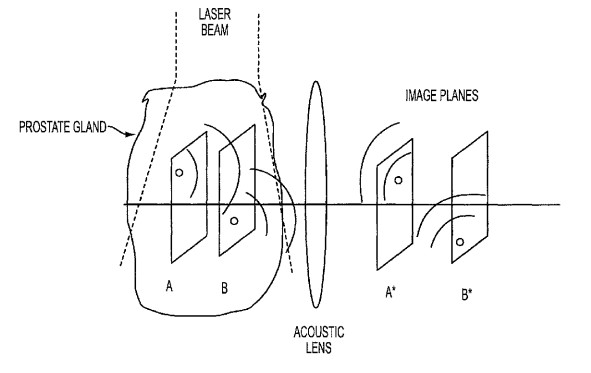
Synopsis
Patent 8,353,833 B2 describes an innovative low-cost device and method for C-scan photoacoustic imaging, representing a significant advancement in diagnostic imaging by making high-resolution tissue visualization more accessible. This invention addresses the challenge of high cost and complexity often associated with advanced medical imaging modalities, paving the way for wider adoption in clinical and research settings.
A core novel aspect of this invention lies in its unique combination of components and methodology to achieve high-quality C-scan photoacoustic imaging at a significantly reduced cost. The device utilizes a focused transducer, a low numerical aperture (NA) optical beam delivery system, and critically, a precise time-gated detection scheme. This time-gated detection is precisely timed (t0 = 2z0/c, where z0 is the depth of the desired scan plane and c is the speed of sound), allowing the system to selectively image a specific depth or plane within the tissue without the need for complex transducer movement in the Z-direction. This simplification reduces mechanical complexity and overall system cost. The ability to perform imaging in x, y, and z directions further indicates its capability for comprehensive volumetric imaging, providing detailed anatomical and functional information. This strategic integration of focused acoustics, simplified optics, and precise time-gating enables robust, high-resolution photoacoustic imaging in a more economically viable package.
The commercial potential for this low-cost photoacoustic imaging system is substantial, particularly in areas where the high expense of current imaging technologies limits widespread use. Possible applications include:
-
Early Cancer Detection and Diagnostics: Given the patent's explicit mention of prostate tissue and tumor detection, this device has immense potential for early cancer screening and diagnosis in various organs (e.g., breast, prostate, skin, thyroid). Its low cost could facilitate more widespread adoption in clinics, potentially improving detection rates and patient outcomes through earlier intervention.
-
Image-Guided Interventions and Biopsies: The real-time, high-resolution imaging capability makes it an ideal tool for guiding minimally invasive procedures, precise biopsies, and surgical resections, allowing clinicians to visualize tissue abnormalities and vascular structures with greater accuracy during procedures.
-
Pre-Clinical Research and Drug Discovery: Academic and pharmaceutical researchers often require cost-effective, high-quality imaging for studying disease progression, monitoring treatment responses, and assessing drug efficacy in animal models. This device could democratize access to advanced imaging in research laboratories.
-
Dermatology and Skin Imaging: For non-invasive assessment of various skin conditions, including melanoma detection, or for monitoring the effectiveness of cosmetic treatments, by providing detailed visualization of subsurface skin layers, vascular networks, and abnormal growths.
-
Vascular Diagnostics: Photoacoustic imaging's inherent sensitivity to blood and hemoglobin makes it excellent for visualizing vascular networks. This device could be utilized for diagnosing and monitoring conditions such as peripheral vascular disease, assessing wound healing, or examining diabetic retinopathy.
This patent offers a transformative solution in medical imaging, providing a powerful, yet accessible, tool for detailed tissue characterization. Its cost-effectiveness and high performance present a compelling opportunity for licensees to bring advanced diagnostic capabilities to a broader market.