8,582,500
Methods for Providing an AD HOC Mobile Communication Network and Systems Thereof
Patent Number
Issue Date
Inventor(s)
Nirmala Shenoy; Yamin S. Al-Mousa; John Fischer
Document
Download PDF for patent 8,582,500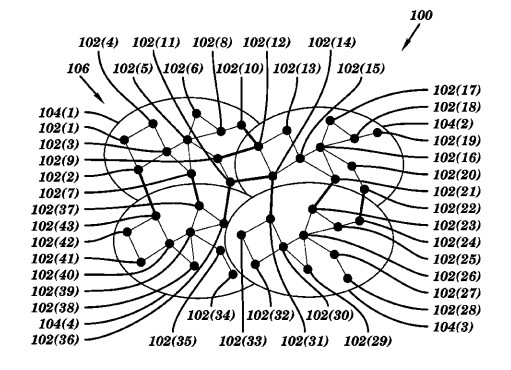
Synopsis
Patent 8,582,500 B2 describes a novel approach to establishing and maintaining mobile communication networks, specifically addressing the challenges of efficiency and reliability in dynamic, ad hoc environments. This invention introduces a method, computer-readable medium, and system that dynamically organizes mobile communication devices into clusters, each structured as a tree and at least partially meshed together.
A core innovation is the dynamic assignment of virtual identifiers (VIDs) to each mobile communication device. These VIDs are derived from the tree structure of their respective clusters and serve as crucial address information for routing communications between devices. This virtual identification system offers significant advantages by facilitating simple and dynamic tree creation with minimal overhead, while inherently preventing routing loops. Critically, it offloads routing functions traditionally handled by Layer 3 of the Open Systems Interconnection (OSI) model. This reduction in Layer 3 processing overhead and delays enhances network performance and ensures the system's independence from future IP layer protocol modifications, such as those in Internet Protocol version 6 (IPv6).
The unique combination of a tree routing structure with a mesh network provides a proactive communication system that balances the simplicity of tree-based routing with the resilience and robustness of a mesh topology. This hybrid architecture ensures uninterrupted communication and efficient data flow even as mobile devices frequently change their connections and movements within the network.
The commercial potential of this invention is substantial, particularly in sectors requiring highly adaptable, reliable, and efficient mobile communication. Possible applications include:
-
Emergency Services and Disaster Relief: The ability to rapidly deploy and maintain self-configuring networks without reliance on fixed infrastructure makes this technology ideal for emergency response, where traditional communication systems may be compromised or unavailable. First responders could establish reliable communication links in critical situations.
-
Military and Tactical Operations: Dynamic and robust ad hoc networks are essential for secure and uninterrupted communication in the field, enabling coordinated operations and real-time information exchange among mobile units.
-
Smart City Infrastructure: This technology could support the development of resilient smart city applications, enabling dynamic communication between autonomous vehicles, public sensors, and mobile devices to manage traffic, monitor environmental conditions, and enhance public safety.
-
IoT and Sensor Networks: For large-scale Internet of Things deployments, especially in remote or challenging environments, this system can provide a flexible and scalable communication backbone for collecting and transmitting data from numerous distributed sensors.
-
Enterprise and Industrial Mobility: Large industrial complexes, construction sites, or campuses could benefit from a self-organizing network that supports mobile workforces and connected equipment, ensuring continuous connectivity and efficient operations.
This patent offers a foundational technology for next-generation mobile communication, providing a robust, efficient, and adaptable networking solution that overcomes limitations of existing mobile ad hoc networks.