8,873,798
Methods for Tracking Objects Using Random Projections, Distance Learning and a Hybrid Template Library and Apparatuses Thereof
Patent Number
Issue Date
Inventor(s)
Grigorios Tsagkatakis; Andreas Savakis
Document
Download PDF for patent 8,873,798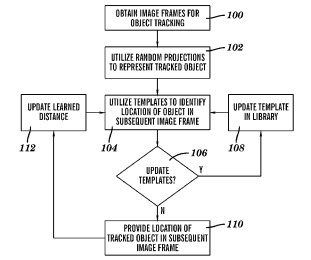
Synopsis
Patent US 8,873,798 B2 describes methods and apparatuses for tracking objects using random projections, distance learning, and a hybrid template library. This invention introduces a robust and efficient approach to real-time object tracking in image sequences, addressing challenges such as partial occlusions, changes in object appearance, and varying lighting conditions. The system leverages machine learning techniques to adapt and improve its tracking performance dynamically.
A key novel aspect of this invention is the integration of random projections with distance learning and a hybrid template library. Traditional object trackers often struggle with maintaining accuracy when objects undergo significant changes in appearance or are temporarily obscured. This patent details a system that:
-
Random Projections: Reduces the dimensionality of image data, allowing for faster processing while retaining essential information. This makes the system computationally efficient, crucial for real-time applications.
-
Distance Learning: Employs algorithms that learn to distinguish between the target object and background elements, even when the object's appearance changes. This learning is continuous and adapts to new visual information.
-
Hybrid Template Library: Utilizes a combination of generic and dynamically updated templates of the target object. This hybrid approach allows the system to generalize to new instances of the object (using generic templates) while also precisely tracking its specific appearance over time (using updated templates). The system intelligently updates its template library, discarding less relevant or outdated templates, ensuring high accuracy and adaptability.
The commercial potential for this object tracking technology is substantial across various industries requiring precise and reliable visual monitoring and analysis:
-
Security and Surveillance: This technology can enhance video surveillance systems by providing more accurate and continuous tracking of individuals or objects across multiple cameras, even in crowded or complex environments. This improves threat detection and incident response.
-
Autonomous Systems (Vehicles, Drones, Robotics): For self-driving cars, drones, and industrial robots, robust object tracking is fundamental for navigation, obstacle avoidance, and interaction with the environment. This system's ability to handle dynamic conditions and occlusions makes it highly valuable for reliable autonomous operation.
-
Augmented Reality (AR) and Virtual Reality (VR): In AR/VR applications, accurate tracking of real-world objects or user movements is essential for seamless interaction and immersive experiences. This technology can provide the precise and stable tracking needed for next-generation AR/VR devices.
-
Sports Analytics and Broadcast: For sports analysis, this system can track players, balls, or other equipment with high fidelity, providing valuable data for performance analysis, tactical insights, and dynamic on-screen graphics for broadcasts.
-
Retail Analytics: In retail environments, tracking customer movements and interactions with products can provide valuable insights into shopping behavior, store layout optimization, and personalized marketing.
-
Medical Imaging and Robotics: In medical contexts, this technology could assist in tracking surgical tools, patient movements during procedures, or even microscopic objects for diagnostic purposes, improving precision and safety.
-
Human-Computer Interaction (HCI): Gesture recognition and eye-tracking systems can benefit from this technology, enabling more natural and intuitive human-computer interfaces.
This invention offers a sophisticated yet efficient solution for real-time object tracking, capable of adapting to complex and changing visual scenes. Its broad applicability across numerous high-growth markets positions it as a key enabler for advanced automation, enhanced security, and immersive digital experiences.