9,729,994
System And Method For Listener Controlled Beamforming
Patent Number
Issue Date
Inventor(s)
David A. Eddins (USF); David A. Borkholder (RIT); Vencent J. Amuso
Document
Download PDF for patent 9,729,994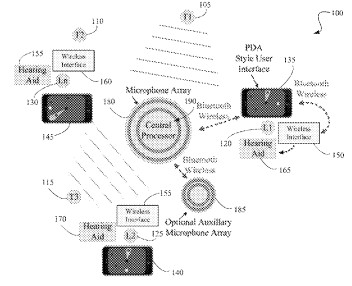
Synopsis
Patent US 9,729,994 B1 describes a system and method for listener-controlled beamforming. This invention addresses a significant challenge in assistive listening by enabling individual listeners to dynamically control the focus of acoustic pickup in environments with multiple sound sources, thereby improving speech intelligibility and reducing distracting noise.
A key novel aspect of this invention is its listener-controlled beamforming capability. Unlike traditional assistive listening devices that might apply a single, fixed beam, this system allows multiple listeners to independently define and adjust their own "acoustic beams." Microphones located in the environment receive acoustic signals, which are then processed to determine the location of various sound sources, including mobile ones. This source location information is transmitted to individual listener-controlled devices, enabling each listener to select and focus on a specific sound source, effectively "zooming in" on desired speech while attenuating unwanted background noise. The system can adapt to moving sound sources and multiple listeners, offering unprecedented personalization in auditory environments.
The commercial potential for this listener-controlled beamforming system is substantial across various sectors:
Assistive Listening Devices (ALDs): This technology represents a significant advancement for hearing aids and other ALDs. Users with hearing impairments could experience dramatically improved speech understanding in complex, noisy environments such as restaurants, classrooms, meeting rooms, or public gatherings. This would lead to better communication and social engagement.
Conference and Meeting Systems: In professional settings, this system could allow individual participants in a meeting to focus on a particular speaker, regardless of their position, or even on a remote participant's voice. This would enhance clarity and productivity in both in-person and teleconferencing scenarios.
Classroom and Lecture Hall Environments: Students, especially those with auditory processing disorders or hearing impairments, could benefit immensely. Teachers' voices could be isolated and amplified for individual students, reducing the impact of classroom distractions and improving learning outcomes.
Home and Entertainment Systems: This technology could be integrated into smart home audio systems, allowing family members to focus on a TV program while others converse, or to isolate specific audio channels in a multi-source entertainment setup. It could also enhance the immersive experience in virtual reality or gaming by allowing users to control their auditory focus.
Security and Surveillance: In specialized applications, this system could be used to isolate and enhance specific conversations or sounds from a noisy environment for analysis, such as in surveillance operations or forensic audio analysis.
Automotive Audio Systems: The invention could allow individual occupants in a vehicle to listen to different audio sources or focus on specific voices within the car's interior, improving personalized entertainment and communication.
This invention offers a sophisticated and highly customizable solution for managing complex sound environments, providing individual listeners with unprecedented control over their auditory experience and opening new possibilities for clearer communication and enhanced engagement across numerous applications.