9,785,835
Methods For Assisting with Object Recognition in Image Sequences and Devices Thereof
Patent Number
Issue Date
Inventor(s)
Jeff B. Pelz; Thomas B. Kinsman; Daniel F. Pontillo; Susan M. Munn; Nicholas R. Harrington; Brendon Ben-Kan Hsieh
Document
Download PDF for patent 9,785,835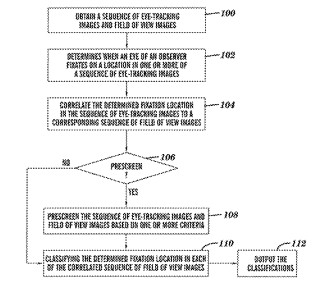
Synopsis
Patent US 9,785,835 B2 describes methods and devices for assisting with object recognition in image sequences. This invention provides a novel approach to improving the efficiency and accuracy of human observers in identifying objects within a series of images, particularly in contexts where rapid and reliable detection is critical.
A key novel aspect of this invention is its integration of eye-tracking data with image processing to enhance object recognition. The system leverages the natural eye movements (fixations) of a human observer to identify regions of interest within an image sequence. It then processes these regions, potentially applying filters, enhancements, or classification algorithms, and presents the refined information back to the observer in a way that facilitates more accurate and efficient object identification. The patent details methods for identifying fixations, correlating them with specific image frames, and then selectively processing these areas to highlight relevant features or even provide preliminary classifications. This interactive and adaptive approach moves beyond passive image display by actively assisting the human visual system.
The commercial potential for this technology is significant across various domains where human observers process large volumes of visual data:
Security and Surveillance: In security monitoring centers, operators are often overwhelmed with continuous video feeds. This system could analyze surveillance footage in real-time, focusing the operator's attention on areas where fixations indicate potential objects of interest and presenting enhanced views or preliminary alerts, thus improving the detection of anomalies, intruders, or suspicious activities.
Medical Imaging and Diagnostics: Radiologists, pathologists, and other medical professionals review vast numbers of images. The invention could guide their attention to subtle features that might otherwise be missed, assisting in the detection of early disease markers, abnormalities in scans, or critical diagnostic patterns in microscopic images. This could lead to more accurate and faster diagnoses.
Quality Control and Inspection: In manufacturing, quality control often involves human inspectors examining products for defects. This system could be integrated into inspection lines to highlight potential flaws based on an inspector's eye movements, ensuring higher precision and consistency in defect detection.
Image Analysis for Scientific Research: Scientists analyzing large datasets of images, such as in biology (e.g., cell counting, organism identification), astronomy (e.g., celestial object detection), or environmental monitoring (e.g., anomaly detection in satellite imagery), could benefit from this guided object recognition to accelerate their research and improve data integrity.
Autonomous Systems and Human-Machine Teaming: This technology could serve as a vital component in human-in-the-loop autonomous systems where human oversight is still required. By augmenting human perception with intelligent image processing, it can improve the effectiveness of human operators interacting with complex automated systems, such as drone piloting or remote vehicle operation.
Training and Education: The system can be used as a training tool to teach novice observers how to effectively scan images for specific objects or patterns, by providing real-time feedback on their fixations and highlighting what an expert observer would focus on.
This invention provides a powerful framework for enhancing human visual performance by intelligently interacting with and processing image data, offering a pathway to improved accuracy and efficiency in visually intensive tasks.