10,018,430
Heat Transfer System and Method Incorporating Tapered Flow Field
Patent Number
Issue Date
Inventor(s)
Licensed/Under Negotiation
Document
Download PDF for patent 10,018,430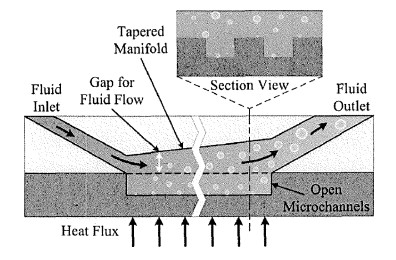
Synopsis
Patent US 10,018,430 B2 describes a heat transfer system and method incorporating a tapered flow field. This invention introduces a novel approach to enhancing heat transfer efficiency in various applications, particularly those involving microchannels and compact heat exchangers.
A key innovation of this patent lies in the design of flow passages with varying cross-sectional areas. The system utilizes tapered or diverging/converging microchannels to manipulate fluid flow, leading to improved heat transfer coefficients and reduced pressure drop penalties compared to conventional parallel microchannel designs. The patent details configurations where the channel width or depth changes along the flow path, creating regions of accelerated and decelerated flow that promote turbulence and mixing without significantly increasing pumping power. This dynamic flow characteristic is crucial for maximizing heat dissipation in compact spaces.
The commercial potential of this heat transfer system is substantial across a wide range of industries that rely on efficient thermal management:
Electronics Cooling: As electronic devices become more powerful and compact, managing their heat dissipation is a critical challenge. This invention offers a solution for cooling high-power components in computers, servers, telecommunications equipment, and consumer electronics. Its ability to achieve high heat flux removal with lower pressure drop makes it ideal for enhancing performance and reliability in these systems.
Automotive Industry: The system could be applied in automotive thermal management, including engine cooling, battery cooling for electric vehicles, and HVAC systems. Improved heat transfer efficiency can lead to smaller, lighter cooling systems, contributing to better fuel efficiency and extended battery life.
Aerospace and Defense: High-performance thermal management is essential for aerospace components, avionics, and defense systems where weight and space are at a premium. The tapered flow field design can offer superior cooling solutions for sensitive electronic equipment and power systems in these demanding environments.
Renewable Energy Systems: In concentrated solar power (CSP), geothermal systems, and fuel cells, efficient heat exchange is vital for energy conversion and system performance. This technology could improve the efficiency of heat recovery and transfer processes, enhancing the overall viability of renewable energy solutions.
Medical Devices: Miniaturized medical devices, such as diagnostic equipment and portable therapeutic devices, often generate heat that needs to be managed effectively. The compact and efficient nature of this heat transfer system could enable the development of more reliable and less invasive medical technologies.
Process Industries: Industries requiring precise temperature control for chemical reactions, distillation, or drying processes could benefit from this invention. Enhanced heat transfer can lead to more efficient operations, reduced energy consumption, and improved product quality.
The distinct advantage of this invention is its capacity to significantly improve heat transfer performance while maintaining manageable pressure drops, making it a highly valuable technology for any application demanding efficient and compact thermal management solutions.