US 10,085,690
System and Method for Feedback of Dynamically Weighted Values
Patent Number
Issue Date
Inventor(s)
Laurence I. Sugarman; Brian L. Garrison; Stephen Jacobs
Document
Download PDF for patent US 10,085,690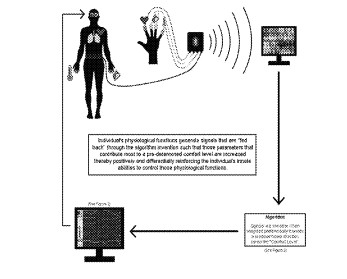
Synopsis
Patent US 10,085,690 B2 describes a system and method for providing feedback of dynamically weighted physiological signals. This invention offers a novel approach to biofeedback, particularly for individuals who may struggle with traditional methods or have physiological variations that make standard feedback challenging.
A core novelty of this invention is its dynamic weighting algorithm. Unlike conventional biofeedback systems that display multiple signals as disconnected pieces or in standard units of measurement, this system processes and displays physiological signals as an aggregate, accentuating those signals that are moving in a pre-identified, desired direction. This dynamic weighting ensures that signals contributing most to a "comfort level" or desired physiological state are emphasized, creating a positive feedback loop that reinforces an individual's innate abilities to control those functions. The system also accounts for physiological variations, allowing signals that are more difficult to change to be de-emphasized while those an individual can more easily control are preferentially weighted.
The system monitors various physiological parameters, including but not limited to, skin conductance level (SCL), skin temperature (TMP), heart rate variability (HRV), and respiration rate (RR). It translates these signals into standard units, calculates their relative values by comparing current readings to established maximums and minimums, and then dynamically weights them before presenting them as a single, cohesive visualization, such as a stacked bar graph. This approach simplifies the interpretation of complex physiological data, making it more accessible and effective for users.
The commercial potential for this dynamically weighted biofeedback system is substantial across several sectors:
Clinical Therapy and Behavioral Health: This invention could significantly enhance the efficacy of biofeedback therapy for conditions such as anxiety, stress, pain management, and attention deficit disorders. By providing clearer, more intuitive feedback, it may improve patient engagement and accelerate the learning process for self-regulation of physiological responses, especially for individuals with developmental differences or inconsistent physiological responses.
Sports Performance and Training: Athletes could utilize this system to optimize their physiological states for peak performance. By providing real-time, easily interpretable feedback on stress levels, recovery metrics, and focus, it could aid in mental training, performance enhancement, and preventing overtraining.
Corporate Wellness Programs: Employers could implement this technology to help employees manage stress, improve focus, and enhance overall well-being. The simplified feedback mechanism would make it a practical tool for general wellness applications, potentially leading to increased productivity and reduced healthcare costs.
Personalized Health and Wearable Technology: The system's ability to monitor and provide feedback on multiple physiological parameters makes it a strong candidate for integration into advanced wearable devices. This could empower individuals to gain greater insight into their daily physiological fluctuations and actively work towards personalized health goals.
Research and Development: Researchers in psychophysiology, neuroscience, and human-computer interaction could leverage this system for more nuanced studies on self-regulation, human performance, and the interaction between cognitive and physiological states.
This invention presents a refined approach to biofeedback, addressing the limitations of existing systems by offering a more intuitive, adaptive, and reinforcing feedback mechanism. Its versatility and potential to simplify complex physiological data make it an attractive solution for improving self-regulation and well-being across diverse applications.