US 10,086,336
Ultra-Thin Nanometer Scale Polymeric Membranes
Patent Number
Issue Date
Inventor(s)
Jirachai Getpreecharsawas;
David A. Borkholder
Document
Download PDF for patent US 10,086,336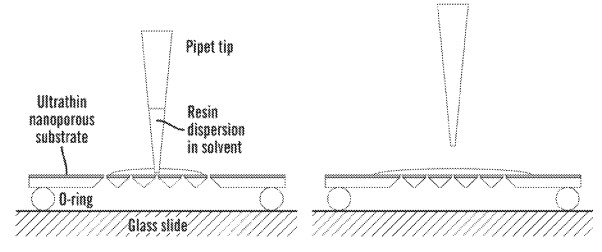
Synopsis
Patent US 10,086,336 B2 describes ultra-thin nanometer-scale freestanding polymeric membranes and methods for their production. The invention details processes for creating both recast and cross-linked membranes with a solid internal backbone.
A novel aspect of this invention lies in the ability to precisely control the thickness and structural integrity of these membranes at the nanometer scale. The methods involve applying a resin dispersion in a solvent onto an ultrathin nanoporous substrate, followed by controlled solvent evaporation or cross-linking processes. This approach allows for the creation of robust, freestanding membranes that maintain their nanometer-scale thickness.
The commercial potential for these ultra-thin nanoporous membranes is significant across various industries, particularly those requiring highly selective separation, sensing, or advanced material integration.
Possible applications include:
Water Desalination and Purification: The membranes' ultra-thin, nanoporous structure and their ability to be fabricated through interfacial polymerization make them highly suitable for advanced filtration processes such as reverse osmosis. Their nanometer scale could lead to more efficient and cost-effective desalination technologies, addressing global demands for clean water by achieving theoretical salt rejection.
Biotechnology and Medical Devices: The precise pore size and robust nature of these membranes could be leveraged for highly selective biological separations, such as cell sorting, protein purification, or drug delivery systems. They could also be integrated into diagnostic devices, acting as critical components for sample preparation or analyte detection due to their controlled permeability.
Gas Separation and Storage: The unique nanoporous structure could enable highly efficient separation of different gases, which is crucial for industrial processes, environmental control, and energy applications. For example, they could be used to separate carbon dioxide from industrial emissions or to enhance the purity of industrial gases.
Sensors and Biosensors: The ultra-thin nature of the membranes allows for rapid diffusion and interaction with target molecules, making them ideal for high-sensitivity sensors. When integrated with detection elements, these membranes could form the basis of advanced chemical or biological sensors for environmental monitoring, medical diagnostics, or industrial process control. Their freestanding nature would also allow for unique sensor geometries and integration possibilities.
Energy Storage and Conversion: These membranes could serve as advanced separators in batteries or fuel cells, where ion transport needs to be precisely controlled. Their thinness could reduce internal resistance, potentially leading to more efficient and compact energy devices.
Protective Coatings and Advanced Materials: The ability to form cross-linked membranes with a solid internal backbone suggests applications as durable, selective coatings for various surfaces, offering protection against corrosion or acting as smart interfaces.
The invention's capacity to produce freestanding, ultra-thin membranes with controlled nanometer-scale porosity offers a foundation for numerous high-performance applications where traditional membranes may fall short in terms of efficiency, selectivity, or durability.