US 10,193,354
Near Zero Volt Storage Tolerant Electrochemical Cells Through Reversible Ion Management
Patent Number
Issue Date
Inventor(s)
Kyle Crompton; Brian Landi
Document
Download PDF for patent US 10,193,354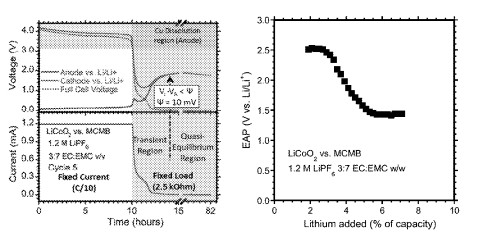
Synopsis
Patent US 10,193,354 B2 describes a novel approach to improving the safety and longevity of electrochemical cells, particularly lithium-ion batteries, by enabling them to tolerate discharge to near-zero volt conditions without sustaining significant irreversible damage. This invention focuses on a reversible ion management strategy that protects the anode during deep discharge, a common cause of performance degradation and safety concerns in conventional battery systems.
The core novelty of this invention lies in the use of a "sacrificial" ion source (e.g., lithium, sodium, or potassium source) that reversibly interacts with the anode during deep discharge. When the electrochemical cell is discharged to near-zero volts, ions from this sacrificial source are released and intercalate into the anode material, preventing the anode's potential from dropping too low and thus averting destructive processes like copper dissolution or electrolyte decomposition. Upon recharging, these sacrificial ions de-intercalate from the anode, and the cell resumes normal operation. This reversible ion management significantly enhances the battery's tolerance to extreme discharge cycles. The system can include a lithium source integrated within the battery cell itself, potentially in the cathode, anode, or electrolyte, and also a method to measure the voltage of the anode relative to a reference electrode. The control method includes maintaining the anode's open circuit voltage above a predetermined threshold by managing charge and discharge processes.
This innovation addresses critical limitations of current battery technologies, including:
Enhanced Safety: Prevents conditions that can lead to thermal runaway or dendrite formation, particularly when cells are deeply discharged or undergo manufacturing defects.
Increased Lifespan: Protects the anode from irreversible damage during deep discharge, extending the overall cycle life and calendar life of the battery.
Improved Reliability: Allows for more robust battery designs that can withstand harsh operating conditions or user mishandling.
The commercial potential of this invention is substantial across numerous industries reliant on advanced battery technology.
Possible applications include:
Electric Vehicles (EVs) and Hybrid Electric Vehicles (HEVs): Increased safety and lifespan of batteries are paramount for EV adoption. This technology could lead to more reliable and longer-lasting EV battery packs, reducing consumer anxiety about battery degradation and enabling deeper discharge cycles for extended range.
Consumer Electronics: Devices like smartphones, laptops, and wearables frequently undergo deep discharge. This invention could result in more durable and longer-lasting consumer electronics, improving user experience and reducing electronic waste.
Grid-Scale Energy Storage: For renewable energy integration (solar, wind), large-scale battery storage systems are crucial. Enhanced tolerance to deep discharge can improve the economics and reliability of these systems, allowing for more complete energy utilization and longer operational life.
Portable Power Tools and Robotics: Applications requiring high-power output and frequent charge/discharge cycles would benefit from the improved durability and safety offered by these batteries, leading to more robust and reliable products.
Aerospace and Defense: In critical applications where battery reliability and safety are non-negotiable, such as drones, satellites, or military equipment, this technology could provide a significant advantage.
Medical Devices: Implantable or portable medical devices require highly reliable power sources. Batteries incorporating this invention could offer enhanced safety and longevity for critical healthcare applications.
This invention provides a compelling solution for the development of safer, more durable, and higher-performing electrochemical cells, offering a significant competitive advantage to potential licensees in the battery manufacturing, automotive, consumer electronics, and energy storage sectors.