US 10,292,594
Method and System for Contactless Detection of Cardiac Activity
Synopsis
Patent US 10,292,594 B2 describes a novel method and system for contactless detection of cardiac activity, offering a non-invasive way to monitor heartbeats and heart rate variability (HRV) using optical sensing techniques. This invention has significant implications for remote health monitoring, simplifying medical diagnostics, and enhancing user comfort.
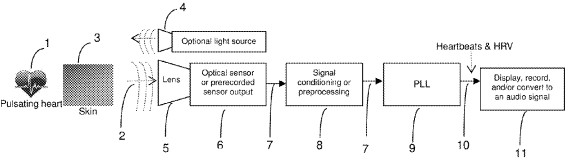
The primary innovation of this patent lies in its ability to detect subtle skin movements caused by cardiac activity without requiring direct physical contact with the patient. The system employs an optical sensor that measures variations in light reflected from or transmitted through the skin. These variations, which are imperceptible to the naked eye, are caused by the mechanical pulsations of the heart as blood flows through superficial capillaries. A key component of the system is a phase-locked loop (PLL) that processes these minute optical signals to accurately extract heartbeat information. The PLL is adept at tracking these periodic, low-amplitude signals, effectively filtering out noise and other motion artifacts that often plague conventional remote sensing methods. The system can even operate in ambient light conditions, though an optional light source can be used for improved performance. The output can be displayed, recorded, or converted to an audio signal, providing versatile utility.
This contactless approach offers several advantages over traditional methods like electrocardiography (ECG) or pulse oximetry, which require electrodes or probes attached to the body. It enhances user comfort, reduces the risk of skin irritation, and enables continuous, unobtrusive monitoring, which is particularly beneficial for sensitive populations or long-term data collection.
The commercial potential for this invention is substantial across numerous sectors, driven by the increasing demand for remote, non-invasive, and continuous health monitoring solutions.
Possible applications include:
Telemedicine and Remote Patient Monitoring: The system could be integrated into smart mirrors, wall-mounted devices, or even smartphone cameras, allowing individuals to monitor their cardiac activity from the comfort of their homes. This would facilitate early detection of cardiac issues, improve chronic disease management, and reduce the burden on healthcare facilities.
Infant Monitoring: For newborns, especially those at risk of SIDS, a contactless system could provide continuous cardiac monitoring without disturbing the infant or causing skin irritation from adhesive sensors. It could be integrated into cribs or nursery cameras.
Sleep Monitoring Systems: Integration into smart beds or sleep tracking devices could allow for passive, continuous heart rate and HRV monitoring throughout the night, providing valuable insights into sleep quality and potential health concerns without wearable devices.
Fitness and Wellness Trackers: While many fitness trackers are worn on the body, this technology could enable contactless heart rate monitoring in gyms, yoga studios, or even integrated into exercise equipment, offering a comfortable alternative.
Automotive Safety and Comfort: Integrated into car seats or steering wheels, the system could monitor driver alertness by tracking cardiac activity, potentially detecting fatigue or stress and triggering alerts to prevent accidents.
Security and Surveillance: In certain controlled environments, the ability to remotely detect vital signs could have applications in security screening or monitoring the physiological state of individuals without their active participation.
This invention offers a compelling solution for the non-invasive and continuous assessment of cardiac activity, presenting a strong value proposition to potential licensees in the healthcare, consumer electronics, and automotive industries.