11,598,518
Devices with an Enhanced Boiling Surface with Features Directing Bubble and Liquid Flow and Methods Thereof
Patent Number
Issue Date
Inventor(s)
Licensed/Under Negotiation
Document
Download PDF for patent 11,598,518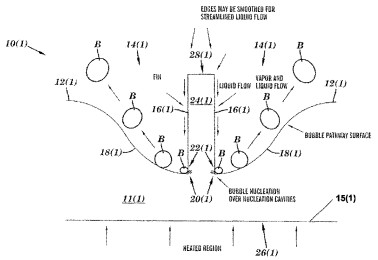
Synopsis
Patent US 11,598,518 B2 describes devices with an enhanced boiling surface that includes features designed to direct both bubble and liquid flow, along with methods for their use. The invention aims to significantly improve heat transfer efficiency during boiling processes, a critical aspect in various industrial and energy applications.
A key novel aspect of this patent is the design of asymmetric shaped cavities extending into a heated substrate. These cavities feature a sidewall that intersects with a bubble pathway surface at a different slope, creating a geometry specifically configured to non-gravitationally direct fluid that is moving along the sidewall out along the bubble pathway surface. This design facilitates the rapid removal of vapor bubbles from the heated surface and promotes continuous liquid flow towards the nucleation sites, preventing the formation of insulating vapor films that can hinder heat transfer. The patent details how these features enable streamlined liquid flow and directed bubble departure, optimizing the two-phase flow dynamics at the boiling interface.
The commercial potential of this invention is substantial in any sector requiring efficient heat exchange, particularly where boiling is involved. The enhanced heat transfer capabilities can lead to more compact, energy-efficient, and cost-effective systems.
Possible applications include:
Power Generation: In steam generators and boilers used in thermal power plants (including nuclear, coal, and natural gas), this technology could lead to increased efficiency and reduced fuel consumption by improving the rate at which water is converted to steam.
Electronics Cooling: With the increasing power density of electronic components (CPUs, GPUs, data centers), advanced cooling solutions are critical. This enhanced boiling surface could be integrated into liquid cooling systems for high-performance computing, servers, and consumer electronics, allowing for more effective heat dissipation and preventing overheating.
Refrigeration and Air Conditioning: The improved boiling efficiency can enhance the performance of evaporators in refrigeration and air conditioning systems, leading to more energy-efficient cooling cycles.
Desalination: In distillation-based desalination processes, where water is boiled and condensed, this technology could reduce the energy required for evaporation, making freshwater production more economical and sustainable.
Chemical and Process Industries: Many chemical processes involve boiling or evaporation steps. This enhanced surface could improve reaction efficiency and product yields by optimizing heat management in reactors and evaporators.
Waste Heat Recovery: The ability to efficiently transfer heat from various sources could be applied in systems designed to recover waste heat, converting it into useful energy.
This invention offers a fundamental improvement in boiling heat transfer technology, providing a pathway to more efficient, compact, and sustainable thermal management solutions across a broad spectrum of industrial and technological applications.