11,923,101
Optical Tweezer Phonon Laser
Patent Number
Issue Date
Inventor(s)
Mishkatul Bhattacharya; Anthony Nickolas; Vamivakas
Licensed/Under Negotiation
Document
Download PDF for patent 11,923,101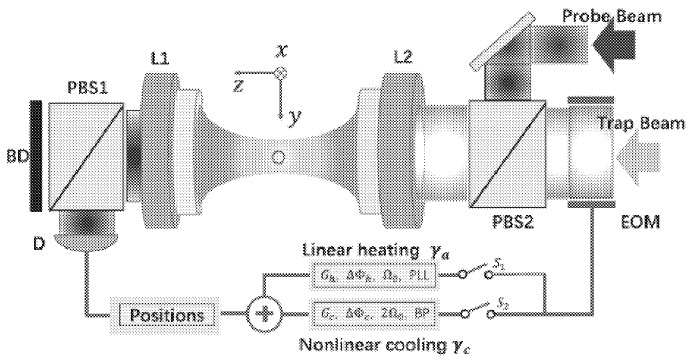
Synopsis
Patent US 11,923,101 B2 describes an optical tweezer phonon laser system and method designed to modulate the mechanical vibrations of an optically levitated mechanical oscillator to produce coherence. This invention focuses on precisely controlling the intensity of a trap beam that levitates a mechanical oscillator, achieved through a feedback loop that supplies an electro-optic modulator with both an amplification signal and a cooling signal. These signals represent an amplification force linear in the mechanical oscillator's momentum and a nonlinear cooling force that depends on the oscillator's position and is linear in its momentum, respectively.
A key novel aspect of this patent is the ability to simultaneously apply both linear heating and nonlinear cooling forces to the mechanical oscillator. This dual control mechanism allows for robust modulation of mechanical vibrations, leading to coherent phonon generation. The system utilizes an optical trap beam to levitate the mechanical oscillator and a probe beam to detect its position and momentum. The detected information is then fed into a control loop, which generates the amplification and cooling signals that adjust the trap beam's intensity via an electro-optic modulator. This intricate feedback system enables precise manipulation of the mechanical oscillator's quantum state, pushing it into a coherent phonon lasing regime.
The commercial potential of this invention is substantial, particularly in fields requiring high-precision measurements and quantum technologies. The ability to generate coherent phonons, or quantized mechanical vibrations, opens avenues for applications in advanced sensing, metrology, and quantum information processing.
Possible applications include:
High-Precision Sensors: The coherent mechanical oscillations can be leveraged for highly sensitive detectors of ultra-weak forces, accelerations, and displacements, which could revolutionize inertial navigation systems, gravimeters, and atomic force microscopy.
Quantum Information Science: The controlled generation and manipulation of phonons could serve as a platform for quantum computing and communication. Phonons can act as quantum bits (qubits) or as intermediaries for coupling different quantum systems, potentially leading to the development of novel quantum devices.
Material Science Research: The system could be used to study fundamental properties of materials at the nanoscale, including their mechanical, thermal, and quantum characteristics, by precisely exciting and probing their vibrational modes. This could lead to the discovery of new materials with tailored properties.
Medical Diagnostics: The high sensitivity of such a system could potentially be adapted for extremely sensitive medical diagnostic tools, detecting minute changes at the cellular or molecular level.
The underlying principle of controlling mechanical vibrations at a quantum level, as demonstrated by this phonon laser, represents a significant step forward in optomechanics. The robust and precise control offered by this patent's feedback mechanism positions it as a foundational technology for a new generation of devices that exploit the quantum nature of mechanical motion.