Matthew Hoffman Headshot

Matthew Hoffman

Professor, Applied Mathematics

School of Mathematics and Statistics
College of Science

585-475-4209
Office Location
GOS-2302
Office Mailing Address
2302 Gosnell Hall 84 Lomb Memorial Dr. Rochester, NY 14625

Matthew Hoffman

Professor, Applied Mathematics

School of Mathematics and Statistics
College of Science

Education

BA, Williams College; MS, Ph.D., University of Maryland

Bio

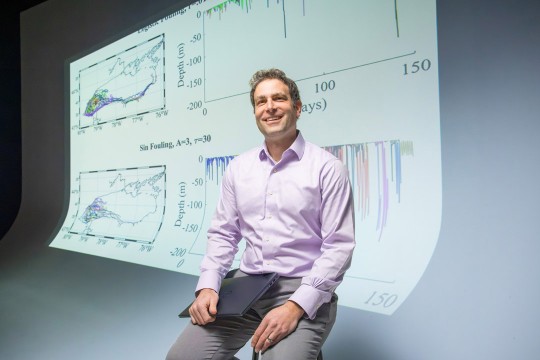
I am an applied mathematician who builds transport models to understand where plastic pollution goes once it enters lakes and oceans. My group produced the first estimates of how much plastic enters and floats in the Great Lakes, and we continue to study its transport through the water column, the the shoreline and sediment, and the food web. I am co-director and co-founder of the Center for Plastics and the Environment at RIT, part of the core team of the pELAstic project, and am part of the Lake Ontario Microplastics Center (LOMP). I also develop data-assimilation methods that blend models with observations, with applications from lake and ocean hydrodynamics to hyperspectral remote sensing and cardiac electrical dynamics.

585-475-4209

Areas of Expertise

Select Scholarship

Journal Paper
Hoffman, Matthew J., et al. "Feature Matching with an Adaptive Optical Sensor in a Ground Target Tracking System." IEEE Sensors Journal 15. 1 (2015): 510--519. Print.
Hoffman, Matthew J., et al. "Integrating Hyperspectral Likelihoods in a Multi-dimensional Assignment Algorithm for Aerial Vehicle Tracking." IEEE Journal of Selected Topics in Applied Earth Observations and Remote Sensing. (2015): --. Print.
Uzkent, Burak, Matthew J. Hoffman, and Anthony Vodacek. "Spectral Validation of Measurements in a Vehicle Tracking DDDAS." Procedia Computer Science 51. (2015): 2493—2502. Web.
Urquhart, E., et al. "Remotely Sensed Estimates of Surface Salinity in the Chesapeake Bay." Remote Sensing of the Environment 23. (2012): 522-531. Print.
Hoffman, M. J., et al. "Assessment of Mars Atmospheric Temperature Retrievals from the Thermal Emission Spectrometer Radiances." Icarus 220. 2 (2012): 1031-1039. Print.
Greybush, S. J., et al. "Ensemble Kalman Filter Data Assimilation of Thermal Emission Spectrometer Temperature Retrievals into a Mars GCM." Journal of Geophysical Research: Planets 117. E11 (2012) Web.
Hoffman, M. J., et al. "An Advanced Data Assimilation System for the Chesapeake Bay: Performance Evaluation." J. Atmos. Oceanic Technol. 29. (2012): 1542-1557. Print.
Greybush, Steven J., et al. "Identifying Martian atmospheric instabilitiesand their physical origins using bred vectors." Quarterly Journal of the Royal Meteorological Society. (2012) Print.
Published Conference Proceedings
Hoffman, Matthew J. "Background Image Understanding and Adaptive Imaging for Vehicle Tracking." Proceedings of the SPIE Defense + Security. Baltimore, Maryland: SPIE, 2015. Print.
Hoffman, Matthew J. "Efficient Integration of Spectral Features for Vehicle Tracking Utilizing an Adaptive Sensor." Proceedings of the IS&T/SPIE Electronic Imaging 2015. San Francisco, California: SPIE, 2015. Print.
Uzkent, Burak, Matthew J. Hoffman, and Anthony Vodacek. "Efficient integration of spectral features for vehicle tracking utilizing an adaptive sensor." Proceedings of the SPIE Conference on Video Surveillance and Transportation Imaging Applications. Ed. Robert Loce and Eli Saber. San Francisco, CA: n.p., 2015. Web.
Uzkent, Burak, et al. "Background image understanding and adaptive imaging for vehicle tracking." Proceedings of the SPIE Conference on Airborne Intelligence, Surveillance, Reconnaissance (ISR) Systems and Applications XII. Ed. Daniel J. Henry, et al. Baltimore, MD: n.p., 2015. Web.
Hoffman, Matthew J. "Spectral Validation of Measurements in a Vehicle Tracking DDDAS." Proceedings of the Procedia Computer Science. , Reykjavik: , 2015. Print.
Uzkent, Burak, et al. "Feature Matching and Adaptive Prediction Models in an Object Tracking DDDAS." Proceedings of the Procedia Computer Science. n.p., 2013. Print.
Invited Keynote/Presentation
Hoffman, Matthew J. "Ground Target Tracking Utilizing DDDAS Based Control of an Adaptive Optical Sensor." IEEE Geoscience and Remote Sensing Joint Chapter Meeting. IEEE Geoscience and Remote Sensing Joint Chapter. Rochester, NY. 31 Mar. 2015. Lecture.

Currently Teaching

ENVS-531
3 Credits
This multidisciplinary course will provide students with diverse perspectives on global climate change issues, providing a survey of important aspects of the problem. Topics include atmospheric chemistry, climate modeling, ecological impacts and feedbacks, economics of climate change, international climate policies, and social and environmental justice. The course will include a variety of instructors and guest lecturers, providing an overview of the complex and inter-related nature of global climate change.
ENVS-631
3 Credits
This multidisciplinary course will provide students with diverse perspectives on global climate change issues, providing a survey of important aspects of the problem augmented by readings in the primary literature. Topics include atmospheric chemistry, climate modeling, ecological impacts and feedbacks, economics of climate change, international climate policies, and social and environmental justice. The course will include a variety of instructors and guest lecturers, providing an overview of the complex and inter-related nature of global climate change. The course will culminate in a project based on finding solutions to the real-world problem of climate change. Students will be required to take a leadership role in bridging the multiple disciplines presented
ENVS-790
1-4 Credits
The thesis option will be available to environmental science graduate students only with prior written approval of program faculty. Students will submit a proposal to a faculty member who agrees to serve as the student's thesis committee chair. The proposal will describe the basic research question to be investigated and the experimental protocols to be employed. Proposals will be reviewed by the program faculty who will give permission to register for thesis credit. This course may be taken several times over the course of a student's graduate program, for variable credits. A written thesis and oral defense are required at the completion of the thesis research.
ENVS-791
1 Credit
Continuation of Thesis
ENVS-795
1-4 Credits
This course is a graduate level, faculty-directed, student project or research involving laboratory or field work, computer modeling, or theoretical calculations that could be considered of an original nature. The level of study is appropriate for students in Environmental Science graduate program.
IMGS-699
0 Credits
This course is a cooperative education experience for graduate imaging science students.
IMGS-890
1-6 Credits
Doctoral-level research by the candidate on an appropriate topic as arranged between the candidate and the research advisor.
MATH-495
1-3 Credits
This course is a faculty-directed project that could be considered original in nature. The level of work is appropriate for students in their final two years of undergraduate study.
MATH-498
1-3 Credits
This course is a faculty-guided investigation into appropriate topics that are not part of the curriculum.
MATH-790
0-9 Credits
Masters-level research by the candidate on an appropriate topic as arranged between the candidate and the research advisor.
PUBL-531
3 Credits
This multidisciplinary course will provide students with diverse perspectives on global climate change issues, providing a survey of important aspects of the problem. Topics include atmospheric chemistry, climate modeling, ecological impacts and feedbacks, economics of climate change, international climate policies, and social and environmental justice. The course will include a variety of instructors and guest lecturers, providing an overview of the complex and inter-related nature of global climate change.
PUBL-631
3 Credits
This multidisciplinary course will provide students with diverse perspectives on global climate change issues, providing a survey of important aspects of the problem augmented by readings in the primary literature. Topics include atmospheric chemistry, climate modeling, ecological impacts and feedbacks, economics of climate change, international climate policies, and social and environmental justice. The course will include a variety of instructors and guest lecturers, providing an overview of the complex and interrelated nature of global climate change. The course will culminate in a project based on finding solutions to the real-world problem of climate change. Students will be required to take a leadership role in bridging the multiple disciplines presented.

In the News