Transforming Lives Through Creativity and Innovation
Advancing with Purpose
RIT is entering a defining moment—one shaped by momentum, possibility, and purpose.
Our Strategic Framework builds on RIT’s history while responding to a rapidly changing world. It articulates our commitment to educating the next generation, advancing research with impact, and harnessing creativity across technology, the arts, and design to improve lives.
Our Promise and Our Future
At RIT, we promise to prepare learners to anticipate what’s next and to define the future.
Through discovery, creativity, and research that expands the boundaries of possibility, we view advancements not as replacements for human agency but as catalysts for a flourishing world.
The RIT Edge
Our graduates are uniquely prepared to:
Message from the President

Message from the President
Our Strategic Framework highlights RIT's distinctive, interdisciplinary identity, its people-first culture, and its long history of adapting to change as the foundation for bold leadership and progress through creativity and innovation.
Spotlights
Follow the meaningful progress RIT is making across this Strategic Framework

Students Use AI to Aid United Nations in Ukrainian Refugee Response
Students in RIT’s unique humanities, computing, and design major are developing an AI‑driven tool to help the United Nations identify and respond to the urgent needs of Ukrainian refugees in Poland. Their work illustrates the creative ways students are applying emerging tools to real human challenges.

Connecting Rochester to a Rainforest
RIT researchers and partners at Seneca Park Zoo in Rochester, N.Y., have developed a virtual reality gaming environment that will allow zoogoers to experience a Madagascar rainforest ecosystem. They recently journeyed to the Centre ValBio field station in Ranomafana National Park on a trip that laid the groundwork for creating accurate 3D models of the exotic wildlife and habitats of Madagascar.

Coast-to-Coast and Beyond: RIT’s LA Experience Prepares Students for Global Success
From tech labs to studio backlots, RIT in LA transforms the industry into a multidisciplinary classroom, guided by professors who are industry veterans. Animators, engineers, business majors, and more gain real-world insights through networking and internships. This transmedia world ensures all Tigers find their professional spotlight, proving that modern entertainment needs RIT’s unique approach.

RIT Dubai Flourishes as a Hub for Global Collaboration and Thought Leadership
RIT Dubai is a global hub for innovation and education in one of the world’s most dynamic cities. The campus is expanding its reach through strategic collaborations and industry partnerships, creating an open ecosystem that connects students, faculty, and global enterprises. RIT Dubai blends academic excellence with real-world impact to prepare students for careers in an interconnected world while fostering cross-cultural exchange and driving cutting-edge research.

RIT’s Community Garden: Where Sustainability and Education Take Root
RIT’s community garden cultivates hands-on learning, sustainability, and collaborative inquiry. Students, faculty, and staff grow food, support pollinators, and explore ecological stewardship through course work and experiential projects. All of these activities serve to strengthen community connections and environmental awareness across campus.

Where Wellness Meets Fun: RIT Club Sports Offer a Space for All
RIT Club Sports offer students an opportunity to stay active, build friendships, and foster a sense of belonging outside the classroom. With more than 50 teams ranging from soccer and hockey to ultimate frisbee and martial arts, Club Sports emphasize wellness, teamwork, and personal growth. They also provide a flexible alternative to varsity athletics, allowing students of all skill levels to participate, compete regionally, and develop leadership skills.

A Central Hub for ASL and Deaf Culture at RIT
RIT’s ASL and Deaf Studies Community Center (RADSCC), founded in 2010, serves as a vibrant hub for learning, interaction, and cultural exchange. The center features a modern classroom, offices, and a lounge that facilitate open communication between Deaf and hearing students and faculty. The center offers ASL classes, tutoring, and programming by local and international Deaf leaders. It also showcases Deaf cultural art, hosts student and community events, and supports advocacy and education.

Family Recipes and Culinary Traditions Bring Authentic Taste to RIT Meals
Through authentic family recipes and a Visiting Chef Series, RIT Dining is bringing global flavors to campus. Visiting chefs collaborate with RIT’s culinary team to prepare signature meals, while family recipes from international students and staff add a personal touch to menus. By blending professional expertise with authentic homestyle cooking, RIT Dining is creating food experiences that celebrate cultural heritage, foster community, and broaden culinary horizons.

Illuminating Lost History
RIT’s Cultural Heritage Imaging Lab developed MISHA, a low-cost, open-source multispectral imaging system launched in 2024 with support from the National Endowment for the Humanities. This portable tool captures 16 wavelengths of light in under a minute, revealing hidden features such as faded text and underdrawings on manuscripts, maps, and artifacts. Students and faculty from RIT collaborate across disciplines, training professionals through summer seminars and international conferences.

Students and Researchers Collaborate to Improve Deaf Health
RIT’s Deaf Health Laboratory, part of the Deaf Health Care and Biomedical Sciences Hub (Deaf Hub) at National Technical Institute for the Deaf, advances research that strengthens health equity for Deaf and hard‑of‑hearing communities. Established in 2022, the Deaf Hub fosters Deaf representation in biomedical fields, supports a network of Deaf scientists and mentors, and engages students in inquiry that drives improved health outcomes.

Tackling the Macro Problem of Microplastics
RIT co-leads a $10 million multidisciplinary effort with the University of Rochester to combat microplastic pollution in the Great Lakes. Supported by NOAA, NSF, and other agencies, the initiative unites mathematicians, ecologists, chemists, engineers, and students to track how plastic waste—from wrappers to cigarette butts—breaks down into microplastics and accumulates in lakes and shorelines. Using tools like LittaTraps and Seabins, team members collect and analyze debris to study polymer breakdown and environmental impact.

Manifesting Quantum
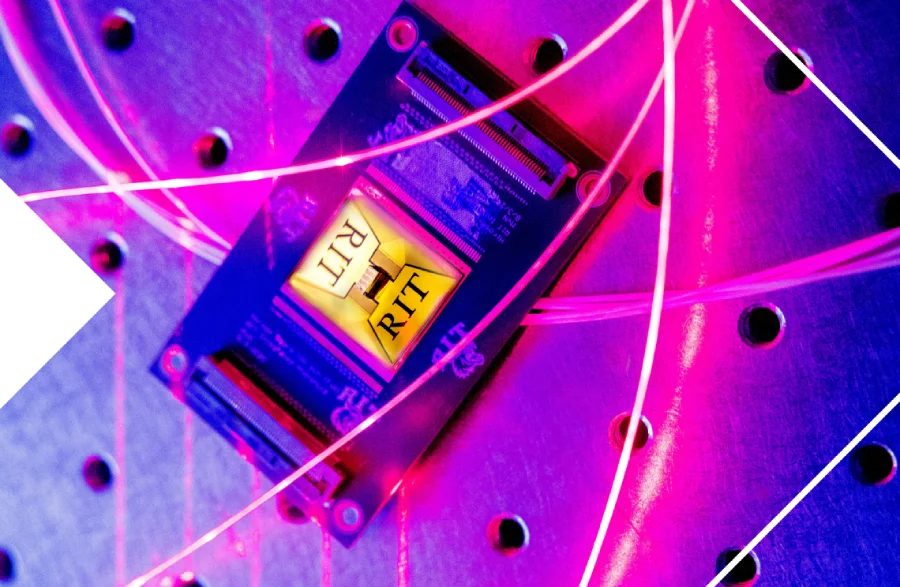
RIT researchers are pushing the boundaries of quantum technology and navigating the next frontier of physics. By advancing quantum science and partnering with industry, this initiative accelerates the commercialization of innovative technologies and entrepreneurial ventures, delivering solutions that will amplify societal and economic impact while reshaping industries such as communication, computing, and security.

Humans Are The Nuts and Bolts of RIT Robotics Research
RIT has been advancing robotics for decades. Today, a human-centered design approach drives research and education, ensuring robots make safe, intelligent decisions that support people and manufacturing processes. Students and researchers integrate vision systems, advanced automation, sensors, and control systems across dozens of undergraduate and graduate programs. Robotics content is also offered through minors, concentrations, and courses available to non-engineering majors campus-wide.

What’s Being Made in RIT’s SHED?
Star Wars–inspired 3D models, remote-controlled aircraft, smart crutches, and brainwave-controlled wheelchairs are just a few projects taking shape in RIT’s SHED. With seven specialized workshops—from laser cutting and 3D printing to metal, wood, textiles, electronics, and performing arts—the SHED fosters hands-on creativity, cross-disciplinary collaboration, and innovation.

Vertically Integrated Projects Connect Students with Faculty for Real-World Research
RIT’s Vertically Integrated Projects Program brings together multidisciplinary student teams and faculty mentors to tackle initiatives in areas like virtual reality, gaming, and accessibility. Students earn academic credit while contributing to faculty-led research, gaining hands-on experience, developing teamwork skills, and advancing their professional development. The program allows students to stay involved for multiple semesters, enabling them to deepen their expertise.

Performing Arts at the Intersection of Talent, Technology, and Deaf Culture
More than 600 first‑year students became RIT Performing Arts Scholars in fall 2025. Their work is elevated by the integration of Deaf culture and technology, where the National Technical Institute for the Deaf’s (NTID) vibrant community intersects with cutting‑edge spaces like the Student Hall for Exploration and Development (SHED) and the new Performing Arts Center. By weaving ASL, digital media, and inclusive design into live performance, RIT shows how innovation and accessibility shape a dynamic creative ecosystem.