
Dimah Dera
Assistant Professor, Imaging Science
Dimah Dera
Assistant Professor, Imaging Science
Bio
Dimah Dera is an Endowed Assistant Professor at the Chester F. Carlson Center for Imaging Science at the Rochester Institute of Technology. She received her Ph.D. and M.S. in Electrical and Computer Engineering and her M.A. in Mathematics from Rowan University. Dr. Dera received the National Science Foundation Faculty Early Career Development Program Award, NSF CAREER Award No. 2542166, in 2026 for her project, “AdaptTrust: Adaptable, Trustworthy and Uncertainty-Aware Learning in Intelligent Sensing Technologies.” She also received the NSF Computer and Information Science and Engineering Research Initiation Initiative Award, CRII Award No. 2401828, in 2023, as well as an NSF Research Experiences for Undergraduates supplement award in 2024 for her research on robust and trustworthy machine learning.
She has won several research awards from IEEE conferences and the engineering community, including the Best Paper Award at the 2019 IEEE International Workshop on Machine Learning for Signal Processing, the NJ Tech Council STEM Innovator to Watch Award in 2019, and the IEEE Philadelphia Section Benjamin Franklin Key Award in 2021. Dr. Dera has served as a member of the IEEE Signal Processing Society and the IEEE Computational Intelligence Society, as well as a member of ACM SIGHPC. She is also an NVIDIA Deep Learning Institute University Ambassador.
Dr. Dera specializes in robust and trustworthy modern machine learning solutions for real-world applications, including healthcare, remote sensing, and surveillance systems. Her research focuses on developing innovative techniques to ensure the robustness, safety, adaptability, and reliability of AI systems by integrating Bayesian theory and statistical signal processing foundations into modern machine learning frameworks. Her work highlights the intricate connections between Bayesian uncertainty learning in machine learning models and their robustness, self-awareness, and adaptability to dynamically changing environments and system failures. She publishes in the areas of trustworthy, reliable, and explainable machine learning, signal and image processing, and optimization.
Select Scholarship
Currently Teaching
In the News
-
May 18, 2026
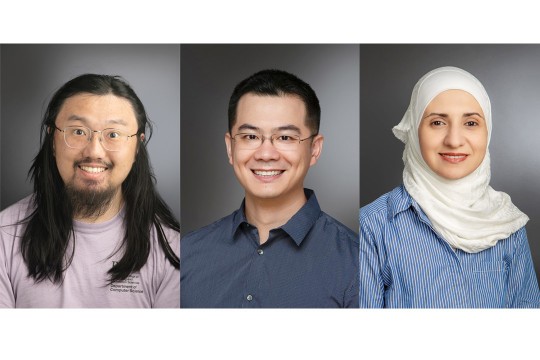
NSF CAREER Awards spotlight RIT research shaping the future of AI
RIT faculty members are tackling some of AI’s most pressing challenges with support from the National Science Foundation’s prestigious CAREER Award program, which recognizes early-career scholars who integrate cutting-edge research with student education.
-
May 18, 2026
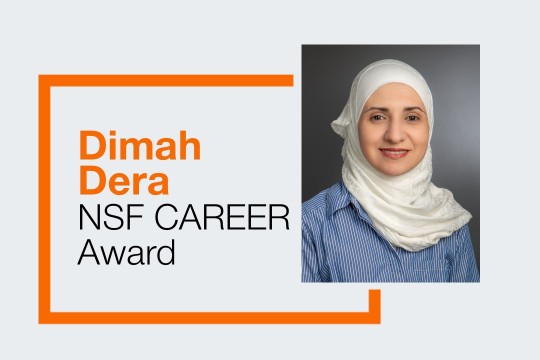
Dimah Dera and students to develop trustworthy AI through NSF CAREER Award
RIT imaging science endowed assistant professor Dimah Dera has received an NSF CAREER Award to engage students to develop trustworthy AI.