Recent alumna thrives in professional role at jewelry shop
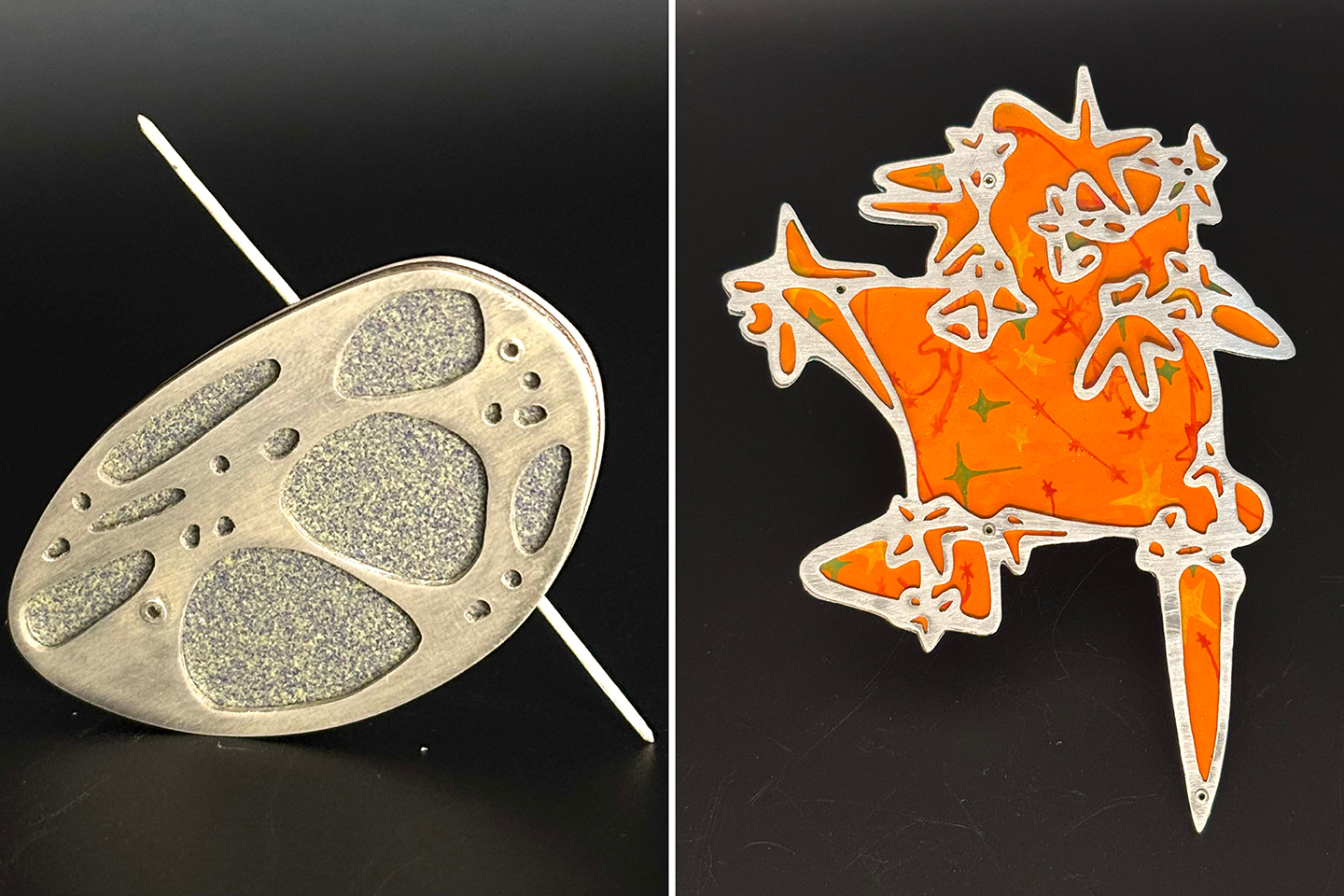
Two of the brooches — a decorative jewelry piece fastened to garments — Cece Plympton designed as part of their capstone project.
Cece Plympton ’25 (studio arts BFA - metals and jewelry design option) enrolled at RIT to become a bench jeweler — an artist who repairs, restores, and creates custom pieces.
During their final semester studying metals and jewelry design at RIT, Plympton accepted a position as sales associate at J. William Jewelers, a fine jewelry and watch shop in nearby Spencerport, N.Y. They are still there after graduating in May, carrying out responsibilities that align with the initial goals established at RIT.
As a young professional, Plympton matches customers with the right pieces for them, performs jewelry cleaning and repairs (such as soldering and rhodium plating), and sketches custom designs.

Cece Plympton
“In school I learned how to build fine jewelry from the bottom up, and honed my traditional drafting skills,” Plympton said. “Now, those are useful at work because I can draw out ideas for customers, keeping in mind how jewelry should be designed in order to have a long-lasting, heirloom quality. I also learned all the basic qualities of metals, as well as skills to prepare me for most repair work.”
Plympton’s professional opportunity with J. William Jewelers emerged after a recommendation from Professor Juan Carlos Caballero-Perez.
Plympton said the semi-annual, custom jewelry sales organized and executed by RIT metals and jewelry design students developed the soft skills and logistics needed in their current role.
“I practiced assisting people in finding pieces that fit their lifestyles and interests best, teaching customers how to care for their pieces, and keeping track of sales,” Plympton said. “I learned the value of a clean, safe, and efficiently organized workspace at RIT, and benefited from collaborating with people who have different problem solving approaches from mine.”
Plympton also valued the mentorship from their faculty — Caballero-Perez and Assistant Professor Laurel Fulton.
“My time at RIT taught me that other people and their creative ideas can be your most valuable resource, and how to advocate for myself in team settings,” Plympton said. ”Those lessons have been incredibly useful since my graduation.”
Plympton’s interest in metal materials at RIT extended to iron arts.
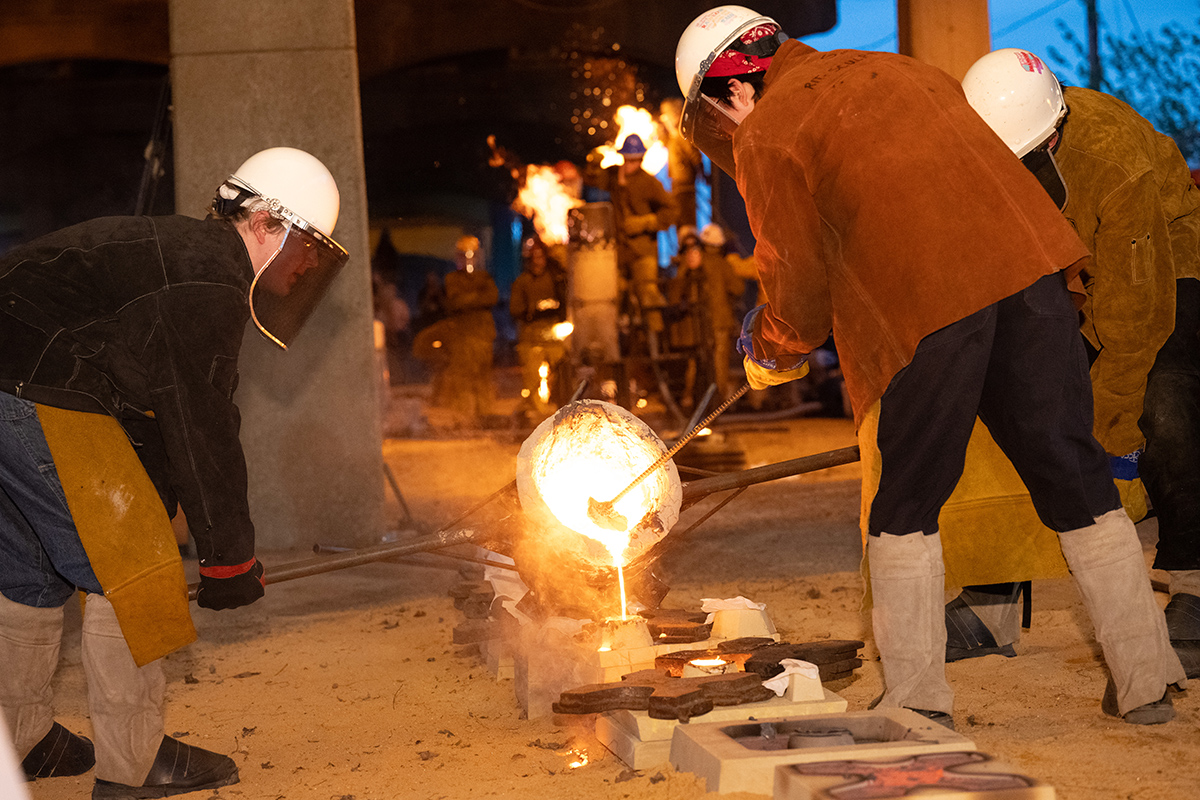
During their senior year, Plympton joined Instruction Support Specialist and Adjunct Faculty Kelly Wilton and her interdisciplinary team of students to design, build, and compete with a cupola furnace from scratch. The device, capable of melting casting iron at 3,000 degrees, was showcased and demonstrated by the RIT team at the National Conference on Contemporary Cast Iron Art and Practices (NCCCIAP) in the spring in Birmingham, Ala.
Dan Hughes
Plympton, right, helps pour molten iron that was melted by a student-made cupola at NCCCIAP in Alabama.
The device won an award in the conference’s Student Cupola competition for its high functionality. Plympton was the team’s co-captain.
“This is a very full world of cast iron art, artists, history, and knowledge that we accessed in a relatively short time,” Plympton said. “There were so many founders who involved us in dialogues about contemporary issues within the cast iron art community. It's truly one of the most accepting, inspiring, and active communities I have been a part of.”


