RIT students help bring Floating Garden to life
Amanda Reis
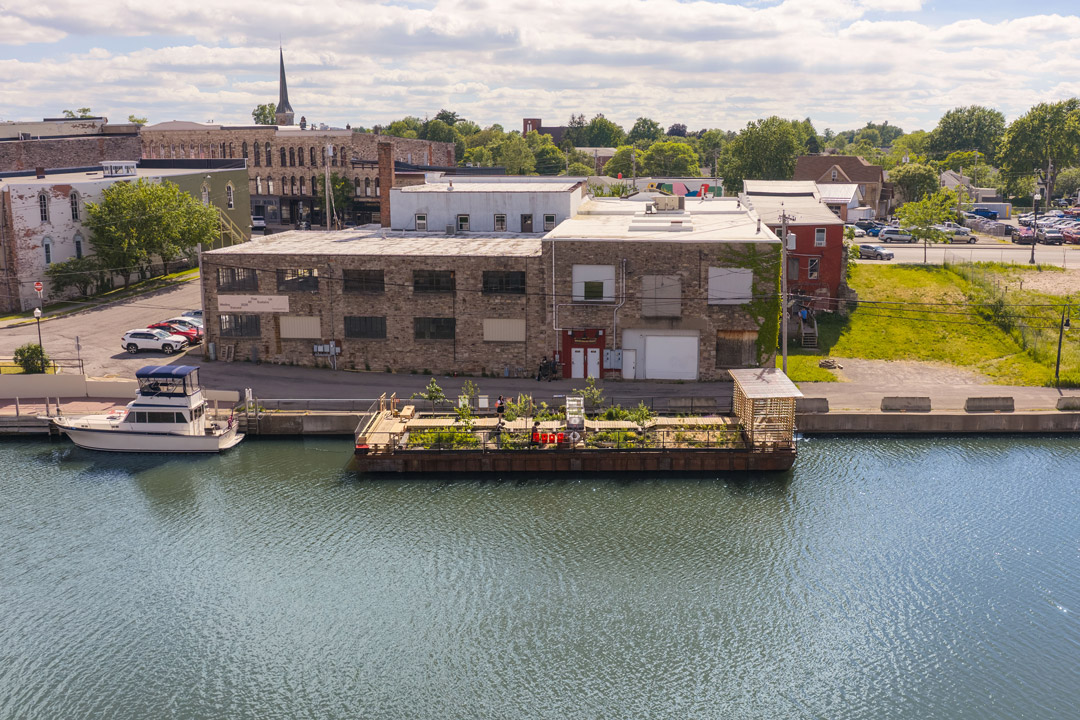
'Floating Garden' is a food forest envisioned by interdisciplinary artist Mary Mattingly, which looks to highlight and help tackle food insecurity across New York state and build connection with its residents. Former RIT faculty member Amanda Reis worked with RIT students to develop the project.
A living symbol of food sovereignty has appeared on the Erie Canal, with RIT students playing a key role in the project’s development.
Floating Garden, a food forest envisioned by New York-based interdisciplinary artist Mary Mattingly and commissioned by the inaugural Medina Triennial – All That Sustains Us, was unveiled June 6 and will be on display until the fall, when it will travel down the Erie Canal and Hudson River into New York City.
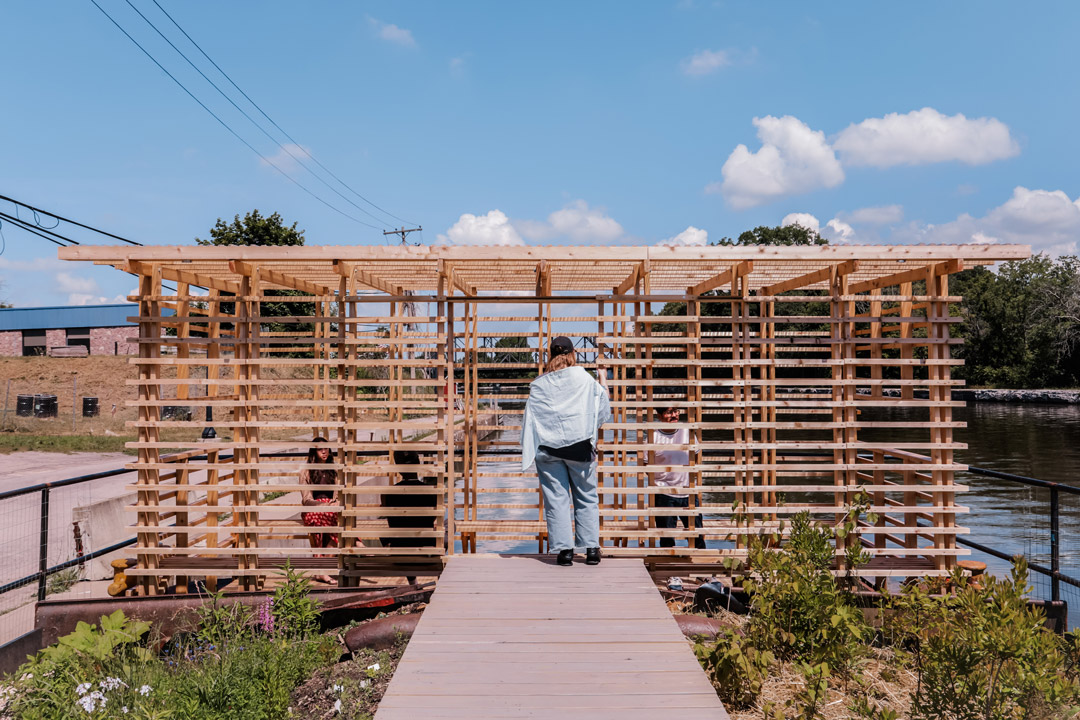
The Floating Pavilion, a gathering space at the barge’s edge built of cedar and polycarbonate, was created by RIT students. The project was led by Amanda Reis, former professor at the Golisano Institute for Sustainability, who structured it as an open, interdisciplinary workshop drawing students from across the university.
“Having more opportunities for student overlap is really essential in any discipline that is by nature very collaborative,” Reis said. “No project happens individually.”
Mattingly credited Reis’s collaborative approach as central to what made the project work.
Youngjin Yi ’26
The pavilion’s sloped roof collects rainwater and channels it into the garden. Horizontal cedar slats provide shade and will offer space for drying herbs or growing vines. Two sides are left open, framing the canal and connecting visitors to the water on either side. RIT students created the pavilion.
“Amanda not only designed the pavilion but worked with her student team to realize it on site, amidst all of the complications of working on the water,” she said. “She brings rigor, pragmatic intellect, and fun into the process—it would not have been the same without her.”
The workshop ran in two phases. Students prefabricated pavilion components in RIT's SHED in February before traveling to Medina in May to assemble the structure on the barge itself. They also incorporated leftover materials from a previous project, Peace Pavilion.
RIT's “maker mentality” plays a significant role in its ranking as a "Most Innovative" campus and a “Top School for Co-op or Internship Programs,” leading to hands-on career preparation, by U.S. News and World Report.
Assembly presented challenges that no shop could replicate. The vessel’s warped metal surface, as well as weather conditions on the water, required constant adjustments.
“That barge was constantly moving,” said architecture alumnus Youngjin Yi ’26. “We went through a lot of troubleshooting as to how we could level the build.”
Members of RIT’s American Welding Society student chapter joined after Reis stopped at their booth at a campus fundraiser. Welding on an aging barge was a different proposition from their indoor shop. Even powering their equipment required improvisation, as they rigged a custom adapter to a generator to provide power for their welder.
“You hear that prep work is about 95% of your time and welding is only 5%,” said Sammy Surcel-Debes, a third-year mechanical engineering student. “In our shop, it was more like 50/50.”
Youngjin Yi ’26
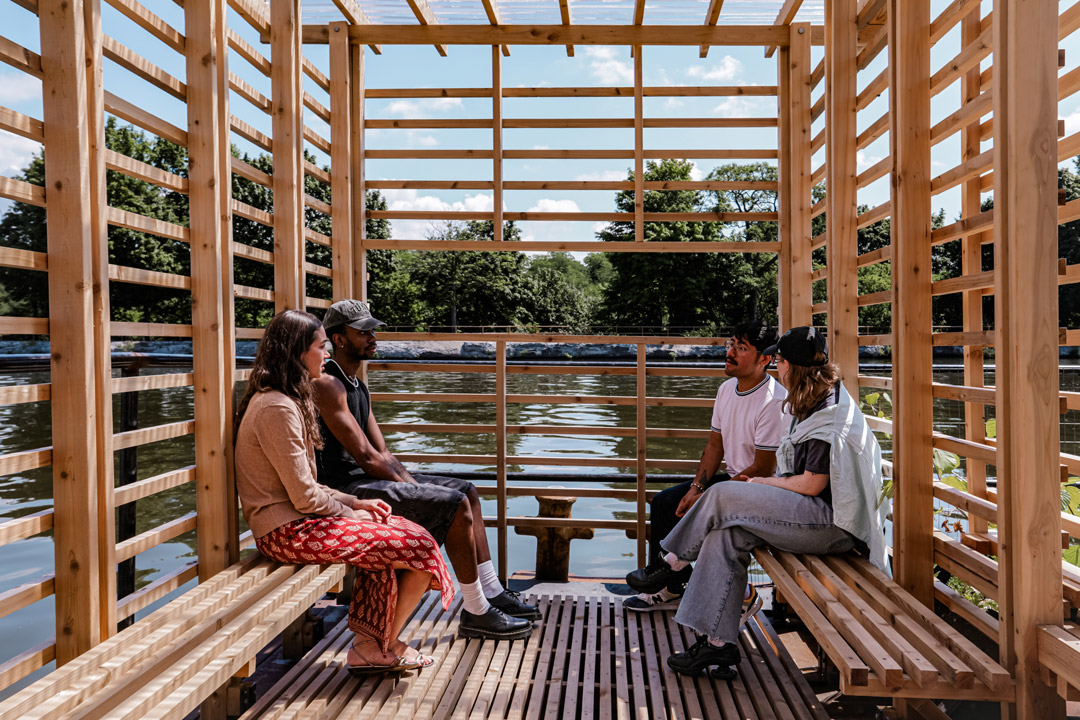
The pavilion, created by RIT students, is a seating and gathering space which hopes to bring community members together amidst the garden.
Graduate students Yi, Gil Merod ’26 (architecture), and Mackendra “Macky” Nobes served as project assistants, contributing to design decisions on the pavilion.
“Projects like the Floating Garden and Pavilion excite me about the future of art and architecture; projects that demonstrate how creative sparks can foster social connections and new traditions,” said Nobes. “Having the opportunity as a student to work with a multidisciplinary team to help provide communities with a unique, interactive public experience has been invaluable.”
“Working on the Floating Pavilion has shown me how architecture can extend beyond design and become a platform for social impact,” added Merod. “Mary Mattingly’s Floating Garden highlights the importance of access to fresh food in urban environments, and this project translates that mission into a shared spatial experience.”
The Floating Garden builds upon nearly a decade of work by Swale, a mobile, community-led food access initiative which looks to transform New York state’s waterways into civic spaces for environmental and economic justice.