INSIGHT
Research Group
Industrial Networks, Sustainability, and IntelliGent High-impact Technologies
- RIT/
- RIT Dubai/
- About/
- Research Groups/
- INSIGHT
Industrial Networks, Sustainability, and IntelliGent High-impact Technologies Research Group
(INSIGHT)
Driving intelligent, sustainable, and data-driven solutions that transform industries through applied research and real-world impact.
Our focus is on the development of deployable models and rigorously validated frameworks that advance operational excellence across key sectors, including manufacturing, healthcare, logistics, and energy.
|
Our Vision To be a leading applied research hub in Industrial Engineering, advancing intelligent, sustainable, and data-driven systems that enhance organizational performance, resilience, and long-term value in a dynamic global environment. |
Our Objective To serve as a strategic innovation partner, enabling organizations to design intelligent systems, strengthen sustainability outcomes, and enhance competitiveness within increasingly complex and data-driven operating environments. |
Mission and Strategic Alignment
The INSIGHT Research Group advances applied, industry-engaged research that integrates sustainability and data-driven intelligence. In alignment with RIT Dubai’s strategic priorities, the group is committed to translating research into practical, scalable solutions that deliver measurable impact. Our objectives align with the core pillars of the RIT Dubai Strategic Plan:
- Research Innovation with Impact: Translating advanced research into deployable, real-world solutions that address complex industry challenges.
- Economic Diversification: Contributing to the development of data-driven and innovation-led sectors through work in smart infrastructure, logistics, and advanced operations.
- Community Engagement: Collaborating with industry and government partners to co-develop solutions that respond to evolving operational and societal needs.
- Educational Technology: Leveraging RIT Dubai’s advanced laboratory ecosystem to support applied research, innovation, and experiential learning opportunities.
Faculty
Dua Weraikat
Fuat Kosanoglu
Haneen Abuzaid
Karam AlAssaf
Sustainable and Circular Engineering Solutions
Integration of Renewable Energy Strategies: A Case in Dubai South
Researcher: Dr. Dua Weraikat
Collaborators: Dubai South
As cities worldwide pursue sustainability, integrating renewable energy has emerged as a strategic priority in urban planning. This research provides a case study investigation into how Dubai South, a distinctive aerotropolis combining aviation, logistics, and residential sectors, can implement a comprehensive renewable energy strategy aligned with the UAE’s clean energy goals. Grounded in the theoretical frameworks of Sustainable Strategic Management (SSM) and Energy Management Systems (EMSs), and informed by global best practices and advanced technological innovations, this study proposes a strategic roadmap tailored to the complex energy demands and urban dynamics of Dubai South. Using the Dubai South HQ solar deployment as a baseline, this research explores technical, regulatory, and economic barriers alongside key enabling factors. Its core contribution is the development of a scalable strategy for renewable energy integration in aerotropolis settings, offering practical insights for policymakers, urban planners, and developers aiming to advance sustainability in rapidly evolving, logistics-based cities.
Data Analytics in Agriculture: Enhancing Decision-Making for Crop Yield Optimization and Sustainable Practices
Researcher: Dr. Dua Weraikat
Collaborator: RIT-Croatia Šorič, K.; Žagar, M.; Sokač, M.
Collaboration across the agriculture supply chain is essential to address the high-yield demand and sustainable practices amid global overpopulation. Limited resources, such as soil and water, are compromised by excessive chemical agents and nutrient use. The Internet of Things (IoT) and smart farming offer solutions by optimizing agent applications, data analysis, and farm monitoring. Evidence from numerous studies indicates that collaboration in the supply chain, including farmers, can improve efficiency and productivity, reduce costs, and enhance crop quality. This paper investigates the transformation of traditional agriculture into smart farming through the integration of IoT technology and community partnerships. It presents a case study focused on educating farm owners about advanced technologies to enhance decision-making, improve crop yields, and promote sustainability. Additionally, the paper highlights the role of data analytics in agriculture. Farmers in the southern region of Zagreb, Croatia, were trained on the use of sensors and yield monitoring. Small farms in that region face challenges in improving yields due to limited capacity and lack of entrepreneurial experience. The DMAIC methodology was employed to address these issues and measure relevant parameters. The paper also discusses consistent patterns between electrical conductivity (EC) measurements and potassium levels in soil. It explains the potential of estimating potassium concentrations based on EC readings, or vice versa. Leveraging EC as a proxy for potassium levels could offer a cost-effective means of assessing soil fertility and nutrient dynamics. Additionally, Principal Component Analysis (PCA) biplot analysis is presented, showing that pH values behaved independently. Understanding these dynamics enhances knowledge of soil variability and informs sustainable soil management practices.
Coordinating a Green Reverse Supply Chain in Pharmaceutical Sector by Negotiation
Researcher: Dr. Dua Weraikat
Collaborator: Concordia University, Zanjani, N. Lehoux.
This paper investigates the pharmaceutical reverse supply chain. For this industry, the reverse supply chain is usually not owned by a single company. A decentralized negotiation process is thus presented in order to coordinate the collection of unwanted medications at customer zones. Using a Lagrangian relaxation method, the model is solved for a real generic pharmaceutical company. Coordination efforts are required from the supply chain entities, facing environmental regulations, to collect and recycle unwanted medications. Therefore, a bonus sharing technique is also proposed based on each entity’s investment in the coordination process. Some numerical results are presented and discussed for two case studies. It shows that up to 28% more products could be collected if companies coordinate their operations efficiently. Besides, future insights on the same network are highlighted.
Coordinating a Green Reverse Supply Chain in Pharmaceutical Sector by Negotiation
Researcher: Dr. Dua Weraikat
Collaborator: Concordia University, Zanjani, N. Lehoux.
This paper investigates the pharmaceutical reverse supply chain. For this industry, the reverse supply chain is usually not owned by a single company. A decentralized negotiation process is thus presented in order to coordinate the collection of unwanted medications at customer zones. Using a Lagrangian relaxation method, the model is solved for a real generic pharmaceutical company. Coordination efforts are required from the supply chain entities, facing environmental regulations, to collect and recycle unwanted medications. Therefore, a bonus sharing technique is also proposed based on each entity’s investment in the coordination process. Some numerical results are presented and discussed for two case studies. It shows that up to 28% more products could be collected if companies coordinate their operations efficiently. Besides, future insights on the same network are highlighted.
Circular Supply Chain Optimization for Sustainable Packaging: Insights, Methods, and Emerging Research Directions
Researcher: Dr. Dua Weraikat
Collaborator: Amirjon Ateov.
This systematic literature review investigates circular supply chain (CSC) optimization approaches in the context of sustainable packaging by analyzing ten key studies that reflect current research trends. A comprehensive search of three academic databases (the Web of Science, IEEE Xplore, and PubMed) identified 20 peer-reviewed studies published between 2018 and 2025. PRISMA 2020 guidelines were implemented, resulting in a final dataset of 10 studies. The review highlights a wide range of optimization models, including mixed-integer linear programming (MILP) for returnable packaging networks, Stackelberg game models for packaging recycling, multi-objective optimization for closed-loop supply chains, and agent-based modeling for recycling logistics. Key application areas include automotive returnable packaging, express delivery packaging recycling, food packaging efficiency assessment, and plastic waste management. The review highlights contributions in integrating circular economy (CE) principles with advanced optimization methods. It also sheds light on policy implications and the role of technology enabled solutions such as IoT and fuzzy evaluation models. However, critical research gaps remain, including limited dynamic assessment frameworks, insufficient cross-industry methodology transfer, and robust real-world validation. Overall, the findings provide comprehensive insights into existing optimization approaches and outline promising directions for future research on circular packaging systems.
Enhancing Waste Management and Circular Economy Practices in Higher Education Institutions in UAE: A Study on Current Policies and Strategic Framework
Researcher: Dr. Dua Weraikat
Collaborator: M. Ali and S. Khan
The study investigates the integration of Circular Economy (CE) principles into higher education institutions (HEIs) in the UAE to address the growing challenges of waste management and sustainability. The UAE's economic growth and population increase have led to significant waste generation, necessitating a transition from the traditional linear economy model to a sustainable CE framework. Despite HEIs’ critical role in promoting sustainable development goals, existing accreditation standards lack requirements for CE implementation. Through a qualitative survey of 43 participants from 45 HEIs in UAE, the presented work examines awareness levels among HEIs employees, existing waste management practices in HEIS, and challenges to CE adoption within HEIs. The preliminary findings reveal a gap in providing formal training on CE and sustainability to HEIs employees, limited awareness of CE concepts within the employees, and inconsistent implementation of waste management practices in HEIs. The study proposes the need for a new CE framework designed for HEIs, focusing on: Awareness and Knowledge, Institutional Policies and Governance, and Infrastructure and Operations, to align with the UAE's 2021-2031 Circular Economy Policy.
Sustainable Supply Chain Management in Construction
Researcher: Kosanoglu, F.
Collaborator: Kus, H.T.
Our research focuses on developing and evaluating sustainable supply chain management strategies for the construction industry. We examine how environmental, social, and economic sustainability can be integrated into construction supply chain decisions, from material sourcing and procurement to construction and building life cycles. The research develops decision-support approaches to identify key sustainability factors, assess current practices, and guide construction organizations toward more sustainable, efficient, and responsible supply chain operations.
Air Pollutants Assessment Across the UAE Using Repeated Measures
Researcher: Dr. Karam Al-Assaf
Collaborator: Khaffaf, I. A., Tayeb, R. A., & Alzaatreh, A.
A significant, manageable hazard to public health, happiness, and the achievement of sustainable development is air pollution. Outdoor air pollution has increased 8% globally over the previous five years, exposing billions of people worldwide to hazardous air. With UAE being no different, there are a variety of pollution-related problems that needs to be addressed. Therefore, to gain insights by the government and decision makers, this study aims to analyze the annual trends of the five major air pollutants (NO2, SO2, 03, CO, and PM10) across five emirates in the UAE (Abu Dhabi, Dubai, Sharjah, Ajman, and Ras AL Khaimah) from 2013 to 2020. The results of the analysis revealed that air pollutants NO2, SO2, and PM10 were significantly different across the years and states. Moreover, it was found that the levels of NO2 is significantly different in Dubai across the years. Moreover, the levels of SO2 are significantly different in Sharjah across the years. Furthermore, it was found that PM10 was significantly different in Ajman across the years. Moreover, the analysis of the significant difference of the pollutants in the three areas (Downtown, Residential, Industrial) revealed that there is no significant difference of the pollutant levels across the years in the three different areas. This tool has shown its effectiveness in monitoring pollutant trends, providing valuable data for government investigations and control measures across the UAE. Additionally, it serves as a valuable resource for decision-makers to develop and implement policies aimed at improving pollutant levels.
Environmental and economic impact assessments of a photovoltaic rooftop system in the United Arab Emirates
Researcher: Dr. Haneen Abuzaid
Collaborator: F. Samara, Philadelphia Solar L.L.C., Jordan and Aquagas Plastic Industries L.L.C., UAE
The shift toward renewable energy resources, and photovoltaic systems specifically, has gained a huge focus in the past two decades. This study aimed to assess several environmental and economic impacts of a photovoltaic system that installed on the rooftop of an industrial facility in Dubai, United Arab Emirates (UAE). The life cycle assessment method was employed to study all the flows and evaluate the environmental impacts, while several economic indicators were calculated to assess the feasibility and profitability of this photovoltaic system. The results showed that the production processes contributed the most to the environmental impacts, where the total primary energy demand was 1152 MWh for the whole photovoltaic system, the total global warming potential was 6.83 × 10⁻² kg CO2-eq, the energy payback time was 2.15 years, the carbon dioxide payback time was 1.87 years, the acidification potential was 2.87 × 10⁻⁴ kg SO2-eq, eutrophication potential was 2.45 × 10⁻⁵ kg PO43-eq, the ozone layer depletion potential was 4.685 × 10⁻⁹ kgCFC-11-eq, the photochemical ozone creation potential was 3.81 × 10⁻⁵ kg C2H4-eq, and the human toxicity potential was 2.38 × 10⁻² kg1,4-DB-eq for the defined function unit of the photovoltaic system, while the economic impact indicators for the whole system resulted in a 3.5 year payback period, the benefit to cost ratio of 11.8, and 0.142 AED/kWh levelized cost of electricity. This was the first study to comprehensively consider all of these impact indicators together. These findings are beneficial inputs for policy- and decision-makers, photovoltaic panel manufacturers, and photovoltaic contractors to enhance the sustainability of their processes and improve the environment.
Assessment of the Perception of Sustainability for Occupants of Residential Buildings: A Case Study in the UAE
Researcher: Dr. Haneen Abuzaid
Collaborator: R. Almashhour, A. Mohammed, and S. Beheiry
The residential sector is multi-faceted by nature. Although evidence shows that the UAE is among the countries in the world that take sustainability seriously, there is a lack of information about the perception of sustainability by occupants in the residential sector in the UAE. The aim of this paper is to assess the perception of sustainability of the residential sector in the UAE, which is achieved by following a methodological framework using the relevant literature review and experts’ knowledge. An online survey was distributed to the targeted population, followed by a statistical analysis to fulfill the aim of the paper. Results confirm the correlation between social, economic, and environmental aspects of sustainability. Additionally, structural equation modeling reveals that the perception of sustainability is significantly influenced by economic and environmental aspects in the residential sector in the UAE. Comparative analysis shows a statistical difference in the perception of sustainability among gender, educational level, employment status, and monthly income. Finally, a predictive classification model is built to classify the perception of occupants based on their attributes using decision tree algorithms. The outcomes of this study would be beneficial to policy and decision makers, developers, contractors, designers, and facility management entities to enhance overall sustainability in the residential sector.
Impact of dust accumulation on photovoltaic panels: a review paper
Researcher: Dr. Haneen Abuzaid
Collaborator: M. Awad, and A. Shamayleh
Photovoltaic systems (PV) have been extensively used worldwide as a reliable and effective renewable energy resource due to their environmental and economic merits. However, PV systems are prone to several environmental and weather conditions that impact their performance. Amongst these conditions is dust accumulation, which has a significant adversative impact on the solar cells’ performance, especially in hot and arid regions. This study provides a comprehensive review of 278 articles focused on the impact of dust on PV panels’ performance along with other associated environmental factors, such as temperature, humidity, and wind speed. The review highlights the importance of modelling dust accumulation along with other ecological factors due to their interactive nature, and the differences between cleaning techniques and schedules effectiveness. Moreover, the study provides a review of statistical and artificial intelligence models used to predict PV performance and its prediction accuracies in terms of data size and complexity. Finally, the study draws attention to several research gaps that warrant further investigation. Among these gaps is the need for proper dynamic optimisation models for cleaning schedules and a more advanced machine and deep learning models to predict dust accumulation while considering environmental and ageing factors.
Photovoltaic Modules Cleaning Method Selection for MENA Region
Researcher: Dr. Haneen Abuzaid
Collaborator: M. Awad, and A. Shamayleh
Photovoltaic (PV) systems are important components of the global shift towards sustainable energy resources, utilizing solar energy to generate electricity. However, the efficiency and performance of PV systems heavily rely on cleanliness, as dust accumulation can significantly obstruct their effectiveness over time. This study undertook a comprehensive literature review and carried out multiple interviews with experts in the PV systems field to propose a map for selecting the optimal PV cleaning method for PV systems within MENA region. These factors, covering meteorological conditions, the local environment, PV system design, module characteristics, dust deposition attributes, exposure time to dust, and socio-economic and environmental considerations, were employed as criteria in a Multi-Criteria Decision-Making (MCDM) model, specifically, an Analytic Network Process (ANP). The results indicate that partially automated cleaning is the most suitable method for existing utility-scale PV projects in the MENA region. The findings provide robust guidelines for PV system stakeholders, aiding informed decision-making and enhancing the sustainability of PV cleaning processes.
Advanced Supply Chain and Operations Solutions
Improving sustainability in a two-level pharmaceutical supply chain through Vendor-Managed Inventory system
Researcher: Dr. Dua Weraikat
Collaborator: Zanjani, M. K., & Lehoux, N
Hospitals, as the main customers of medications, typically adopt conservative inventory control policies by keeping large quantities of drugs in stock. Given the perishable nature of medications, such strategies lead to the expiration of excess inventory in the absence of patients’ demand. Consequently, producers are faced with governmental penalties and environmental reputation forfeit due to the negative impact that disposing expired medications pose to the environment. This article aims to improve the sustainability of a pharmaceutical supply chain using a real case study. An analytical model is proposed to explore the effect of implementing a Vendor-Managed Inventory (VMI) system in minimizing the quantity of the expired medications at hospitals. Further, a set of Monte-Carlo simulation tests are conducted to investigate the robustness of the VMI model under demand uncertainty.
Bundle-based auction framework for Québec timber allocations
Researcher: Dr. Dua Weraikat
Collaborator: FORAC, Marc-André Carle, Sophie D'Amours and, Mikael Rönnqvist
Timber allocation problem is complicated and generally involves multiple stakeholders and cross-chain coordination decisions. Due to their well-defined economic environment and structure, auctions are used in allocation timber similar to other natural resources allocation problems. In Québec, the government provides 25% of the public forests through an auctioning system. However, the current wood allocation system lacks the flexibility to allow bidding for a bundle of available lots or areas. Consequently, few companies are interested in participating in the auctions offered by the government and a significant number of the auctions remain unsold. In this article, we highlight some issues regarding the current allocation system and suggest new mechanism in order to make the auction process more beneficial to all parties involved.
A multi-skilled workforce optimisation in maintenance logistics networks by multi-thread simulated annealing algorithms
Researcher: Kosanoglu, F.
Collaborator: Turan, H. H. and Atmis, M.
Keeping high-value assets available depends on resilient maintenance networks, which this study builds by optimising repair-shop workforce capacity and cross-training. A two-stage heuristic is developed: a multi-thread simulated annealing search first identifies low-cost cross-training policies, enhanced with a multi-neighbourhood feature to avoid getting stuck in local optima and run in parallel for speed.
In the second stage, workforce capacity and spare parts inventory are sized around the chosen policy using queuing approximation and a greedy heuristic. Across 128 test cases, the approach achieved the lowest cost in 91, ahead of genetic algorithms, variable neighbourhood search, single-thread simulated annealing, and integer-programming-based clustering.
A risk-averse simulation-based approach for a joint optimization of workforce capacity, spare part stocks and scheduling priorities in maintenance planning
Researcher: Kosanoglu, F.
Collaborator: Turan, H. H. and Atmis, M.
This study models a repair facility that stocks repairable spare parts to keep assets running, seeking the best combination of spare-parts stock, workforce capacity, and repair scheduling rule to minimise inventory holding and backorder costs. Because such systems are hard to analyse with standard queuing models and decision-makers vary in risk appetite, the researchers built a risk-averse simulation-based optimisation approach.
A discrete-event simulation of the repair system is paired with an improved reduced variable neighbourhood search that hunts for the best decision variables, with risk attitude modelled as a trade-off between expected and worst-case cost. The approach is compared against common industry benchmarks and well-known metaheuristics.
Comprehensive review of Enterprise Resource Planning (ERP) systems and performance management integration in healthcare
Researcher: Dr. Karam Al-Assaf
Collaborator: Alzahmi, W., Ahmed, V., & Bahroun, Z.
This review paper investigates the relationship between Enterprise Resource Planning (ERP) systems and performance management in healthcare, aiming to clarify how ERP implementation affects both operational and strategic outcomes. Applying the PRISMA framework, the study analyzed 74 research papers, providing a detailed content analysis of ERP benefits, challenges, and implementation factors alongside a quantitative review of research themes and geographic focus. Findings indicate that ERP systems can streamline healthcare operations and enhance strategic management, yet a significant gap remains, indicating that limited studies address how ERP systems specifically affect performance management frameworks. This review is particularly relevant for healthcare administrators, policymakers, and system integrators, offering insights to optimize operational efficiency, allocate resources, and align ERP adoption with strategic goals. While considerable research examines ERP’s operational advantages, few studies connect these to actual performance outcomes, highlighting a need for further investigation. This review focuses on ERP systems within healthcare, recommending that future research extend to other systems to support broader healthcare improvements. The practical implications of integrating ERP with performance management frameworks extend to improving patient-centered care and driving efficient service delivery. Addressing identified gaps may strengthen ERP adoption and performance strategies, fostering a more effective healthcare environment. Moreover, integrating ERP with performance management frameworks has social implications, as it could enhance patient-centered and efficient service delivery. The originality of this study lies in its comprehensive exploration of ERP-performance relationships, providing a meaningful foundation for future research initiatives.
Organizational Excellence and Agility: A Correlation Model
Researcher: Dr. Karam Al-Assaf
Collaborator: Saïdi, S.
The strive to sustain excellence within organizations has increased with the constant change in customer demands and toughening of competition. With these rapid changes occurring, the need for organizations to be agile has become a significant element in their operation schemes to sustain the excellence and be future-ready. This need raises the question of the relationship between organizational excellence and agility. Various models and frameworks have been developed to achieve excellence and agility in organizations. However, limited studies have correlated the two. This research investigates the relationship between excellence and agility within organizations and develops an assessment correlation index matrix between the two domains. That will help organizations understand their states in agility and excellence. The out-take for an organization is to know its categorization in the correlation model (beginner, master, conservative or fashionist) and determine the under achieving pillars in each domain. The results of the study have shown that there is a high positive correlation between the two domains in both the public and private organizations. Although while one would expect that private organizations would have higher correlation between the two domains, it has been observed in this study that public organizations within the UAE have shown higher correlation data. This could be attributed to the fact that the Government of the UAE has introduced various initiatives since the 90’s that encouraged public organizations to implement excellence models such as DQA and SKEA. Moreover, the study has shown that regardless of the size of the company, the correlation between agility and excellence is highly positive.
Creativity in Project Implementation: An Empirical Study of Project Managers
Researcher: Dr. Haneen Abuzaid
Collaborator: R. Almashhour and S. El-Sayegh
The construction industry is a dynamic and ever-evolving sector, continuously adapting to societal needs. Within this context, project managers play a pivotal role in steering projects from inception to completion. This study delves into the vital dimension of creativity among project managers in the United Arab Emirates (UAE) and its substantial contribution to the growth of the construction industry in the region. Research in the broader field of construction and project management has traditionally concentrated on factors such as scheduling, cost control, and risk management. However, a noticeable gap exists in the exploration of the relationship between project manager creativity and project success. Hence, the objective of this study is to comprehensively explore various dimensions of project managers’ creativity and evaluate its influence, alongside other criteria, on the outcomes of construction projects. Dimensions and indicators of creativity are derived from a meticulous literature review, and online survey questionnaires were employed to gather insights from individuals engaged in construction projects. The resulting hypothetical model underwent rigorous statistical analysis, employing confirmatory factor analysis and structural equation modeling. Findings indicate a positive impact of tacit knowledge sharing and emotional intelligence on the creativity of construction project managers in the UAE. Moreover, the study establishes that project managers’ creativity, combined with other criteria, significantly contributes to the success of construction projects in the region. These insights are instrumental for fostering creativity among project managers and enhancing overall project success within the construction industry. The study’s originality lies in its distinct contribution to the discourse on creativity in the construction sector.
Data-Driven Decision Intelligence and optimization
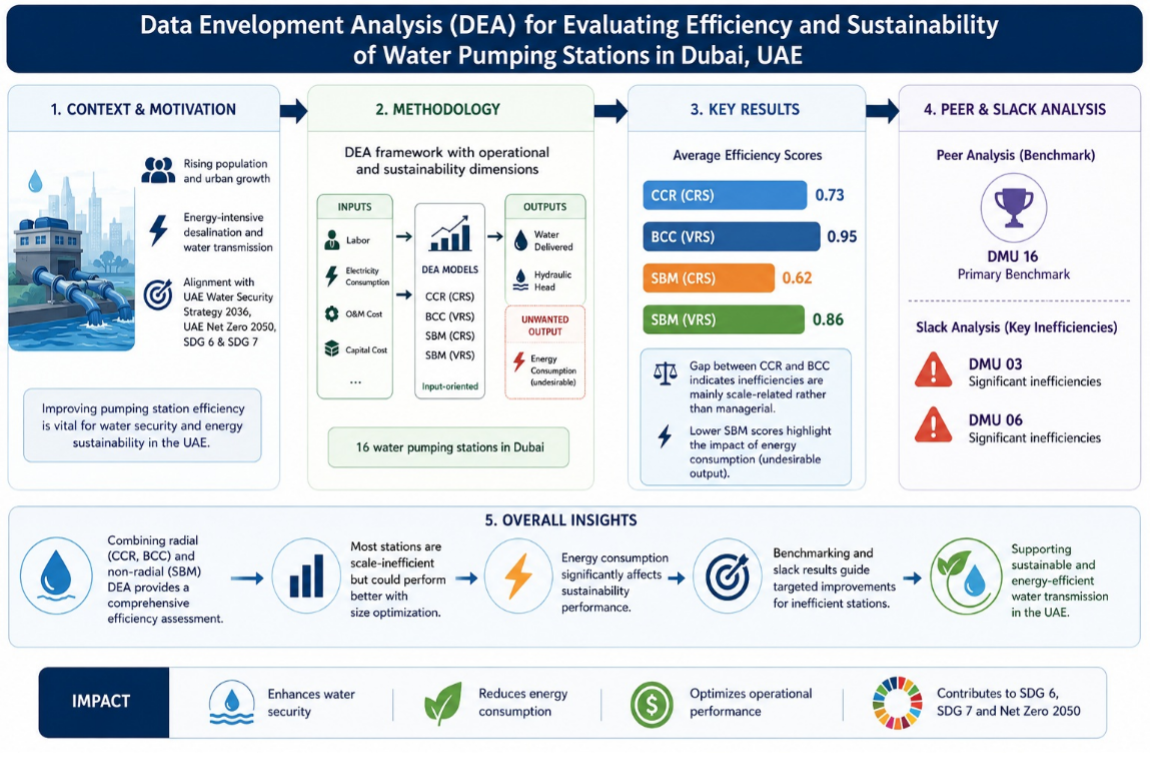
Efficiency Evaluation of Water Pumping Stations Using Data Envelopment Analysis: A Multi-Model Framework Incorporating Undesirable Outputs
Researcher: Dr. Dua Weraikat
Collaborator: Dewa, Rowdha Alblooshi
Water pumping stations are critical components of water transmission systems, particularly in the Gulf region, where potable water supply is heavily dependent on energy-intensive desalination processes. Despite their importance, pumping station efficiency is often assessed using single-dimensional indicators that fail to capture operational complexity, scale effects, and environmental impacts. This study develops a Data Envelopment Analysis (DEA) framework to evaluate the performance of 16 water pumping stations in Dubai, each treated as a decision-making unit (DMU), by incorporating both operational and sustainability dimensions. A multi-model approach was applied, integrating input-oriented Charnes, Cooper, and Rhodes (CCR) and Banker, Charnes, and Cooper (BCC) models with Slack-Based Measure (SBM) models that treat energy consumption as an undesirable output.
An Integrated Decision Support System (DSS) for Sustainable Supplier Selection, Evaluation, and Benchmarking Using a FIS Approach
Researcher: Dr. Dua Weraikat
Collaborator: Ghannam, S., Khan, S.,
Applications of sustainable supplier selection criteria in supply chain management (SCM) remain underdeveloped compared to other evaluation methods. This study focuses on three main dimensions of sustainable supplier performance: economic, environmental, and social criteria. The research aims to identify significant criteria within each dimension that are crucial for sustainable supplier selection process. These criteria will be utilized to develop a decision support system (DSS) that integrates a fuzzy inference system. The proposed model offers a holistic approach to supplier evaluation by considering economic performance, environmental impact and social responsibility. By incorporating these dimensions, the model ensures that the selection process aligns with broader corporate and environmental goals. The approach enables companies to make informed and sustainable decisions, ultimately contributing to a more resilient and responsible SCM. Furthermore, the fuzzy inference system effectively handles the inherent uncertainty and vagueness in supplier performance data. To enhance the robustness and reliability of the decision-making process, the proposed model can be integrated with multi-objective linear programming models, making it a valuable tool for supply chain managers. The findings of this work revealed that the economic criteria of supplier selection focus on quality, flexibility, cost, lead time, relationships, and technical capability. The environmental criteria include resource consumption, eco-design, recycling, emissions, and sustainability practices. The social criteria emphasize stakeholder involvement, staff training, safety, rights, and accident prevention in supplier selection. In summary, this comprehensive framework evaluates and benchmarks supplier sustainable performance, supporting more resilient and sustainable SCM.
Demand Forecasting with Real Case Analysis for Effective Retail Decision-Making
Researcher: Dr. Dua Weraikat
Collaborator: Safika Kabir, Caroline Zaidan, Moh’d Ishtiaq, Adolf Acyaqe
Supply chain decisions involve different entities and activities such as sourcing of material, production of goods, and logistics. Through the efficient management of these activities, firms can gain a competitive edge by beig responsive in maximizing customer value and enhance its efficiency by minimizing operating costs. Inadequate management results in poor replenishment processes which can, in turn, lead to lack of product availability in stores, lost sales, or oversupply of products, etc. Accurate demand forecasting plays a crucial role in reducing these problems by providing precise quantities required to order and store to satisfy the customer demands, reduce inventory and production costs, reduce safety stocks and transportation, and improve replenishment processes. However, demand forecasting for products, mainly perishable goods can be challenging for firms. Many companies, such as retailers, have struggles in accurately predicting future demand. Suppliers usually have a bulk shipment process that can cause inventory differences for the retailer's desires. Furthermore, without proper information sharing between a retailer and its suppliers, mismanagement of order quantities and production can occur. Recently, these problems are tackled through the adoption of collaboration models between supplier and retailer. More precisely, companies are encouraged to integrate inventory management models to order when required. The integrated model enhances the demand planning, inventory control and replenishment processes in the supply chain. Nonetheless, the investments in such methodologies are costly for both suppliers and retailers alike. Moreover, the benefits from implementing these models are not clear in monetary terms and are not widely discussed in the literature. This research aims to improve inventory management of a retailer located in the United Arab Emirates that is facing issues with its replenishment and forecasting processes. To achieve this purpose, forecasting models such as ARIMA, exponential smoothings and machine learning models such as Artificial Neural Networks (ANN) were built and tested for the highest accuracy. The results show that forecast models ARIMA and average of ARIMA and triple exponential smoothing achieve the best accuracy, i.e., the least forecasting error value. Implementing the forecast model needs coordination and collaboration between the supply chain entities. Therefore, collaborative planning, forecasting and replenishment collaborative, CPFR, was suggested for the retailer’s supply chain through a specific framework. Finally, the benefits of the collaboration framework in terms of transportation costs were displayed using discrete-event simulation. Several scenarios and parameters were tested. Adopting the CPFR collaborative framework could reduce the transportation cost for some retail items by 42% evident in the simulation.
AI-Driven Quality Monitoring for Additive Manufacturing
Researcher: Kosanoglu, F.
Collaborator: Pervaiz, S. (RIT Dubai) and Beyca, O. F. (Istanbul Technical University)
Our research explores the use of artificial intelligence, computer vision, and machine learning to enable real-time quality monitoring in extrusion-based additive manufacturing. We focus on detecting and predicting printing defects during the manufacturing process, with the goal of improving part quality, reducing material waste, and increasing process reliability. The research also investigates adaptive AI models that can generalize across different printers, materials, and operating conditions, supporting the development of intelligent and autonomous additive manufacturing systems.
A Fuzzy-AHP (FAHP)-based model for evaluating blockchain adoption in the UAE
Researcher: Dr. Karam Al-Assaf
Collaborator: Alshaikh, R., Aldoukhi, S., & Ndiaye, M.
Blockchain, a decentralized digital ledger, enables secure and traceable online transactions, fostering a shared economy and digital currencies while protecting user privacy. Governments worldwide, including Canada, Switzerland, and Denmark, are increasingly adopting blockchain technology to address inefficiencies and enhance operations. However, its adoption remains limited in some governmental sectors, underscoring the need to understand the factors influencing this process. This research identifies critical factors affecting the adoption of blockchain technology in government and private sectors across technological, environmental, and organizational domains. Utilizing Multi-Criteria Decision Making (MCDM) methods, the study reveals key determinants that influence adoption, providing valuable insights for policymakers and agencies to make informed decisions on implementing blockchain technology, thereby enhancing operational efficiency and security.
Customers' perception of residential photovoltaic solar projects in the UAE: A structural equation modelling approach
Researcher: Dr. Haneen Abuzaid
Collaborator: L. A. Moeilak, and A. Alzaatreh
Photovoltaic solar systems are widely used as a renewable energy resource worldwide due to the numerous negative impacts of the conventional-depleted energy resources. In the context of the Middle East, the United Arab Emirates has been a pioneer in regulating renewable energy and setting annual targets for the dependency on and market share of renewable energy and carbon dioxide emissions. The purpose of this paper is to define the main factors that affect customers' perception of photovoltaic solar projects for the residential sector as an alternative renewable source of electricity in the United Arab Emirates. Reliably collected responses were used to build a hypothetical model using confirmatory factor analysis and structural equation modeling. The findings showed that financial and environmental aspects are the main contributors to customers' perception in the United Arab Emirates. Furthermore, it was apparent that different nationalities in the United Arab Emirates have similar average perception of photovoltaic systems projects and finally, we suggest that perception may positively impact the intention towards adopting residential photovoltaic systems. These findings can be utilized by governmental related authorities, photovoltaic systems contractors, photovoltaic systems leasing companies, and energy consultants to enhance the perception of customers and increase the tendency to install such projects in the residential sector.
Ranking risk attitudes using an integrated AHP-TOPSIS approach
Researcher: Dr. Haneen Abuzaid
Collaborator: L. Obaid, D. Dalalah, S. Alhassani, F. Albastaki, and T. E. Khalil
Due to the ambiguity between risk attitudes, this study aims at ranking the different risk attitudes considering the factors that affect the behaviour of the decision-makers. Both the technique for order preference by similarity to ideal solution (TOPSIS) and analytical hierarchy process (AHP) are employed to address the characteristics of risk attitudes aiming to highlight the criteria significance and finally to rank the most impactful risk attitude. It was found that regret aversion and risk aversion attitudes have higher impact in real life decision-making problems. In contrast, the maximin and maximax risk attitudes have the lowest importance. Risk seeking and regret aversion attitudes demonstrated the highest importance using TOPSIS of equal-weights while the importance of loss aversion and regret aversion have the highest for the AHP-TOPSIS approach. The results of this study can be beneficial for decision-makers who encounter a variety of risk attitudes in their decision problems.
Driving towards Sustainability: A Neural Network-Based Prediction of the Traffic-Related Effects on Road Users in the UAE
Researcher: Dr. Haneen Abuzaid
Collaborator: R. Almashhour, and G. Abu-Lebdeh
Transportation is fundamental, granting access to goods, services, and economic opportunities. Ensuring sustainable transportation, especially in vehicular modes, is crucial for the pillars of social, economic, and environmental sustainability. High-traffic countries, like the United Arab Emirates (UAE), grapple with significant challenges to this end. This study delves into the repercussions of traffic-related incidents on UAE road users and their intricate links to the social and economic dimensions of sustainability. To achieve this, this work examines the influential demographic factors contributing to incidents, utilizing artificial neural network models to predict the likelihood of individuals experiencing traffic tickets and accidents. Findings reveal associations between gender, driving frequency, age, nationality, and reported incident frequency. Men experience more accidents and tickets than women. Age exhibits a negative linear relationship with incident occurrence, while driving experience shows a positive linear relationship. Nationalities and cultural backgrounds influence road users’ adherence to traffic rules. The predictive models in this study demonstrate their high accuracy, with 93.7% precision in predicting tickets and 95.8% in predicting accidents. These insights offer valuable information for stakeholders, including government entities, road users, contractors, and designers, contributing to the enhancement of the social and economic aspects of road sustainability.
A Structural Equation Modeling of Customer Attitudes towards Residential Solar Initiatives in Jordan
Researcher: Dr. Haneen Abuzaid
Collaborator: L. A. Moeilak, and A. Alzaatreh
Photovoltaic (PV) systems have gained global significance as a sustainable and renewable energy resource, playing a pivotal role in mitigating climate change and meeting growing energy demands. Like many other nations, Jordan recognizes the potential of PV systems and has been actively pursuing their adoption across various sectors, particularly in the residential sector. This paper aims to investigate the factors influencing residential customers' perceptions of PV systems and their intentions to adopt these systems in Jordan by identifying key determinants of perception and adoption and developing a comprehensive Structural Equation Model (SEM) to quantify the relationships between identified factors and their effect on the intention to adopt residential PV systems. A theoretical model was developed to achieve the study's objectives, employing confirmatory factor analysis and structural equation modeling. Data for this study was collected through a comprehensive survey targeting the residential segment. The findings indicate that social, technological, governmental, and financial factors positively and statistically significantly impact residential customers' perceptions of PV systems, fostering their intention to embrace this technology. Surprisingly, the environmental factor was deemed insignificant in influencing residential customers' decision-making processes. This research offers valuable insights to various stakeholders, including PV contractors, consultants, governmental entities, policy, and decision-makers. By understanding the key drivers and barriers shaping residential PV adoption, stakeholders can devise more effective strategies to promote sustainable energy practices, foster economic growth, and contribute to the global transition towards cleaner energy sources.
AI-Powered Smart Industrial Systems
Systematic Review of Machine Learning and Artificial Intelligence in Pharmaceutical Supply Chain (PSC) Resilience: Identifying Gaps and Future Research Directions
Researcher: Dr. Dua Weraikat
Collaborator: Alhourani, S.
The resilience of the pharmaceutical supply chain (PSC) is crucial to ensure the continuous availability of essential medicines and other products, particularly during logistics disruptions. This article presents a systematic review of the literature on machine learning (ML) and artificial intelligence (AI) techniques and their importance to PSC resilience. By analyzing existing literature from multiple databases, including Web of Science and IEEE Xplore, over the past five years, we identified key areas where ML and AI have been effectively utilized. These areas include demand forecasting, risk management, and inventory optimization. This review also highlights significant research gaps and proposes future directions for investigation. Our findings suggest that while ML and AI offer promising solutions for improving supply chain resilience, there is a need for more studies that integrate various ML and AI approaches into PSC.
Our analysis reveals that there are no clear government regulations related to the usage of ML or AI in PSC, no robust real-world applications addressing the challenges of adopting these technologies, and no clear predictive models to assess their impact on PSC resilience. This ongoing work aims to provide a foundation for future research, ultimately fostering more adaptive and resilient PSCs.
Transforming Service Quality in Healthcare: A Comprehensive Review of Healthcare 4.0 and Its Impact on Healthcare Service Quality
Researcher: Dr. Karam Al-Assaf
Collaborator: Bahroun, Z., & Ahmed, V.
This systematic review investigates the transformative impact of Healthcare 4.0 (HC4.0) technologies on healthcare service quality (HCSQ), focusing on their potential to enhance healthcare delivery while addressing critical challenges. This study reviewed 168 peer-reviewed articles from the Scopus database, published between 2005 and 2023. The selection process used clearly defined inclusion and exclusion criteria to identify studies focusing on advanced technologies such as artificial intelligence (AI), the Internet of Things (IoT), and big data analytics. Rayyan software facilitated systematic organization and duplicate removal, while manual evaluation ensured relevance and quality. The findings highlight HC4.0’s potential to improve service delivery, patient outcomes, and operational efficiencies but also reveal challenges, including interoperability, ethical concerns, and access disparities for underserved populations. The results were synthesized descriptively, uncovering key patterns and thematic insights while acknowledging heterogeneity across studies. Limitations include the absence of a formal risk-of-bias assessment and the diversity of methodologies, which precluded quantitative synthesis. This review emphasizes the need for future research on integration frameworks, ethical guidelines, and equitable access policies to realize HC4.0’s transformative potential. No external funding was received, and no formal protocol was registered.
The Relative Importance of Key Factors for Integrating Enterprise Resource Planning (ERP) Systems and Performance Management Practices in the UAE Healthcare Sector
Researcher: Dr. Karam Al-Assaf
Collaborator: Alzahmi, W., Alshaikh, R., Bahroun, Z., & Ahmed, V.
This study examines integrating Enterprise Resource Planning (ERP) systems with performance management (PM) practices in the UAE healthcare sector, identifying key factors for successful adoption. It addresses a critical gap by analyzing the interplay between ERP systems and PM to enhance operational efficiency, patient care, and administrative processes. A literature review identified thirty-six critical factors, refined through expert interviews to highlight nine weak integration areas and two new factors. An online survey with 81 experts, who rated the 38 factors on a five-point Likert scale, provided data to calculate the Relative Importance Index (RII). The results reveal that employee involvement in performance metrics and effective organizational measures significantly impact system effectiveness and alignment. Mid-tier factors such as leadership and managerial support are essential for integration momentum, while foundational elements like infrastructure, scalability, security, and compliance are crucial for long-term success. The study recommends a holistic approach to these factors to maximize ERP benefits, offering insights for healthcare administrators and policymakers. Additionally, it highlights the need to address the challenges, opportunities, and ethical considerations associated with using digital health technology in healthcare. Future research should explore ERP integration challenges in public and private healthcare settings, tailoring systems to specific organizational needs.
Enhancing Healthcare Service Quality in the Era of Healthcare 4.0: A UAE Perspective
Researcher: Dr. Karam Al-Assaf
Collaborator: Ahmed, V., & Bahroun, Z.
The integration of digital technologies is fundamentally transforming how healthcare service quality is delivered, assessed, and improved. Yet, existing evaluation frameworks often fall short in capturing the complexities introduced by technological advancements. This study investigates the evolving concept of Healthcare Service Quality (HCSQ) within the context of digital integration, drawing on expert perspectives from the healthcare sector in the United Arab Emirates (UAE). Using thematic analysis of semi-structured interviews, the study identifies key dimensions, influencing factors, and representative Key Performance Indicators (KPIs) that reflect the dual need to maintain traditional quality principles while embracing emerging digital imperatives. The findings highlight critical gaps in conventional service quality models and propose the foundations for a more comprehensive, technology-integrated approach to evaluating healthcare quality. This work contributes to advancing the understanding of HCSQ in digitally enabled healthcare systems and provides a basis for future model development and strategic quality improvement initiatives.
Predictive Modelling of Photovoltaic System Cleaning Schedules Using Machine Learning Techniques
Researcher: Dr. Haneen Abuzaid
Collaborator: M Awad, A Shamayleh, H Alshraideh
Photovoltaic (PV) solar systems are a key contributor to sustainable energy generation, but their performance is significantly reduced by dust accumulation, highlighting the need for proper cleaning. This study develops predictive models to optimize cleaning schedules by forecasting the Performance Ratio (PR), a standardized metric essential to performance-guaranteed contracts. The first model uses time-series approaches (LSTM, ARIMA, SARIMAX) to predict PR, while the second uses a threshold-based ensemble voting classifier (RF, Logistic Regression, GBM) to predict cleaning needs. Two large datasets from case studies in the UAE and Jordan were used for validation. Results show SARIMAX outperforming other models, with R2 values of 93.36 % and 91.74 %. The cleaning classification model achieved accuracies of 91 % and 88 % in the respective case studies. The PR prediction models outperformed the cleaning classification models in terms of accuracy. The study also identified location-specific factors influencing PV system performance, emphasizing the need for geographically tailored maintenance strategies. This research provides valuable insights for improving the efficiency and sustainability of PV systems.
Advanced Optimization of Photovoltaic Systems Using Response Surface Techniques (RSM)
Researcher: Dr. Haneen Abuzaid
Collaborator: M. Hamdan, N. Khlaifat, A. Sakhrieh, M. Arafeh
This work includes an analysis of experimental results obtained for a 2 kW grid-connected photovoltaic system mounted on an adjustable sun tracker system. A suitable optimization model is exploited to determine the optimal factors' settings that maximize the performance of a photovoltaic system in the lowest productive period in the year concerning solar irradiance (W/m2 ). This system was installed at Philadelphia Solar Ltd. in Amman-Jordan. Response surface methodology was the optimization model employed in this study, and it was applied for multiple responses of interest. These responses were the input current and the input voltage; these responses were assumed to be affected by the tilt angle and the azimuth angle. It was found that the optimal tilt angle was 35°, and the optimal azimuth angle was 0°. These installation settings ensured their validity when used in periods with the worst environmental conditions in Jordan. The efficiency of the photovoltaic station can be increased by 10% in this period by operating the station using these settings, where the current value is 7.9197 A and the voltage value is 225.451 V.
A Machine Learning-Based Prediction Of Photovoltaic Output Power Using Utility-Scale PV Power Plant
Researcher: Dr. Haneen Abuzaid
Collaborator: M. Awad, and A. Shamayleh