11,950,304
Direct Server-to-Server Wireless Data Center Network and Method Thereof
Patent Number
Issue Date
Inventor(s)
Amlan Ganguly; Minseok Kwon; Andres Kwasinski; Sayed Ashraf Mamun; Sree Gowrishankar Umamaheswaran
Licensed/Under Negotiation
Document
Download PDF for patent 11,950,304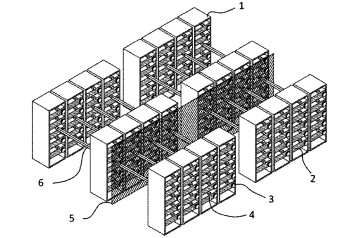
Synopsis
Patent US 11,950,304 B2 describes a server-to-server wireless data center network and a method for transmitting data within it, focusing on obstruction-avoidance routing. The invention addresses the increasing power consumption and physical limitations of traditional wired data centers by proposing a wireless alternative utilizing millimeter-wave (mmWave) or sub-THz wireless links. This system aims to improve efficiency and scalability in data center operations.
A key novel aspect of this patent is the use of directional transmitters and receivers within the data center, which can establish direct communication links between servers across different racks and planes. This design contrasts with traditional architectures that rely on tree-like hierarchies of switches and routers, which consume significant power and have inherent physical limitations as data volume increases. The wireless approach allows for more flexible and efficient routing paths, as it avoids the need for data to traverse multiple intermediate switches.
The patent also introduces an adaptive routing mechanism that incorporates obstruction-avoidance. This is particularly important in a dense wireless environment where servers, racks, and other equipment can act as physical obstructions. The routing algorithm can detect obstructions in horizontal communication paths and then re-route the flow in a 3-hop manner using vertical-first routing. This adaptive rerouting ensures reliable data transmission even in dynamic data center layouts. The ability to establish direct server-to-server communication, combined with obstruction-avoidance, significantly reduces latency and improves bandwidth utilization compared to conventional wired networks.
The commercial potential of this invention lies in its ability to offer a more scalable, energy-efficient, and high-performance solution for data centers. As data demands continue to grow, the power consumption and physical footprint of traditional wired data centers are becoming increasingly problematic. This wireless approach could lead to significant reductions in operational costs due to lower power consumption and simplified infrastructure. The flexibility of a wireless network could also enable more dynamic and reconfigurable data center layouts, allowing for easier expansion and adaptation to changing needs.
Potential applications extend beyond traditional enterprise data centers. The technology could be highly valuable for cloud computing providers, who require massive and highly efficient data processing capabilities. Furthermore, specialized applications such as high-performance computing (HPC) and artificial intelligence (AI) clusters, which demand extremely low latency and high bandwidth, could greatly benefit from this wireless architecture. The patent's focus on mmWave and sub-THz frequencies also positions it to leverage future advancements in wireless communication technologies, potentially offering even higher data rates and improved spectral efficiency. This could lead to a paradigm shift in data center design, enabling more agile and powerful computing infrastructures.