RIT part of NSF-funded Quantum Leap Challenge Institute
Professor Ben Zwickl is co-PI on $37.5 million grant
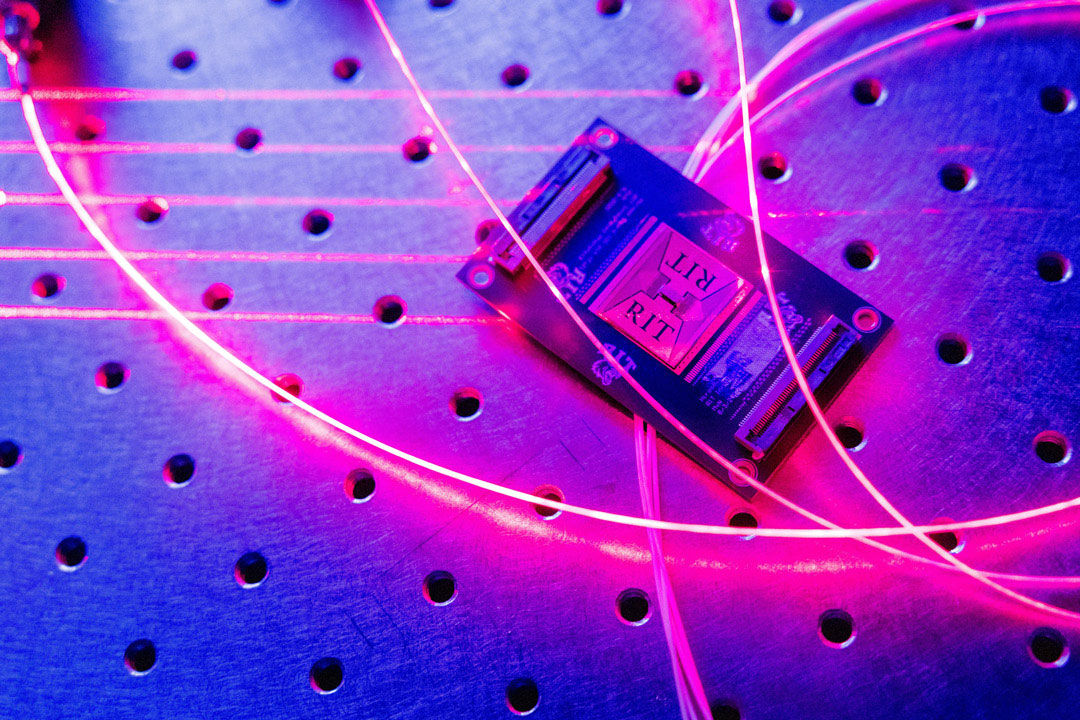
Carlos Ortiz/RIT
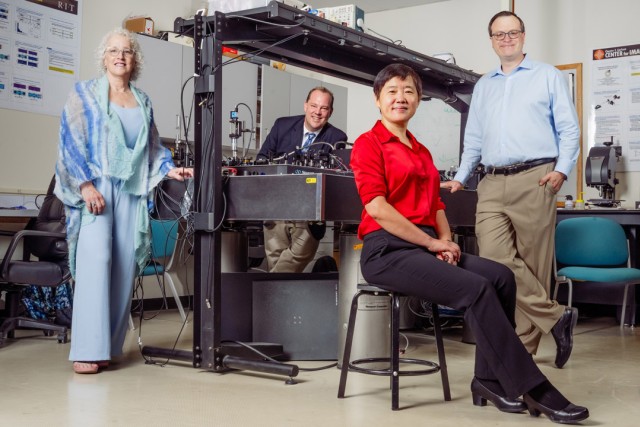
RIT is part of a $37.5 million NSF Quantum Leap Challenge Institute that aims to advance quantum computing error-correction and build quantum education and workforce development.
Rochester Institute of Technology is building its eminence in quantum research as part of a $37.5 million National Science Foundation (NSF) award for large-scale interdisciplinary research projects known as Quantum Leap Challenge Institutes.
The goal of the project, led by Yale University, is to advance the science and engineering of practical quantum error by creating a community of physicists, engineers, computer scientists, and chemists who contribute to the realization of large-scale, error-corrected quantum hardware. Called the NSF Quantum Leap Challenge Institute for Physics and Engineering of Practical Quantum Error Correction (NSF PRACTIQAL), the grant is one of eight awarded to large-scale interdisciplinary research centers. Along with RIT, co-PIs come from Virginia Tech and University of California San Diego.

Professor Ben Zwickl
RIT’s involvement will focus on education and workforce development, led by Ben Zwickl, professor of physics. Zwickl and his team will manage center-wide professional development for undergraduates, graduate students, postdocs, and faculty; manage exchange programs within the center; and conduct education research and lead curriculum development related to the quantum error correction and the societal benefits of quantum technology.
“I’m excited to work with such an outstanding team of scientists and engineers at Yale, Virginia Tech, and elsewhere,” said Zwickl. “Our work at RIT will help take their advanced ideas about quantum error correction and make them accessible for a wide range of learners. We also want to shift the dialog around quantum education to include the people and communities impacted by the practical quantum technologies envisioned by PRACTIQAL. The QLCI will support the expansion of our minor in quantum information science and technology to include a new hands-on interdisciplinary quantum technology laboratory course, as well as provide support for undergraduate, graduate, and postdoctoral researchers.”
Zwickl has conducted extensive research in quantum education and the workforce, backed by previous funding from the NSF and Department of Defense. He is also an adviser for RIT’s interdisciplinary minor in quantum information science and technology, which has grown continuously since its launch in the fall of 2022. RIT added a general education immersion in quantum information science and technology that started fall 2026.
Building the education and future workforce for quantum technology is a vital part in pushing the emerging technology forward. Quantum computing holds the promise of solving a range of problems that are nearly impossible for classical computers. Potential applications in materials science, drug design, and more could enhance quality of life and drive economic growth.
Through NSF PRACTIQAL, Zwickl and his team will receive support over the next five years to train the next generation of quantum scientists.
The NSF has invested $290 million in the eight Quantum Leap Challenge Institutes, led by Harvard University, University of Illinois, Princeton University, Yale University, University of California-Berkeley, University of Chicago, University of Colorado, and University of Maryland.
For more information on the NSF Quantum Leap Challenge Institutes, visit the NSF website.
Quantum across RIT
Along with Ben Zwickl, RIT researchers are pushing quantum technology forward.
- Stefan Preble, professor of microsystems engineering, helped establish the first quantum communication network centered on quantum photonic chips.
- Sonia Lopez Alarcon, professor in computer engineering, is working on quantum computing. She is using her previous experience as a visiting NASA scholar to develop core computing functions like routing.
- Hanif Rahbari, associate professor of cybersecurity, is researching connected vehicles and how to keep systems safe during the transition from classical cryptography to post-quantum crypto.