Research Project
Examining critical processes in physics graduate education
Principal Investigator(s)
Casey Miller (School of Chemistry and Materials Science), Ben Zwickl
Research Team Members
Grad students:
Mike Verostek
Collaborators:
Lindsey Owens, Julie Posselt, Theodore Hodapp, Rachel Silvestrini
Funding
Graduate Admissions:
NSF Award HRD-1834516 (September 1, 2018)
Finding a PhD Advisor:
NSF Award HRD-1834516 (September 1, 2018)
Graduate Retention:
NSF-NRT 1633275 (September 15, 2016)
Project Description
Impact
Departmental practices for admitting and retaining students at the graduate level fundamentally determine who is allowed to shape the future of physics research. Assuring that the path to a physics PhD is inclusive and equitable for students of all backgrounds is therefore critical. Despite the vital importance of graduate education, physics education research has traditionally focused most strongly on improving the experiences of undergraduates, leaving education at the graduate level relatively understudied. Questions surrounding the equitability of standard physics PhD admissions criteria abound, and high attrition rates represent an ongoing problem. Current data indicates that the retention rate of physics PhD students is approximately 60%, with attrition from PhD programs disproportionately affecting traditionally underrepresented students. Our group has worked to fill several gaps in the physics education literature by focusing on how physics graduate students are admitted into graduate programs, and how they navigate the PhD process once they arrive.
Our group has focused on better understanding three main aspects of graduate education:
- Graduate admissions practices in physics and the efficacy of different metrics in predicting PhD completion
- Characterizing the process by which physics PhD students find research groups
- Understanding factors contributing to physics graduate students leaving their programs
Graduate Admissions
Funding: NSF Award HRD-1834516 (September 1, 2018)
Our group has conducted two large quantitative studies to examine the efficacy of traditional physics graduate admissions metrics, including undergraduate grades and GRE general and subject scores, in predicting various graduate school outcomes. Although GRE scores are among the numeric metrics that best predict admission into U.S. graduate programs, there are significant disparities in typical GRE performance between students of different demographic backgrounds. Combined with the fact that physics remains one of the least diverse of all the STEM fields, the prospect that GRE tests limit the ability of certain students to enter graduate school has led researchers to question the utility of GRE exam scores in the graduate admissions process. This issue is particularly important particularly in the wake of the COVID-19 pandemic, as physics departments are considering eliminating GRE scores from their admissions processes more strongly than ever.
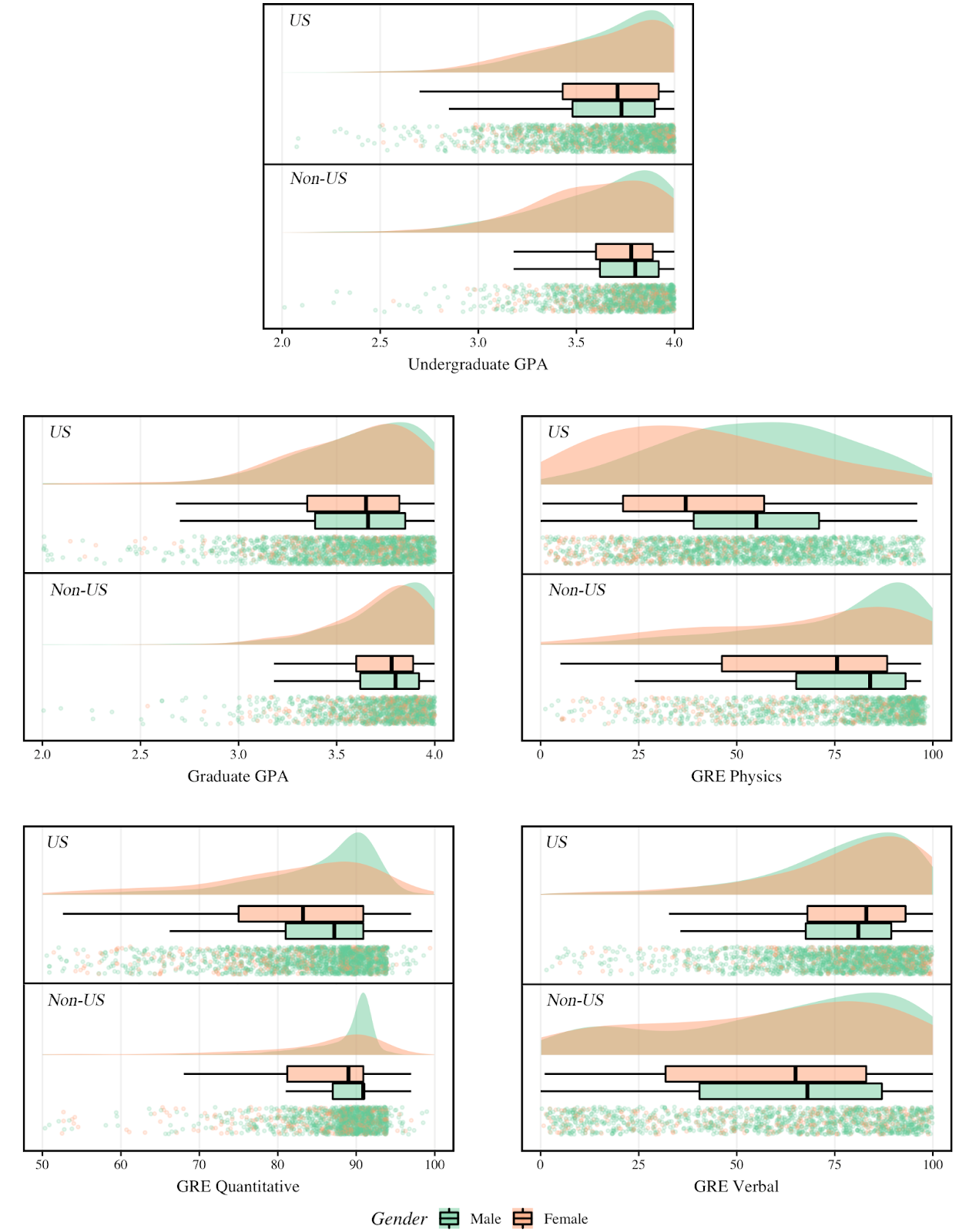
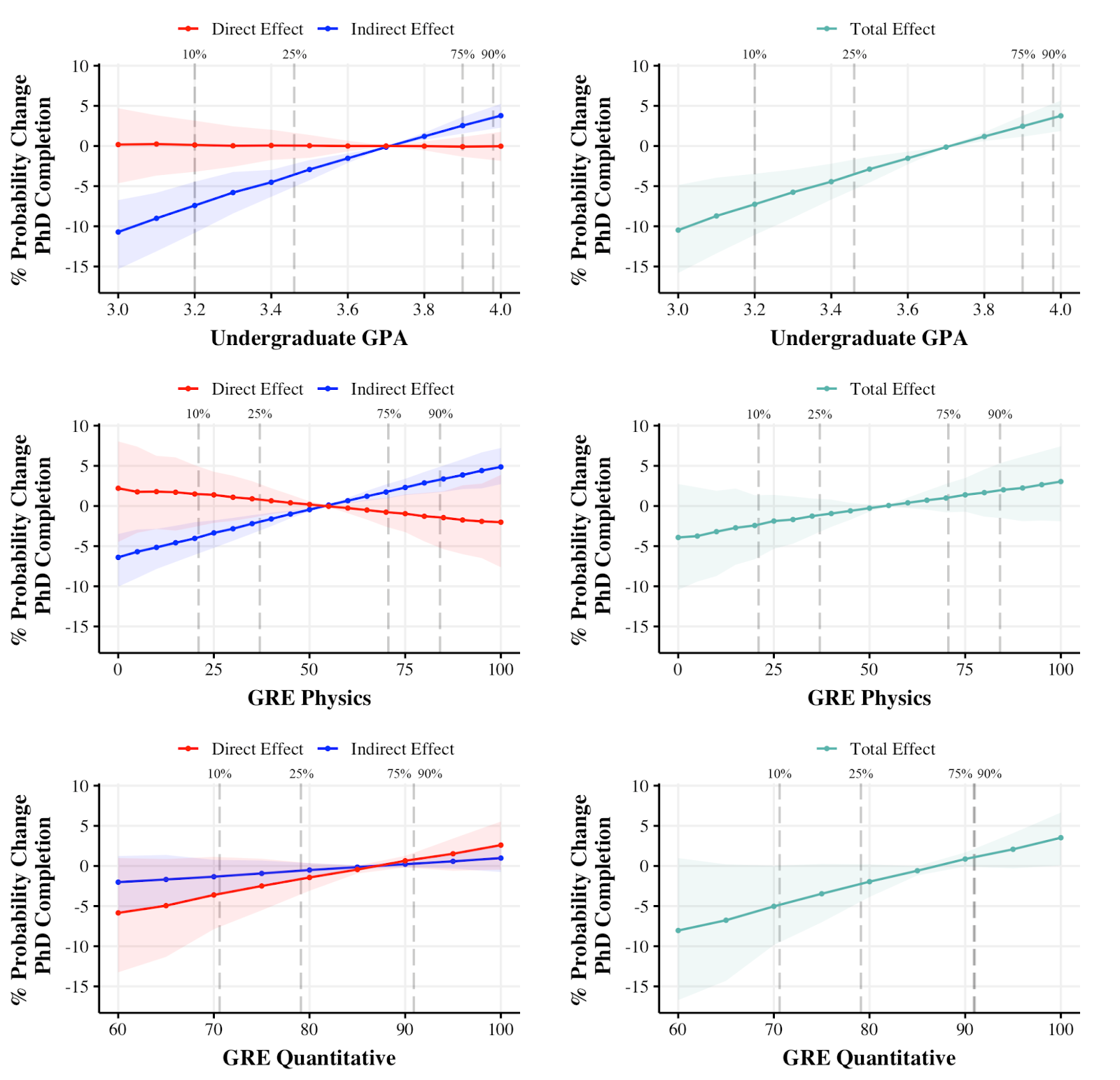
Our first study, led by Casey Miller and Ben Zwickl in collaboration with Julie Posselt of USC, Rachel Silvestrini of RIT, and Theodore Hodapp of the American Physical Society, primarily examined whether typical admissions criteria predict PhD completion. A follow-up study led by Mike Verostek, Ben Zwickl, and Casey Miller analyzed whether those same admissions metrics predict graduate grades, and extended the first analysis by examining the role that graduate grades play in predicting PhD completion. Taken together, this research indicates that GRE physics score is not a statistically significant predictor of PhD completion. Meanwhile, undergraduate grades were statistically significant predictors of completion. Both were significant predictors of graduate course grades, but the effect was small. Thus, the primary takeaway from our work is that traditional metrics used in graduate admission do little to predict important outcomes in graduate school. Identifying a broader set of applicant characteristics that predict graduate student outcomes is therefore essential, and represents an exciting avenue for future research.
Finding a PhD advisor
Funding: NSF Award HRD-1834516 (September 1, 2018)
Led by Mike Verostek, Ben Zwickl, and Casey Miller, this ongoing project is focused on characterizing the process by which physics PhD students find a research group. Previous studies on graduate attrition indicate that a negative advising relationship is a key factor that motivates students to leave. Currently, most research on graduate advising relationships has been geared toward identifying which qualities are indicative of productive or unproductive mentorships. Existing studies generally do not examine the process by which these relationships form, despite the fact that finding an advisor is often cited as a crucial decision for PhD students to make. PhD students often find navigating their first year of study to be difficult, and if the group search process is difficult for students to navigate, they may be less likely to find a group that provides them with a fulfilling research experience. Gaining a better understanding of how students go about finding their PhD advisor may therefore provide key insights into improving attrition rates and overall student satisfaction.
Our overarching research question for this project is, “How do physics PhD students experience the process of seeking and finding a research group?”
- What characteristics do students value in prospective research groups?
- What actions, particularly regarding information gathering, occur during this process?
- Which parts of the process are difficult, and how do students overcome these difficulties?
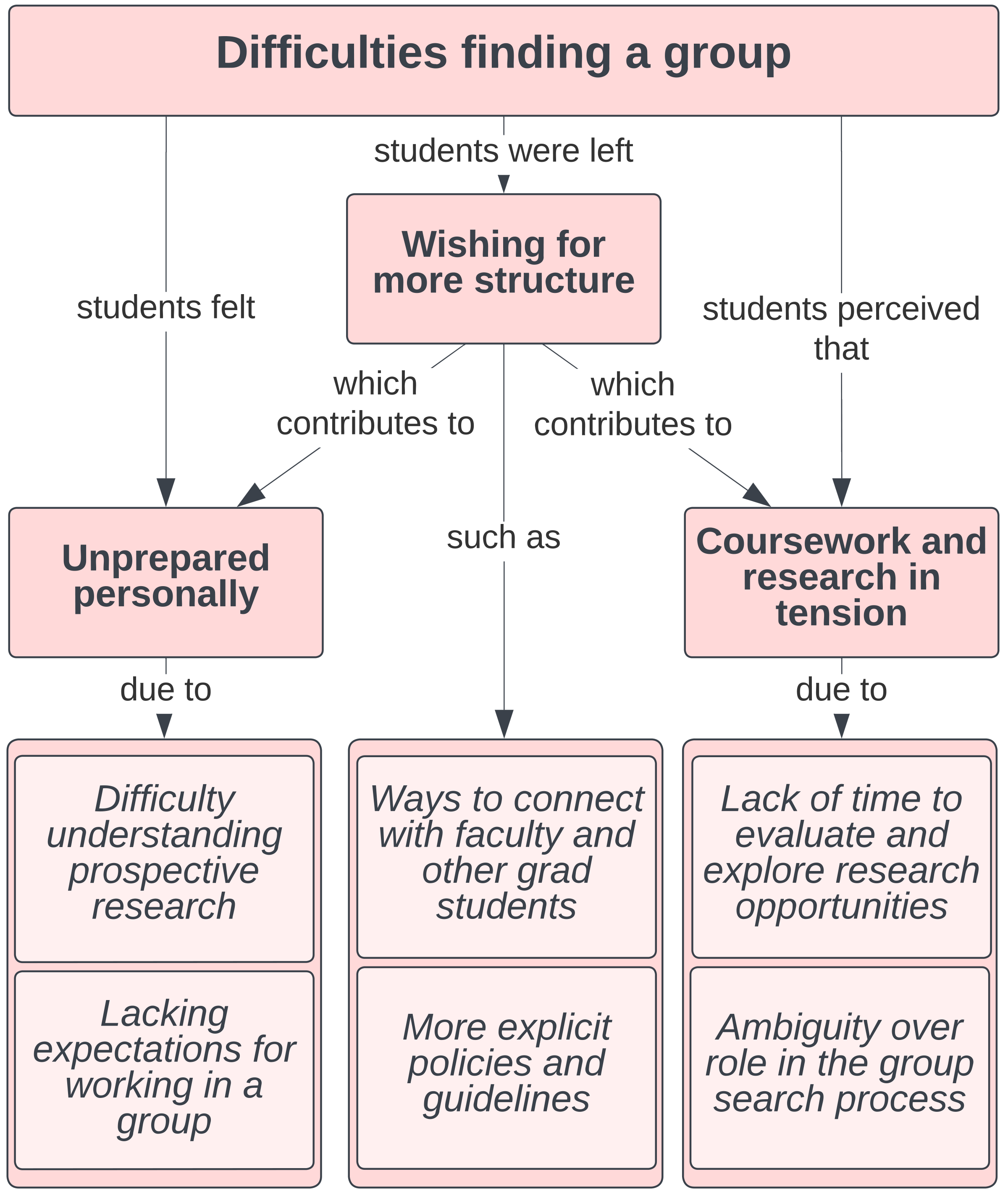
To address these questions, we conducted 40 interviews with first and second year graduate students from physics departments across the country. The first study resulting from this data collection, "Physics Ph.D. student perspectives on the importance and difficulty of finding a research group" was featured in Physics Magazine and was an Editors' Suggestion in Physical Review Physics Education Research. This work showed that incoming physics graduate students see joining a research group as a significant decision that can affect their ability to complete the program. Moreover, we found that struggling to find a group can lead to feelings of isolation and concern about falling behind their peers, whereas students who were able to quickly immerse themselves in a positive group environment reported an increased sense of belonging. Despite the importance of timely integration into a research group, we found that many students felt unprepared to navigate the advisor selection process. Difficulties included an overall lack of guidance from their departments and a lack of time to look for a group due to their coursework. Our findings suggest that departmental reforms aimed at better supporting students looking for research groups could help improve retention as well as improve students' overall satisfaction in their graduate programs.
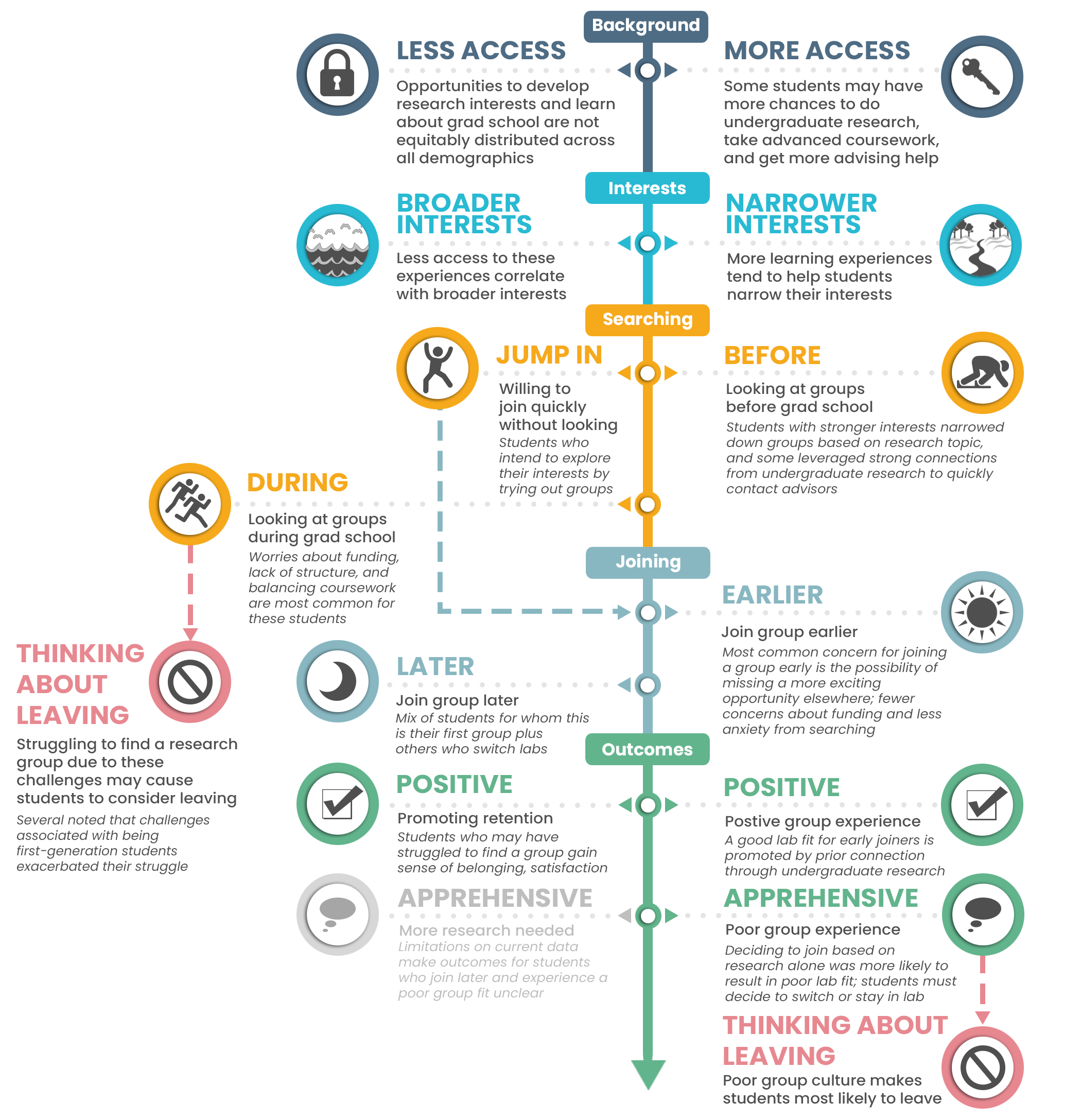
In a follow-up study, we explored how students' prior research experiences and level of interest certainty affect when and how they find research groups in graduate school. Our analysis resulted in a model describing the characteristic pathways that physics Ph.D. students take while evaluating the interest congruence of prospective research groups. We found that students who had stronger research interests upon entering graduate school were more likely to join a research group sooner, while students with broader interests took longer to find groups and tended to encounter more challenges along the way. For some, these difficulties led to more anxiety and a lower sense of belonging in the program. Critically, students' access to opportunities for undergraduate research, advanced coursework, and early advisor contact were found to help students narrow their interests and evaluate their group fit earlier. However, such opportunities are not always available to students depending on their background. This can lead to disparities in who persists in their graduate studies, and emphasizes the importance of developing support structures to level the playing field and allow students of all backgrounds to engage with research early and find the right fit.
Graduate Retention
Funding: NSF-NRT 1633275 (September 15, 2016)
Improving diversity, equity, and inclusion in physics graduate programs will require addressing a broad set of factors affecting graduate student retention. To this end, better understanding the factors contributing to attrition within physics graduate programs is essential in order to suggest constructive changes. Led by Lindsay Owens, Ben Zwickl, and Casey Miller, and in collaboration with Kelli Shar of the University of Tampa, this project sought to answer the question of “Why do physics graduate students leave their programs?”
Our team conducted semi-structured interviews with 17 faculty from four different institutions and 69 graduate students from 23 institutions, and asked interviewees why physics and astronomy graduate students leave their programs. Faculty and student responses differed in that faculty attributed leaving to students’ academic deficiencies, noncognitive deficiencies, and systemic reasons, while students most frequently explained leaving in terms of cultural and systemic issues that impacted their sense of belonging in the program. Students also reported personal non-academic reasons for leaving. We also found that many of the reasons that negatively impacted students were experienced disproportionately by women and other traditionally underrepresented groups in physics. Thus, the results of this study help to shed light on the underlying mechanisms behind the alarming levels of attrition in physics graduate programs.
Publications
- Verostek, M., Miller, C. W., & Zwickl, B.M. (2024). Modeling when and how physics Ph.D. students search for a research group: The role of interests and prior research experiences in timely group integration. Physical Review Physics Education Research, 20(2), 020119. https://doi.org/10.1103/PhysRevPhysEducRes.20.020119
- Verostek, M., Miller, C. W., & Zwickl, B. M. (2024). "It was awkward to leave, and I wish it wasn't": Physics PhD students' perceptions about switching research groups. Paper presented at Physics Education Research Conference 2023, Boston, MA. https://doi.org/10.1119/perc.2024.pr.Verostek
- Verostek, M., Miller, C. W., & Zwickl, B. M. (2023). Physics Ph.D. student perspectives on the importance and difficulty of finding a research group. Physical Review Physics Education Research, 20(1), 010136. https://doi.org/10.1103/PhysRevPhysEducRes.20.010136
- Verostek, M., Miller, C. W., & Zwickl, B. M. (2023). Inequities and misaligned expectations in PhD students' search for a research group. Paper presented at Physics Education Research Conference 2023, Sacramento, CA. https://doi.org/10.1119/perc.2023.pr.Verostek
- Verostek, M., Miller, C. W., & Zwickl, B. (2021). Analyzing admissions metrics as predictors of graduate GPA and whether graduate GPA mediates Ph. D. completion. Physical Review Physics Education Research, 17(2), 020115. https://doi.org/10.1103/PhysRevPhysEducRes.17.020115
- Verostek, M., Miller, C., & Zwickl, B. (2021, August 4-5). Time to PhD completion is no different between men and women despite score gap on physics GRE. Paper presented at Physics Education Research Conference 2021, Virtual Conference. https://doi.org/10.1119/perc.2021.pr.Verostek
- Miller, C. W., Zwickl, B. M., Posselt, J. R., Silvestrini, R. T., & Hodapp, T. (2019). Typical physics Ph. D. admissions criteria limit access to underrepresented groups but fail to predict doctoral completion. Science Advances, 5(1), eaat7550. https://doi.org/10.1126/sciadv.aat7550
- Owens, L., Zwickl, B., Franklin, S., & Miller, C. (2018, August 1-2). Misaligned Visions for Improving Graduate Diversity: Student Characteristics vs. Systemic/Cultural Factors. Paper presented at Physics Education Research Conference 2018, Washington, DC. https://doi.org/10.1119/perc.2018.pr.Owens