Home Page

RAMLab
Lab News
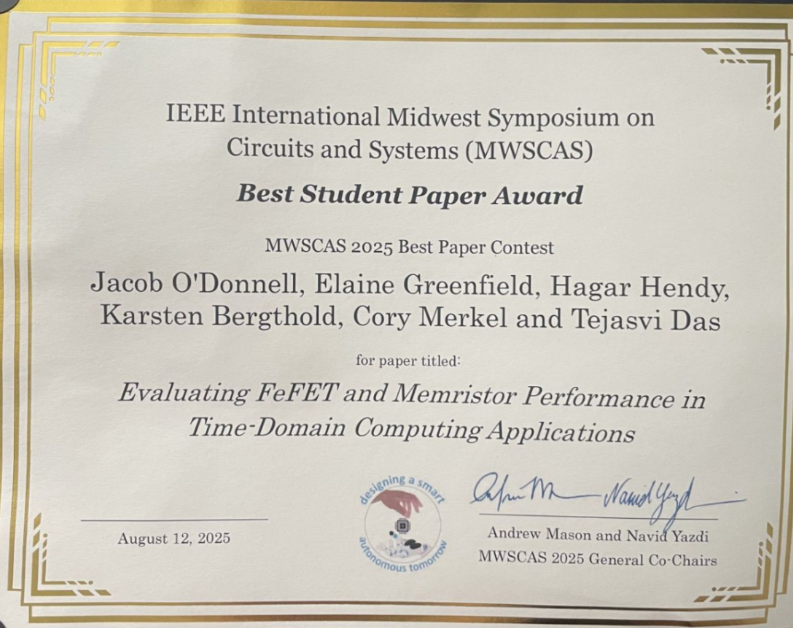
RAMLab wins Best Student Paper Award at MWSCAS
Congratulations to Jacob O'Donnell and co-authors Elaine Greenfield, Hagar Hendy, and Karsten Bergthold on receiving the Best Student Paper award at MWSCAS!
Their paper, a collaboration between RAMLab and Brain Lab, explores the use of FeFETs in time-domain computing, advancing the frontiers of neuromorphic and emerging memory research. We are proud to celebrate this achievement and the impact of our students and collaborators on cutting-edge technology.
Read More About RAMLab wins Best Student Paper Award at MWSCAS
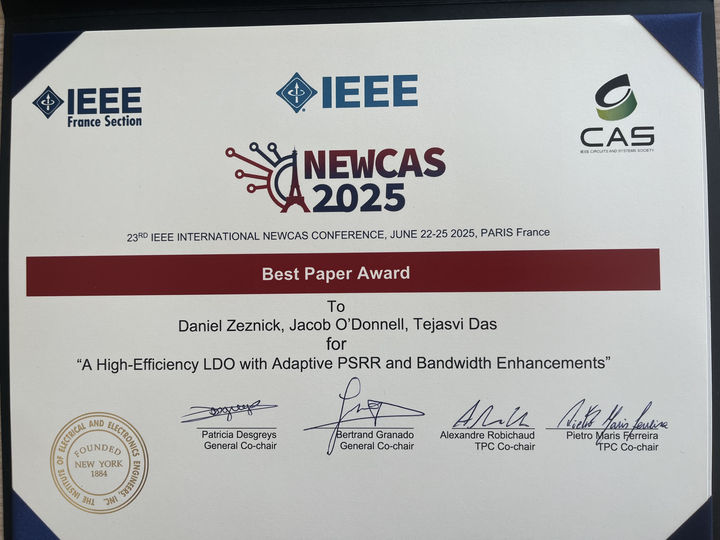
NEWCAS 2025 Best Paper Award
"A High-Efficiency LDO with Adaptive PSRR and Bandwidth Enhancements" by Daniel Zeznick, Jacob O'Donnell, and Tejasvi Das was named the best paper for the 23rd IEEE international NEWCAS conference.
New Publication in TCAS II on Optimizing Time-Domain Neuromorphic Computing
We’re excited to share our latest work, published in IEEE Transactions on Circuits and Systems II (TCAS II), which explores optimizing time-domain neuromorphic computing for higher throughput. This research is a collaborative effort by students Karsten Bergthold, Hagar Hossam, and Elaine Greenfield, alongside faculty members Tejasvi Das and Cory Merkel.
The paper, titled "Enabling Long Chain Lengths and High Throughput for Time-Domain Neuromorphic Computing," presents new methods to enhance performance in this emerging field.
New project on Neuromorphic Computing (funded by Dept. of Energy)
Exciting new research led by KGCOE faculty members Cory Merkel (associate professor in computer engineering) and Tejasvi Das (associate professor in electrical and microelectronic engineering) aims to revolutionize neuromorphic computing by designing AI systems that closely emulate the complexity of the biological nervous system.
Read More About New project on Neuromorphic Computing (funded by Dept. of Energy)