Home Page


Expanding and exploring the frontiers of science and mathematics.
Get started by exploring our Areas of Study
We prepare the next generation of problem solvers to discover and innovate solutions for the future.
The College of Science promotes novel ways of thinking and implementation in a rapidly changing world.
We provide our scholars with hands-on experience, cross/multi-disciplinary research, and faculty and staff mentors who not only educate but inspire our scholars.
Daily Tours and Information Sessions
Visit campus six days a week or explore other ways to experience RIT.

Faces of RIT
-
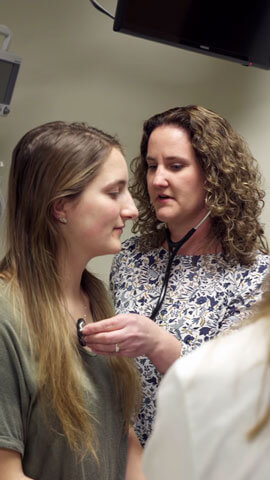
![Jennifer Wheeler, M.D.]()
Giving Back
Jennifer Wheeler, M.D. BS ’01BiotechnologyFamily MedicineAfter 9/11, Wheeler enlisted in the US Army and served as a doctor in Afghanistan. Now, she practices family medicine and serves as a preceptor to RIT students who are embarking on their own careers in medicine.
-
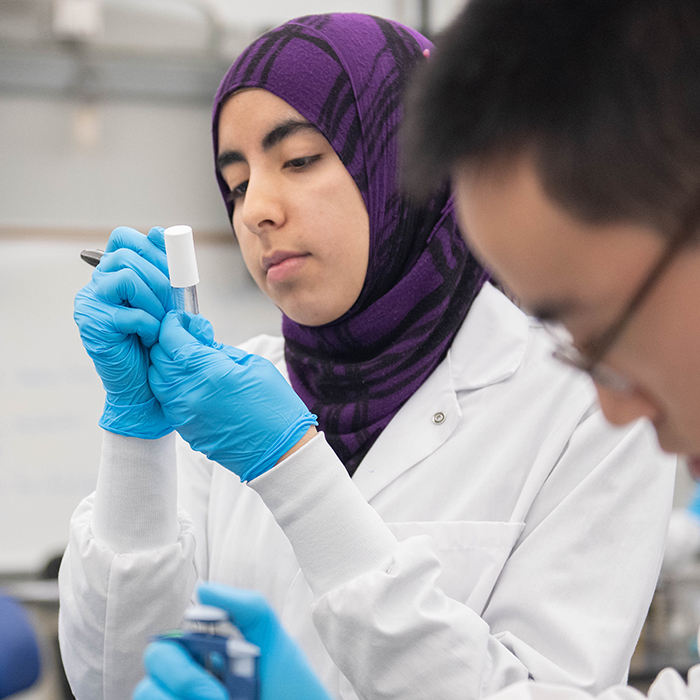
![Nicole Pannullo working in a chemistry lab.]()
Medicine's Future
Nicole PannulloBiochemistryBy working on a faculty-guided research project, Pannullo has gained hands-on research experience to pursue a future in regenerative medicine. It’s one way Pannullo is putting experiential learning to work.
-
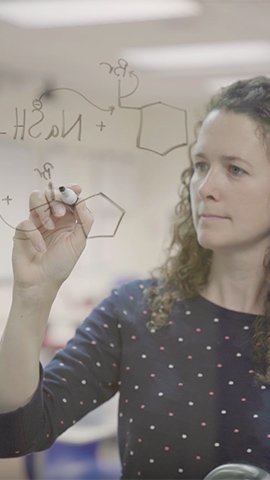
![Professor Tina Goudreau Collison writing a chemistry formula.]()
Expanding ASL
Tina Goudreau CollisonProfessor of ChemistryA complicated vocabulary and a lack of dedicated signs in American Sign Language makes Organic Chemistry a challenge for deaf and hard of hearing students. Collision worked with interpreters to develop new ASL signs, leading to profound learning improvements for her students.
-
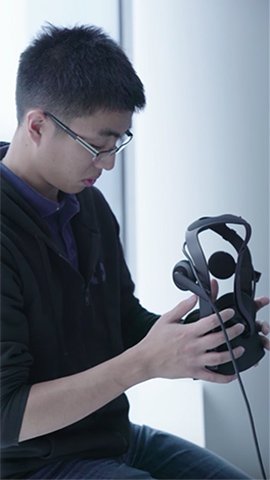
![Kevin Kha using a VR headset.]()
Enhancing Reality
Kevin KhaImaging ScienceKha interned with Oculus testing their next generation of VR cameras, which have the potential to aid law enforcement and impact learning in schools. The internship turned into a full-time job, and Kha plans to work on enhancing the VR experience.
-
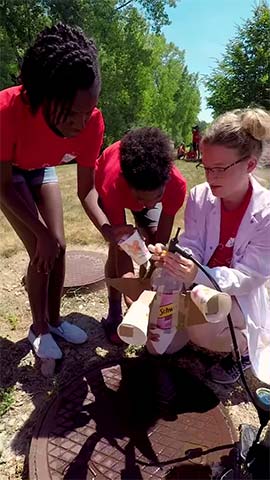
![Devon Christman conducting a science experiment with some kids.]()
Connecting Kids to Science
Devon M ChristmanPhysicsOver the summer, Christman taught a workshop called “Experiments in Science” to a group of children from RIT’s Kids on Campus program. By helping to change their perspectives on who and what a scientist is, Christman is shaping the minds of tomorrow’s scientists.
Latest News
-
June 12, 2024
![the cover of a paper titled High-Dimensional quantum entanglement on a chip is shown.]()
Ph.D. student is lead author on paper published on cover of 'Optica Quantum'
Microsystems engineering Ph.D. student Evan Manfreda-Schulz ’20 (physics) accomplished something many academic researchers aim for when his first paper was published on the cover of Optica Quantum.
-
June 7, 2024
![a tomato is shown covered in microplastics]()
How to Minimize Your Exposure to Microplastics
The New York Times talks to Christy Tyler, professor in the Thomas H. Gosnell School of Life Sciences, about how to reduce microplastics in your food and indoors.
-
June 5, 2024
![the aurora borealis is shown with green and purple lights.]()
Aurora Borealis Could Be Visible in the US Tonight, Thanks to Slamming of Coronal Mass Ejection Onto Earth
The Science Times speaks to Professor Emeritus Roger Dube about the strength of solar storms.
-
May 20, 2024
![porus media is shown as rocks and red jelly like substance bubbles.]()
RIT research examines spread and flow of soil contaminants
Understanding how contaminants in porous materials flow and are transported is key in the fields of industry, medicine, and environmental science. A two person team in the School of Physics and Astronomy recently had their research on the topic published and featured on the cover of Soft Matter, a journal by the Royal Society of Chemistry.


