Cross-disciplinary collaborations lead to growth for double-major students
Alumni support enables computer science and economics double major students to present research
Provided
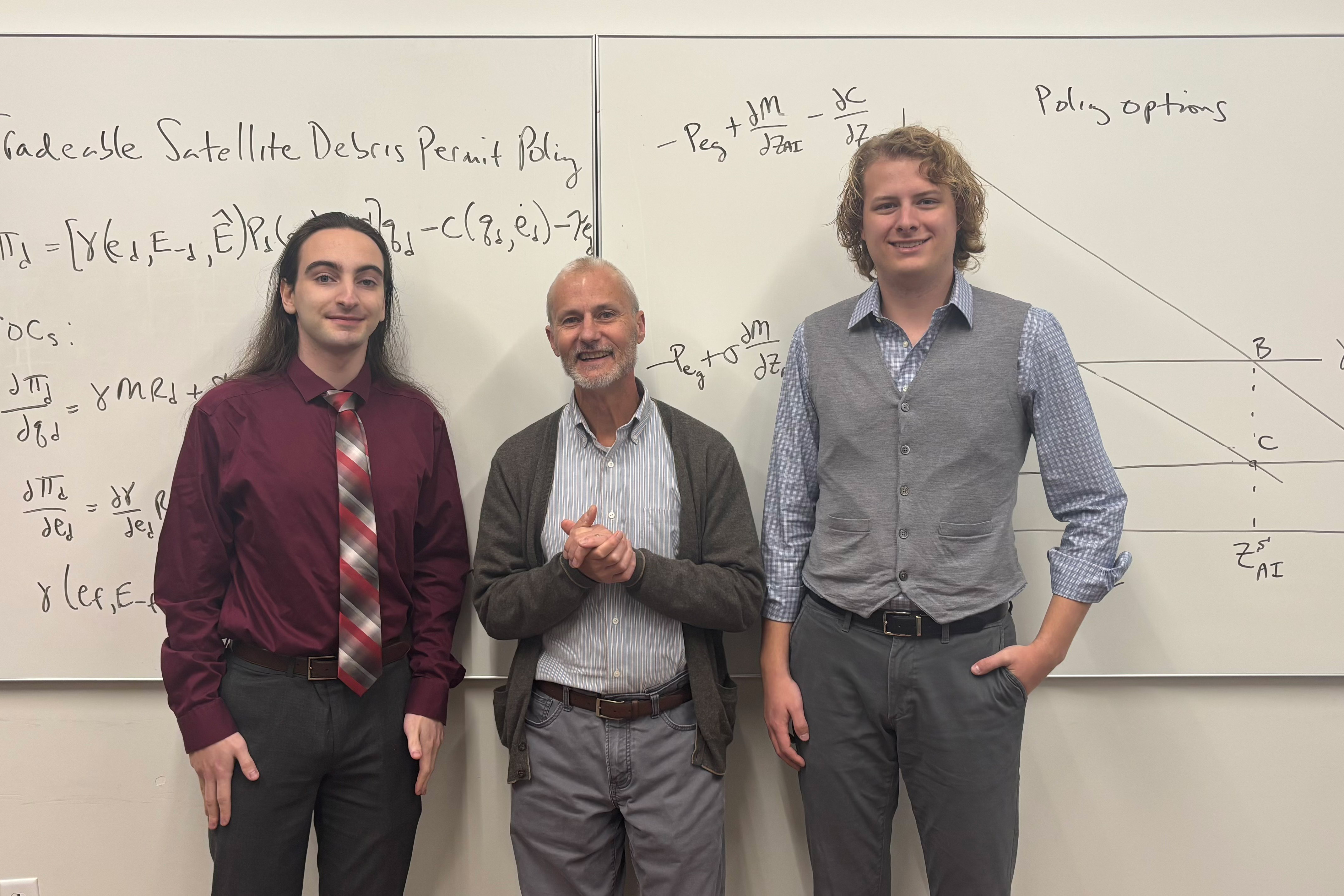
Support from a family of proud RIT alumni is helping students Mitchell Rieder, left, and Ben Bremer, right, present the research alongside their co-author Professor Jeffrey Wagner, center.
Traveling to conferences and presenting research can give undergraduate students a competitive edge. However, the cost of travel and other barriers can make an exciting opportunity feel out of reach.
After Aaron Schwall ’22 (computer science and economics) had a positive experience working with Professor Jeffrey Wagner, his family felt inspired to nurture the culture of research at RIT. Sam Schwall ’87 (industrial engineering), the father of two RIT alumni, contributed funds to the Department of Economics to support more undergraduate, double-major student researchers by covering conference presentation expenses.
“Having dedicated funds that permit students to attend a research conference during their undergraduate years is terrific. We are grateful to the Schwall family for supporting undergraduate economics student and faculty research collaborations,” said Wagner.
Most recently, Wagner has co-authored papers with two fourth-year computer science and economics double majors, Ben Bremer and Mitchell Rieder.
Both students’ papers began as assignments for Wagner’s Environmental Economics course. When Bremer and Rieder expressed interest in co-authoring more in-depth drafts for publication, Wagner was excited about the insights that could result from this type of cross-disciplinary collaboration.
Having Bremer and Rieder present their work alongside him at an industry conference was the natural next step.
“Having a chance to be off campus to see more of the profession and how that world works is beneficial. Every person you can meet has different experiences that you learn from,” said Wagner, who had similar experiences as a student. “I know how valuable it is, so I don’t miss a chance to put my students in that position.”
Bremer traveled with Wagner to present “The Economics of AI in Waste Management” at the 2025 Association of Environmental and Resource Economists’ Summer Conference in New Mexico. The pair is set to travel to Tampa Nov. 22-24 to co-present at the annual meeting of the Southern Economic Association.
Rieder co-presented “The Law and Economics of Tradeable Satellite Debris Permit Market Design” with Wagner at the 2025 New York State Economics Association Annual Conference. They will travel to Chicago to present at the Midwest Economics Association Annual Meeting March 20-22, 2026.
Maximizing profits in AI development
Ben Bremer, from Denver, Colo., is grateful to have discovered his passion for economics as a first-year student after interviewing an economics professor for an RIT 365 project. That experience, paired with his own economics coursework, inspired him to pursue a double major.
Bremer and Wagner set out to collaborate on a paper that extends an ongoing conversation in the field of computer science: thinking critically and creatively about artificial intelligence research and development (AI R&D) to maximize profits. One of their biggest findings, Bremer explained, was that AI R&D is unique because of its spillover benefits.
“AI models at their core are trained to recognize patterns and correlations. Even if you develop an AI tool for a very specific purpose, it can still have applications to a completely different, very specific case that our brains might not connect,” he said.
At the conference in New Mexico, Bremer enjoyed being immersed in a community of researchers who are passionate about their work. He said a highlight was meeting a professor whose work he and Wagner cited in their paper.
“There are people from all over the country there who will stop and take the time to talk to you because they think your research is interesting. As an undergraduate student, you don't get that opportunity often,” he said. “Everyone was very supportive. They loved seeing an undergraduate student step up and co-present.”
The trouble with satellite debris
Adding a major in economics opened Mitchell Rieder’s eyes to the possible applications of computer science.
“I always loved the logic of the computer science major. But I always struggled with finding a way to apply that logic and understanding to the real world,” said Rieder, from Framingham, Mass. “Economics took these numbers off the page and allowed me to apply the logic that I so dearly love to a real-world environment.”
For his research with Wagner, Rieder set his sight on the sky and delved into the increasingly precarious topic of satellite debris management. Rieder explained that satellites are an integral part of everyone’s lives, allowing people to make phone calls, stream their favorite shows, and more.
But these conveniences come with a cost that is largely invisible to consumers.
“With more satellites going up, the likelihood of two satellites colliding or a satellite becoming not operational has increased,” he said. “Unlike when a car accident happens on the freeway, you can’t simply move the debris from a satellite out of the line of space-traffic.”
Rieder said that his experience writing a formal research paper for publication and preparing for these conference presentations made him a stronger student.
“Having the humility and self-reflection to recognize where your understanding is lacking, and the drive to increase that understanding, is not something that is easily taught in class,” he said. “I've had the privilege of learning how to do so, and how to make sure that the work that I do, if not entirely inscrutable, is strong under a certain level of scrutiny.”


