Economics Bachelor of Science Degree

An economics bachelor’s degree prepares you to collect and analyze information, monitor economic trends, and develop forecasts to guide industries in making critical decisions.
Overview for Economics BS
Why Study Economics at RIT?
Three Dynamic Tracks: Choose from economic theory, environmental economics, or managerial economics.
Future-Focused Curriculum: Develop communication, computational, and management skills in addition to economic reasoning and quantitative abilities.
Flexible Capstone Experience: Choose to publish a paper, present a paper at a conference, or present research at an exhibit at Imagine RIT: Creativity and Innovation Festival.
Teaching Partnership Program Available: 4+1 or 3+2 programs enable you to earn your bachelor’s degree at RIT and a master’s degree in education at one of our partner universities.
Accelerated Bachelor’s/Master’s Available: Earn both your bachelor’s and your master’s in less time and with a cost savings, giving you a competitive advantage in your field.
STEM-OPT Visa Eligible: The STEM Optional Practical Training (OPT) program allows full-time, on-campus international students on an F-1 student visa to stay and work in the U.S. for up to three years after graduation.
Economists play a role in a range of industries, from business and law to social sciences, agriculture, and environmental studies. They study how society distributes its resources – from land, labor, raw materials, and machinery – to produce a range of goods and services. They also conduct research, collect and analyze information, monitor economic trends, and develop forecasts to guide industries in making critical decisions. If you have strong math skills but are also interested in impacting policy and social issues, an economics BS degree is an exciting, dynamic major for you.
RIT’s Economics Bachelor’s Degree
Develop your communication, computational, and management skills in addition to refining your economic reasoning and quantitative abilities. You’ll be prepared to apply economic analysis to help solve real-world problems.
The bachelor's in economics emphasizes the quantitative analytical approach to dealing with economic problems in both the public and private sectors, providing you with marketable skills and the intellectual foundation for career growth. You will be prepared for entry-level managerial and analytical positions in both industry and government and to pursue graduate studies in economics, business, and law. You may choose one of the following tracks: economic theory, environmental economics, or managerial economics.
Economics Bachelor’s Degree Courses
The economics BS curriculum develops communication, computational, and management skills in addition to economic reasoning and quantitative abilities. Required courses develop your abilities to apply economic analysis to real-world problems. Liberal arts courses enhance oral and written communication skills. Business courses include accounting and finance. Quantitative analytical skills are developed by a course sequence that includes computer science, mathematics, and statistics.
Free electives allow you to pursue advanced study in your individual areas of interest and/or develop a double major. Along with finance, marketing, mathematics, statistics, or computer science, there are many other possibilities. Faculty advisors help you develop professional options that assist you in attaining your career goals.
Capstone Experience
You are required to complete a creative capstone experience. You may publish a paper in a refereed journal, present a paper at a professional conference or an RIT-sponsored conference, present research at an approved exhibit at Imagine RIT: Creativity and Innovation Festival, or fulfill a comparable creative capstone requirement in your primary major (if economics is the secondary major).
Double Majors
Double majors are a way to customize your education to best reflect your interests, career goals, and your marketability after you graduate. The economics bachelor's degree is flexible and allows you to pursue a double major in a secondary field of study. Even with a double major, you are able to graduate in four years.
Academic Enrichment Opportunities
Economics faculty members serve as mentors and are available to enhance your personal and professional growth. You may work as a teaching assistant for a professor in economics courses or learn about research techniques as a research assistant for faculty. For both of these activities, you receive a stipend. Finally, you can engage in independent or joint research with a faculty member, receiving academic credit and obtaining funding for your research needs.
RIT’s Pre-Law Program
Law schools welcome applications from students majoring in a wide range of academic programs. RIT’s pre-law program will help you navigate the admission process for law school, explore a range of legal careers, and guide you through course selection to ensure you build the skills and competencies required of competitive law school applicants. The program is open to students in all majors who are interested in pursuing a career in law.
Furthering Your Career in Economics
Combined Accelerated Bachelor’s/Master’s Degrees: Today’s careers require advanced degrees grounded in real-world experience. RIT’s Combined Accelerated Bachelor’s/Master’s Degrees enable you to earn both a bachelor’s and a master’s degree in as little as five years of study, all while gaining the valuable hands-on experience that comes from co-ops, internships, research, study abroad, and more.
- Economics BS/Science, Technology, and Public Policy MS: As an economics undergraduate student, your study of market and resource distribution–from the interplay between firm behaviors and consumer choices—exposes you to the complexity of governmental policies and social issues while also building essential computational, management, and communication skills. From this foundation, the science, technology, and technology MS equips you to tackle challenges in policy areas such as technology policy, economic policy, industry regulation, environmental sustainability, health care, digital policy, and more.
- Economics BS/Artificial Intelligence MS: For the economists of the future, an accelerated dual degree pathway in which you can earn both your BS in economics and your MS in artificial intelligence serves to supercharge a foundation in economics with the power of AI to transform approaches for forecasting and predictive modeling, analyzing big data, assessing behavioral modeling, reviewing and analyzing labor markets, evaluating policy, and more. Graduates are equipped for careers in fintech, insurance, policy making, business strategy, government, data science, and research.
- Economics BS/Finance MS: This program allows students to build a strong foundation in economic theory while gaining advanced expertise in financial analysis, markets, and investment strategies. This accelerated pathway prepares graduates with both broad economic insight and specialized financial skills—ideal for careers in corporate finance, consulting, banking, or policy analysis.
- Economics BS/Sustainable Systems MS: Combine your passion for economics and sustainability in a combined/accelerated dual degree where you'll develop a strong foundation in economic theory and data analysis while exploring the environmental, social, and business factors that shape sustainability challenges. By integrating economic principles with sustainability science, you’ll be prepared to tackle pressing global issues like climate policy, resource management, and sustainable development—equipping you for careers in policy, business strategy, and beyond.
- +1 MBA Early Acceptance Pathway: Successful RIT applicants who are offered admission into the BS degree in economics as an incoming first-year student may also be offered conditional early acceptance into the +1 MBA Early Acceptance Pathway. This option enables you to earn both your BS degree and an MBA in as little as five years of study. Learn how the +1 MBA Early Acceptance Pathway can help you add a competitive advantage to your studies.
- +1 MBA: Students who enroll in a qualifying undergraduate degree have the opportunity to add an MBA to their bachelor’s degree after their first year of study, depending on their program. Learn how the +1 MBA can accelerate your learning and position you for success.
3+3 Accelerated BS/JD Programs
RIT has partnered with Syracuse University’s College of Law and University at Buffalo School of Law to offer accelerated 3+3 BS/JD options for highly capable students. These programs provide a fast track to law school where you can earn a bachelor’s degree at RIT and a Juris Doctorate degree at Syracuse University or University at Buffalo in six years. Interested students may apply to the option directly, with successful applicants offered admission to RIT and conditional acceptance into either Syracuse University’s College of Law or University at Buffalo School of Law.
RIT's economics degree is one of the approved majors for the 3+3 option. Learn more about RIT's Accelerated Law 3+3 Programs.
RIT’s Teaching Partnership Programs
Whether your goal is to go into early childhood or elementary education, become a secondary education teacher with a content area specialty at the middle or high school level, or work in the higher education or counseling fields, RIT’s partnership programs with local universities provide a guided pathway to a career in teaching.
These 4+1 or 3+2 programs enable you to earn your bachelor’s degree at RIT and a master’s degree in education at one of our partner universities. As you progress, you’ll benefit from focused academic advising, career exploration opportunities, and resources for research, learning, and skill development.
RIT’s economics degree is eligible for RIT’s Teaching Partnership Program. Learn more about RIT’s Teaching Partnership Programs.
Careers and Experiential Learning
Typical Job Titles
| Market Research Analyst | Financial Analyst | Credit Analyst |
| Compensation and Benefits Manager | Economic Consultant | Policy Analyst |
| Lawyer | Actuary |
Industries
Cooperative Education and Internships
What’s different about an RIT education? It’s the career experience you gain by completing cooperative education and internships with top companies in every single industry. You’ll earn more than a degree. You’ll gain real-world career experience that sets you apart. It’s exposure–early and often–to a variety of professional work environments, career paths, and industries.
Co-ops and internships take your knowledge and turn it into know-how. A liberal arts co-op provides hands-on experience that enables you to apply your knowledge in professional settings while you make valuable connections between course work and real-world applications.
Students in the economics degree are strongly encouraged to participate in cooperative education.
Featured Work and Profiles
-

RIT economics alumnus represents Dominican Republic at World Bank Group
Julio Eduardo Diaz Sosa ’12 says RIT’s blend of liberal arts, technology, co-op, and critical thinking helped launch his career in international finance.
Read More about RIT economics alumnus represents Dominican Republic at World Bank Group -

Economics Alum's Research Shows Economic Impact of Climate Change
Climate change is one of the most significant challenges of the 21st century, affecting communities around the world from changing agricultural productivity to infrastructure damage and mortality from...
Read More about Economics Alum's Research Shows Economic Impact of Climate Change -
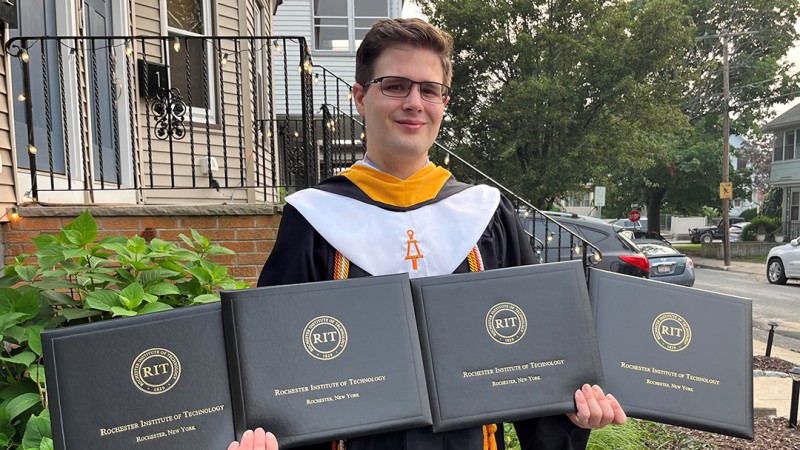
Student Graduates with Multiple Degrees
Bobby Kovach Despite overcoming health challenges from a car accident, Bobby Kovach, who recently graduated from RIT, managed to earn two degrees in four disciplines at the same time.
Read More about Student Graduates with Multiple Degrees
Curriculum for 2026-2027 for Economics BS
Current Students: See Curriculum Requirements
Admissions and Financial Aid
This program is STEM-OPT Visa Eligible when studying on campus and full time.
First-Year Admission
First-year applicants are expected to demonstrate a strong academic background that includes:
- 4 years of English with a strong performance is expected.
- 3 years of social studies and/or history with a strong performance is expected.
- 3 years of math is required and must include algebra, geometry, and algebra 2/trigonometry.
- 2-3 years of science.
Transfer Admission
Transfer applicants should meet these minimum degree-specific requirements:
- A minimum of college algebra is required.
Financial Aid and Scholarships
100% of all incoming first-year and transfer students receive aid.
RIT’s personalized and comprehensive financial aid program includes scholarships, grants, loans, and campus employment programs. When all these are put to work, your actual cost may be much lower than the published estimated cost of attendance.
Learn more about financial aid and scholarships


Related News
-
March 20, 2026

Students Honored for Writing Excellence
Eighteen students from across campus were honored this year by the Rochester Institute of Technology College of Liberal Arts 46th annual Student Writing Awards presentation on March 20, 2026.
-
December 5, 2025

Deaf Santa Claus makes holiday magic more inclusive
WXXI highlights the documentary Deaf Santa Claus, which follows deaf Texan Charles Graves as he becomes Santa to bring holiday joy and inclusion to deaf children. The film is produced by Evan Winegard '99 (economics), '10 EMBA.
-
November 20, 2025

Cross-disciplinary collaborations lead to growth for double-major students
From satellite debris to artificial intelligence, double major students find research success by combining expertise in computer science and economics.
