Research Awards and Recognition

RIT has been recognized as a doctoral university by the Carnegie Classification of Institutions of Higher Education since 2016 because of its growing research activity.
Sponsored Research Awards
In millions of dollars
Research Expenditures
In millions of dollars
Federal Awards
In millions of dollars
Major Grants
-
September 25, 2026
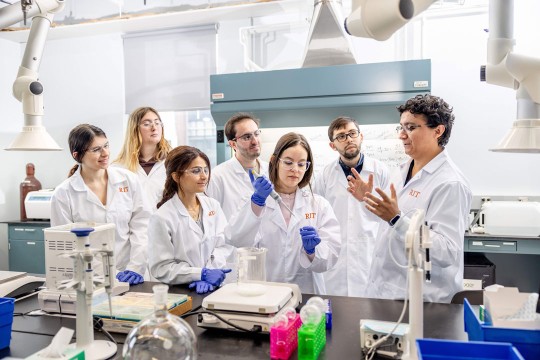
RIT chemical engineering students reshaping particles to help build the materials of the future
Chemical engineering student Natalie Bedolla-Mortensen is playing a role in reengineering tiny particles that could one day become cell tissues of 3D-printed organs. Her research is part of Rochester Institute of Technology’s work in the growing field of soft matter development.
-
August 27, 2026
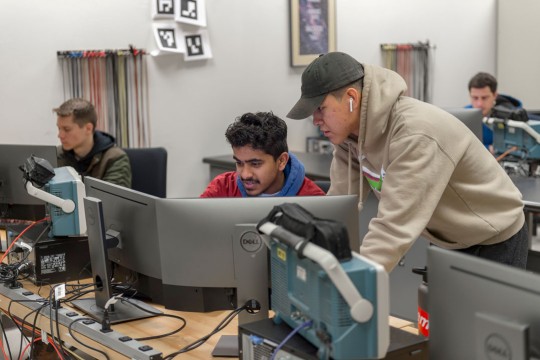
RIT researchers study teamwork skills in engineering education
The new research hub will improve engineering education to close skills gaps and address how artificial intelligence is impacting the workplace.
-
May 5, 2026

RIT partners with Army to strengthen nation’s future workforce
The U.S. Department of the Army Science, Technology, Engineering, and Mathematics has awarded RIT a premier cooperative agreement to establish and lead the Army STEM Education Consortium.
NSF CAREER Awards
2026

For “AdaptTrust: Adaptable, Trustworthy and Uncertainty-Aware Learning in Intelligent Sensing Technologies”
2026

For “Unsteady Inertial Flow Dynamics in a Confined Domain Excited by Analytical and Empirical Actuation Patterns”
2026

For “Unifying Volatile and Non-Volatile In-Materia Computing with Ionically Gated Transistors for Energy-Efficient Edge AI”
2026

For “Defending Machine Learning Models from Adversarial Threats via Unified Interpretability and Attribution”
2025

For “Enhancing Knowledge Acquisition in Design and Manufacturing Education through Visual Experiential Learning”
2025

For “Jamming and Phase Transition of a Suspension of Soft Particles in Porous Media”
2024

For “Computation-efficient Resolution for Low-Carbon Grids with Renewables and Energy Storage”
2023

For “Toward Reliable and Quantum-resistant Connected Vehicle Security”
2022

For “Investigating the Use of Empathy-Building Interventions in Experiential Computing Education”
2022

For “Chirality and polymer thermodynamics: frustration and amplification”
2021

For “Interface-mediated Ionic Transport in Mismatched Complex Oxide Heterostructures: Role of Misfit Dislocations”
2021

For “Co-evolution of Machine Intelligence and Continuous Information”
2020

For “Computational Model of Perceived Color and Appearance in Augmented Reality”
2019

For “Learning to Solve Problems in context-rich environments: A Naturalistic study in STEM Workplaces, research labs, project-based and lab courses”
2018

For “Development of High-Efficiency Ultraviolet Optoelectronics”
2016

For “Energy-Efficient Datacenters with Wireless Interconnection Networks”
2015

For “Magnetocaloric Effect in Metallic Nanostructures”
2015

For “Theory of Optomechanical Nanorotation Sensing – Approaching the Quantum Regime”
2014

For “Integrating Physical Models into Data-Driven Inference”
2013

For “Environmental impacts of reusing, recycling and disposing of lithium-ion batteries after they have been used in electric vehicles”
2010

For “Strain Balanced Quantum Dots for high Concentration Photovoltaics”
2010

For “Graphics: Gaze Manipulation”
PI Millionaires
Since 2000, RIT has recognized 206 principal investigators and researchers who have achieved $1 million or more in funding by inducting them into a class of “PI Millionaires.”
Current faculty in this group include:
- Vinay Abhyankar
- Cecilia Alm
- Irshad Altheimer
- Martin K. Anselm
- Callie Babbitt
- Charles Bachmann
- Mishkat Bhattacharya
- Scott Brown
- Vincenzo Buonomo
- Donna Burnette
- Manuela Campanelli
- Enid Cardinal
- Christopher Collison
- Denis Cormier
- Paul Craig
- Agamemnon Crassidis
- Feng Cui
- Moumita Das
- Steven Day
- Richard DeMartino
- Travis Desell
- Gabriel Diaz
- Carlos Diaz-Acosta
- Matthew Dye
- Doreen Edwards
- Joshua Faber
- Don Figer
- Scott Franklin
- Tom Gaborski
- Matthew Ganter
- Bill Garno
- Michael Gartley
- Aaron Gerace
- Christina Goudreau Collison
- Richard Hailstone
- Peter Hauser
- Karl Hirschman
- Matthew Hoffman
- Seth Hubbard
- André Hudson
- Matt Huenerfauth
- Clyde Eirikur Hull
- Emmett Ientilucci
- Bonnie Jacob
- Keith Jenkins
- Daniel Johnson
- Christopher Kanan
- Satish Kandlikar
- Jeyhan Kartaltepe
- Joel Kastner
- Parsian Katal Mohseni
- John Kerekes
- Robert Kremens
- Daniel Krutz
- Michael Kuhl
- Santosh Kurinec
- Andres Kwasinski
- Brian Landi
- Donna Lange
- Blanca Lapizco-Encinas
- Christopher Lewis
- Cristian Linte
- Xumin Liu
- Barbara Lohse
- David Long
- Carlos Lousto
- Sharon Mason
- Drew Maywar
- David Messinger
- Casey Miller
- Lishibanya Mohapatra
- Matthew Montanaro
- James Myers
- Darren Narayan
- Nabil Nasr
- Nenad Nenadic
- Dina Newman
- Zoran Ninkov
- Jason Nordhaus
- Richard O'Shaughnessy
- Justin Pelletier
- Keven Poore
- Stefan Preble
- Ivan Puchades
- Jie Qiao
- Ryne Raffaelle
- S. Manian Ramkumar
- Emma Richardson
- Andrew Robinson
- Risa Robinson
- Sean Rommel
- Eli Saber
- Carl Salvaggio
- Thomastine Sarchet
- Andreas Savakis
- Hans Schmitthenner
- Jennifer Schneider
- Joha Shamsujjoha
- Nirmala Shenoy
- Joseph Sirianni
- Bruce Smith
- Michael Stinson
- Lu Sun
- Grover Swartzlander
- Michael Thurston
- Brian Tomaszewski
- Gill Tsouri
- Christy Tyler
- Jan van Aardt
- Anthony Vodacek
- Linwei Wang
- Steven Weinstein
- John Whelan
- Eric Williams
- L. Kate Wright
- Matthew Wright
- Karin Wuertz-Kozak
- Qian Xue
- Shanchieh Yang
- Qi Yu
- Bo Yuan
- Richard Zanibbi
- Michael Zemcov
- Jing Zhang
- George Zion
- Ben Zwickl
Seed Funding
RIT awards researchers seed funding of $5,000 for proposals written during the fall semester and later refined over the course of a two-day Grant Writers’ Boot Camp.

For “Monitoring and Improving Length of Stay and Readmission Rates Using Learn Management Techniques”

For “Advancing Culturally Relevant STEM Learning Experiences for Underrepresented Students”

For “Development of Bioplastic Packaging Solution for the Transport of Apples”
For “A Principled Model Selection Method for Deep Learning in Protein Function Analysis”

For “Robotic Collaborative Perception and object Manipulation for Effective and Affordable Elder Care”

For “Integrating dynamical systems and machine learning to study paleoclimate data”

For “Neurocognitively-Motivated Conversational Assistants Based on Distribution Representations”
NIH Boot Camp Seed Funding
RIT also offers an advanced boot camp focused on the National Institutes of Health. Participants in the NIH Boot Camp submitted proposals for seed funding to help develop competitive proposals or revise proposals to specific NIH programs in the coming year. 2019 awardees will receive up to $10,000 and include:

Kate Gleason College of Engineering

College of Health Sciences and Technology

Kate Gleason College of Engineering