Cooperative Education and Internships

Graduate With Real Career Experience
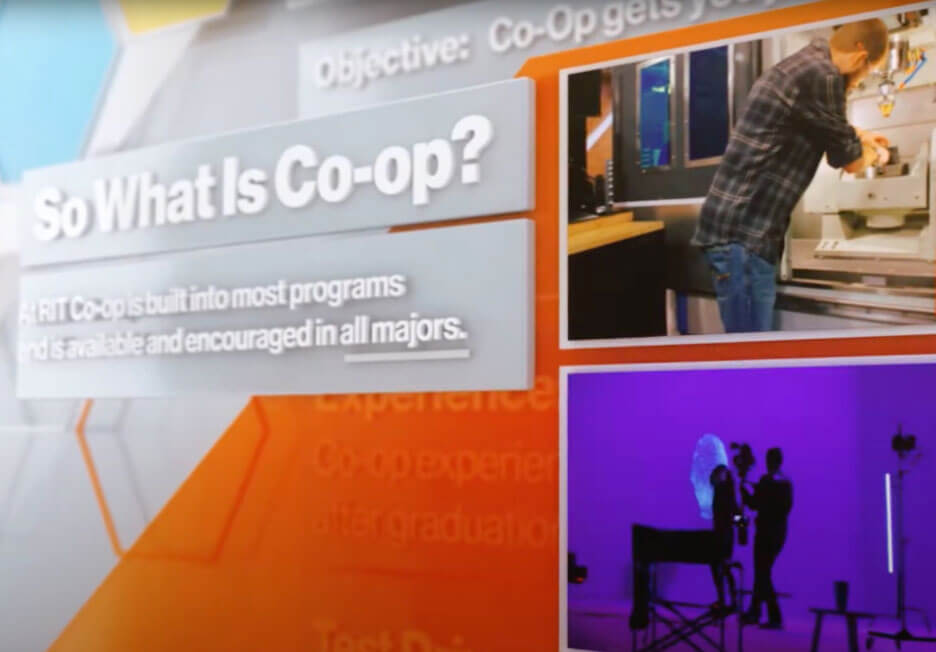
There’s no better way to learn than on the job. RIT’s cooperative education program, or co-op, provides you with career experience in a variety of industries and environments. And, with co-op and internships built into most programs, and available and encouraged in all majors, you’ll gain the experience that employers look for in their next top hires.
#5
Top School for Co-op or Internship Programs
Ranked among nation’s best in hands-on career preparation
96%
Of co‑op employers said they would hire their RIT co‑op student for a full‑time position
4,500+
Students Participate Annually
3,400+
Global Hiring Organizations
What is an Internship?
Like co-ops, internships are hands-on experience in your career field. They can range from a few hours a week to full-time employment, and everything in between. Some internships may be paid and some may be unpaid, depending on the employer and the career field. While most RIT majors require co-op, a few encourage internships because in some degree fields, internships tend to be more common. While internships may differ in length from co-ops, they are equally as valuable in providing career experience, hands-on learning, and professional networking opportunities.
What’s the Difference Between Co-ops and Internships at RIT?
|
Co-op |
Internship |
|
|
Length |
Co-ops are typically one semester, one summer term, or multiple consecutive semesters. |
Internships can range from a few weeks to a summer or part-time experience during a semester. |
|
Type of Work |
Usually full-time employment during the co-op term. |
May be full-time, part-time, or a few hours per week. |
|
Salary |
All co-op positions are paid. |
Internships may be paid or unpaid, depending on the employer and industry. |
|
Majors |
More common in fields such as engineering, computing, business, and applied sciences. |
More common in fields such as communication, journalism, marketing, and media. |
|
Professional Development |
Includes structured supervision, mentoring, and professional skill development. |
Provides workplace exposure, networking, and career exploration opportunities. |
|
Tuition Free |
Students do not pay tuition while on co-op. |
Students do not pay tuition if they are completing a full-time internship. They may pay tuition if the internship is a few hours a week or part-time and students continue to take courses. |
How Does Co-op Work?
RIT students typically follow these steps to identify and complete a co-op or internship:
1
Understand the
Requirements
Review your academic program’s co-op requirements, timing, and eligibility criteria.
2
Explore
Opportunities
Search for positions through RIT’s Career Connect platform, attend career fairs, participate in employer information sessions, and explore other job-search resources.
3
Apply for
Positions
You'll identify opportunities, submit applications, interview with employers, and secure an offer.
4
Confirm the
Position Qualifies
Check with your Career Services coordinator or academic department to confirm if a position meets the program’s requirements.
5
Complete the
Work Experience
Work full-time in a professional setting and fulfill your academic department’s co-op requirements.
RIT provides career resources and employer connections to support students throughout the search process. However, students are responsible for applying and securing a position; a co-op job is not guaranteed.
Does Co-op Delay Graduation?
No. At RIT, co-op is integrated into the curriculum and academic plans for most undergraduate majors. Students complete paid, career-related work experience as part of their degree requirements and graduate with both a degree and professional experience.
One or Two Blocks
|
|
Fall |
Spring |
Summer |
|
Year 1 |
Classes |
Classes |
|
|
Year 2 |
Classes |
Classes |
Co-op/Internship |
|
Year 3 |
Classes |
Classes |
Co-op/Internship |
|
Year 4 |
Classes |
Classes |
|
Three or Four Blocks
|
|
Fall |
Spring |
Summer |
|
Year 1 |
Classes |
Classes |
|
|
Year 2 |
Classes |
Classes |
Co-op |
|
Year 3 |
Co-op |
Classes |
Co-op |
|
Year 4 |
Classes |
Co-op |
|
| Year 5 | Classes | Classes |
What’s it Like on Co-op?

Lily Roberts
Major: Mechanical Engineering
Co-op/Internship: Universal Studios Epic Universe
“I was fortunate enough to shadow the central shops team, gaining hands-on experience in welding, machining, and fiberglass repair. Each experience built upon the previous one, leaving me with a broader understanding of sustaining engineering and a new perspective on the field.”

Halle Wagner
Major: Supply Chain Management
Co-op/Internship: Gulfstream Aerospace
“My favorite part of my co-op was the level of exposure I gained across the entire aircraft lifecycle from the initial definition and design phases to final delivery.”

Ben McManus
Major: Computer Science
Co-op/Internship: Indivisible Partners
“I got better at communicating technical concepts in plain language, realizing not everyone speaks ‘tech.’ I also sharpened my scripting and automation skills, which has given me more confidence in both IT and coding.”

Shannon Lesch
Major: Photographic and Imaging Arts, Visual Media Option
Co-op/Internship: Rachel Harrison Communications
“I worked with about seven different clients and brands. I did a lot of social media clipping, I would draft captions and stories, and I made Instagram reels for the company. I would also draft shot lists and make mood boards for client photoshoots.”