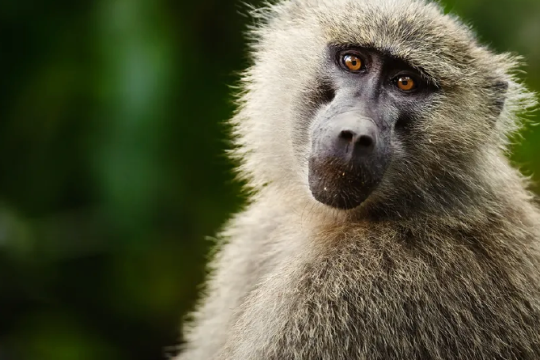
Live Science covers a study by Dr. Jessica Cantlon (CMU), Dr. Caroline DeLong (RIT), and colleagues showing monkeys use some of the same mental strategies as people do to perceive abstract relationships between shapes. This study was published in the Proceedings of the National Academy of Science.
The New York Times covers a study by Dr. Jessica Cantlon (CMU), Dr. Caroline DeLong (RIT), and colleagues in which baboons and rhesus monkeys were given the same geometric task as children and adults to test whether humans have an innate geometric intuition. The study was published in the Proceedings of the National Academy of Sciences.
Popular Science covers a study by Dr. Jessica Cantlon (CMU), Dr. Caroline DeLong (RIT), and colleagues in which baboons and rhesus monkeys were given the same geometric task as children and adults that showed that geometric intuitions are part of the basic architecture of the primate mind. The study was published in the Proceedings of the National Academy of Sciences.
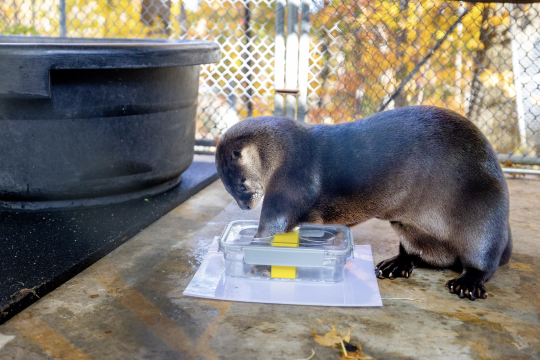
Dr. Caroline DeLong (RIT), in partnership with Dr. Heather Hill (St. Mary's University) and Dr. Deirdre Yeater (Sacred Heart University), have established the ManyOtters project. ManyOtters brings together institutions from across the nation to expand and enhance data sets for otter cognition research. In the first ManyOtters study, multiple zoos and aquariums are testing their otters using foraging devices presented at two time points to assess long-term memory abilities. This study allows undergraduate and graduate students the opportunity to conduct research and learn about big team science.
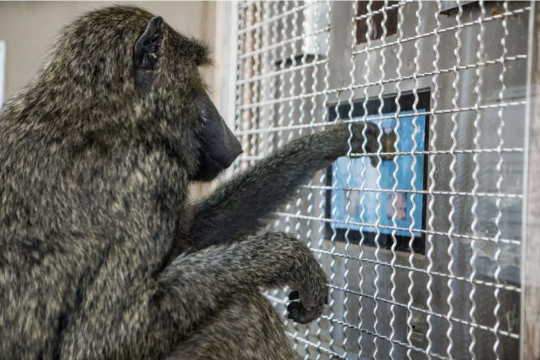
Dr. Jessica Cantlon (Carnegie Mellon University) and Dr. Caroline DeLong (Rochester Institute of Technology) completed an education pilot study that bridges animal behavior research and computer coding to engage elementary school students in real-world, interdisciplinary science. The elementary school students code games for olive baboons to play at the Seneca Park Zoo in Rochester, N.Y. The pilot study shows the students gained computational thinking skills over the course of the coding unit.
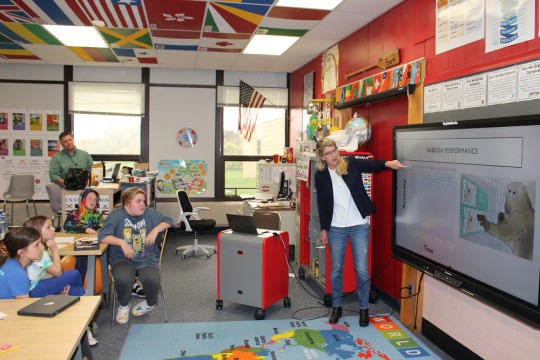
Intermediate REACH students at Hilton’s QUEST are coding games for baboons at the Seneca Park Zoo. They recently worked with Dr. Caroline DeLong, professor and undergraduate director of psychology at RIT, who is running the study to increase young students’ interest in STEM (science, technology, engineering and math) by engaging them with something that is interesting and familiar – animals at the zoo. She is working with a team of researchers at both RIT and Carnegie Mellon University.
RIT’s College of Liberal Arts brings the humanities, social sciences, and performing arts into the digital age. Innovate, imagine, and grow in our uniquely human-centered, tech-infused environment, supported by a community of creators who are inspired and equipped to turn “What If?” into “I Will."
When kids are presented with the choice of learning to code or going to the zoo, most would choose the latter. An RIT professor wonders why they can’t do both.
From robot waiters to river otters, RIT’s Graduate Showcase will cover a wide variety of topics representing graduate scholarship from the university’s Henrietta and global campuses. The symposium, held April 7, will feature oral presentations in the morning and poster presentations, demonstrations, and visual exhibitions in the afternoon.
Kaitlin Gunther, a fourth-year psychology and computer science double major from Webster, N.Y., is trying to better understand how fish view the world. Gunther will present her research, Visual Discrimination of Rotated 3D Unicolor Objects in Goldfish, at RIT’s virtual Undergraduate Research Symposium.
Research involving North American river otters based at a zoo in Rochester has concluded that the aquatic mammals can visually discriminate between two-dimensional objects and detect differences in shapes and colors.
One way that Seneca Park Zoo helps save wildlife is through conservation science. Your Zoo partners with academic institutions and with other zoos and aquariums to conduct and support research that helps understand the species in our care.
Search RIT
This website uses cookies to provide better user experience and functionality. You can control and configure cookies in your web browser.
Cookie Statement
|
How to Disable Cookies