Acoustic Devices for Agricultural Monitoring (ADAM)
Principal Investigator(s)
Anthony Vodacek
Research Team Members
Micheline Kazeneza (PASET Doctoral Scholar)
Emmanuel Ndashimye (Carnegie Mellon University-Africa, Rwanda)
Damien Hanyurwimfura (ACE-IoT, University of Rwanda)
Project Description
The ADAM project is investigating the use of passive acoustic sensors for monitoring agricultural activities in Rwanda. The Internet of Things (IoT) prototype system for detecting known pest bird sounds has been built and the detection module relies on compact algorithms that do not require extensive computing power. The last stage of the research examined efficient edge detection techniques, resulting in Enhanced MicroDSC (Microcontroller Depthwise Separable Convolution), an optimized depthwise separable convolution architecture for acoustic pest bird detection on low-cost microcontrollers.
Audio data used to train the model were collected across three regions of Rwanda from grain crop farms cultivating maize, wheat, and rice. Recording sessions captured natural behavioral contexts across varied environmental conditions, seasons, and times of day to ensure representative real acoustic complexity and diversity. A dataset comprising 9,970 audio samples (1.5 s duration) representing 11 classes; eight pest species, two beneficial species, and one non-bird category was constructed. The mel-frequency energy (MFE) feature was extracted and fed into the various machine learning models (Fig. 1). Evaluation of Enhanced MicroDSC across 10 independent training runs demonstrated high performance accuracy despite large decreases in model parameters compared to standard deep learning models (Table 1). Practical feasibility was validated through deployment on a microcontroller, demonstrating real-time inference capability with minimal resources. The proposed system offers an economically viable solution for automated pest detection in smallholder grain crop production systems, where avian pests pose critical threats to food security.
Figures and Images
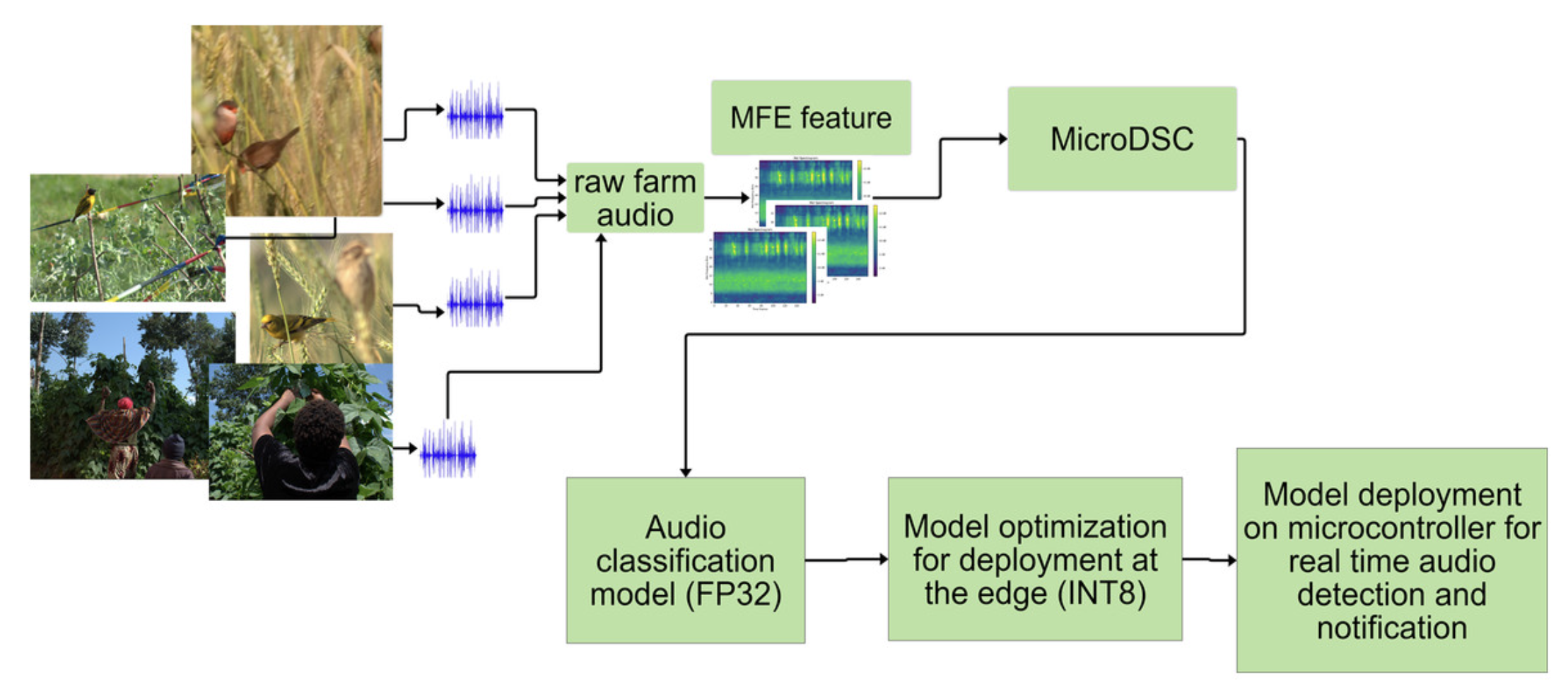
Training methodology flowchart
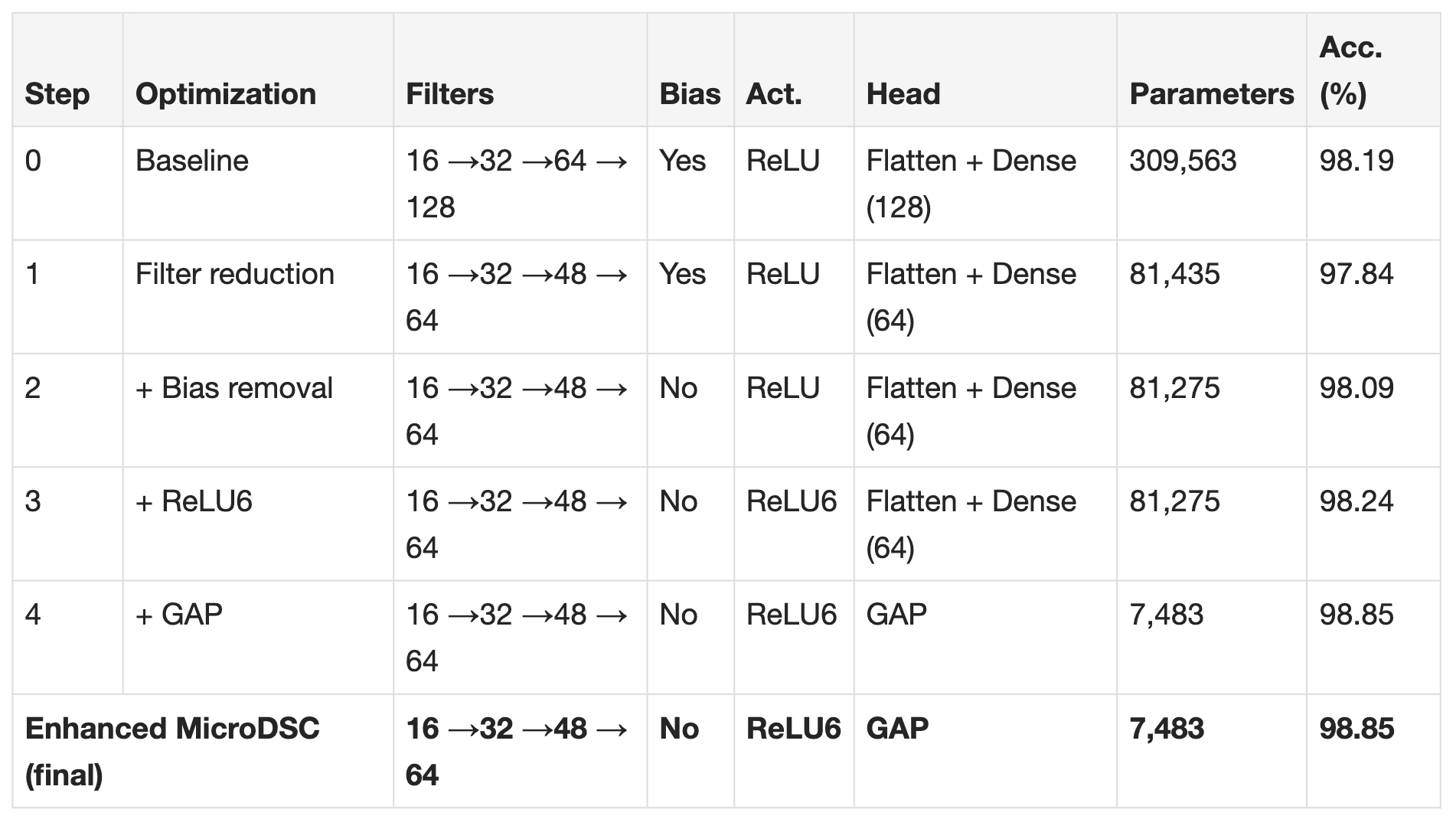
Sequential ablation study: cumulative effect of optimizations applied progressively