Deep Multi-Target Regression for Voxel Content Estimation in Simulated Forests via DIRSIG
Principal Investigator(s)
Jan van Aardt
Research Team Members
Amirhossein Hassanzadeh
Bartosz Krawczyk
Michael Saunders
Rob Wible (PhD Student)
Dimah Dera
Keith Krause (Battelle)
Project Description
LiDAR has become one of the primary sensing modalities for characterizing three-dimensional forest structure, supporting applications ranging from ecosystem monitoring and carbon estimation to habitat assessment and precision forestry. To reduce the computational burden associated with processing dense point clouds, LiDAR data are commonly converted into voxelized representations. While voxelization substantially improves storage efficiency and computational scalability, it inevitably averages the underlying measurements, resulting in the loss of fine-scale structural information within each voxel. Existing approaches largely treat voxelization as a one-way transformation, leaving an important question unanswered: can the detailed composition of a voxel be recovered from its coarse representation
Addressing this problem is particularly challenging because accurate ground truth describing the internal composition of individual voxels is nearly impossible to obtain in real forest environments. Forest structure is highly heterogeneous, with materials such as bark, leaves, soil, and other objects exhibiting vastly different spatial distributions and severe target imbalance. Obtaining voxel-level material fractions through field measurements is impractical, making it difficult to develop and evaluate supervised learning algorithms capable of recovering this missing structural information.
To address these challenges, we developed a deep multi-target regression framework that estimates the fractional content of multiple forest materials within every voxel directly from voxelized LiDAR point clouds. Rather than predicting a single forest attribute, the proposed model simultaneously estimates the percentage of bark, leaves, soil, and miscellaneous materials contained within each voxel. The framework builds upon the KPConv architecture and adapts it from semantic segmentation to continuous multi-target regression, enabling the network to learn rich three-dimensional structural representations while producing physically meaningful material fractions. To address the severe imbalance inherent in forest environments, we introduce a computationally efficient Density-Based Relevance (DBR) weighting strategy together with a cost-sensitive loss function that emphasizes underrepresented samples during training. A key contribution of this work is the development of a large-scale simulated LiDAR dataset generated from a high-fidelity Harvard Forest scene using the DIRSIG radiative transfer model. This simulation framework provides geometrically accurate, voxel-level ground truth that would be impractical to obtain through field measurements while enabling systematic evaluation across multiple voxel sizes to investigate the tradeoff between spatial resolution, computational efficiency, and predictive accuracy.
Experimental results demonstrate that detailed voxel composition can be inferred with meaningful accuracy despite the information loss introduced by voxelization. The proposed framework consistently outperformed competing deep learning models for multi-target regression, while the DBR weighting strategy significantly improved predictions for underrepresented materials. The voxel-size analysis further showed that larger voxels reduce prediction error by decreasing structural variability, whereas finer voxel resolutions preserve greater ecological detail but present a more challenging learning problem. Collectively, these findings suggest that deep learning can recover fine-scale structural information that is not explicitly retained in voxelized LiDAR data, providing a practical framework for detailed forest characterization while maintaining the computational advantages of voxel-based processing.
Figures and Images
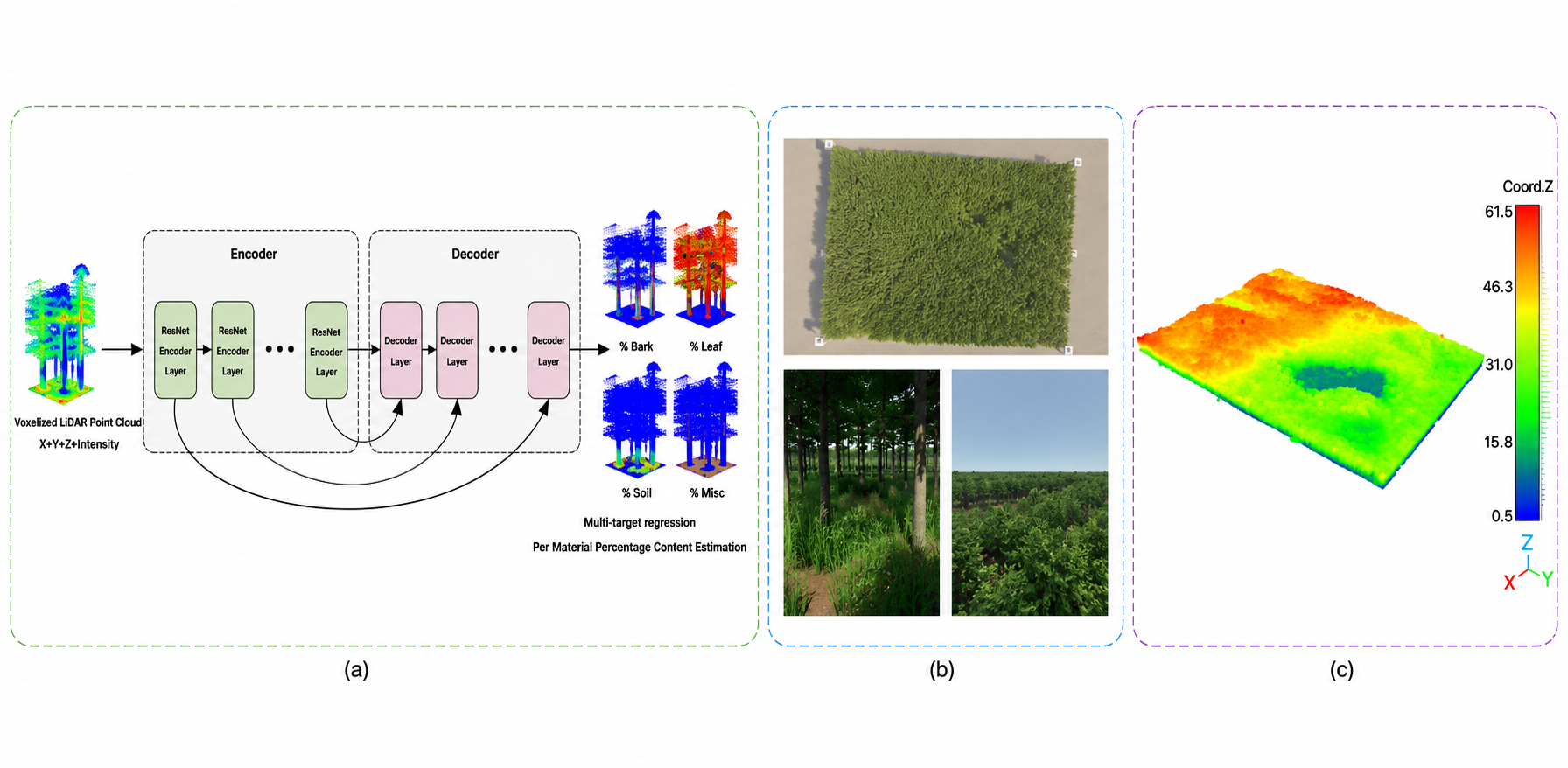
Overview of the proposed framework and simulated dataset. (a) KPConv-rigid architecture adapted for multi-target regression, consisting of an encoder-decoder network that estimates the fractional content of bark, leaves, soil, and miscellaneous materials from voxelized LiDAR point clouds. (b) Harvard Forest scene simulated using DIRSIG, including an aerial view (top), within-forest perspective (bottom left), and above-canopy perspective (bottom right). (c) Simulated LiDAR point cloud generated from the DIRSIG Harvard Forest scene, with color representing height above ground.