Enhanced 3D Sub-Canopy Sensing with Airborne and Spaceborne Full-Waveform LiDAR
Principal Investigator(s)
Jan van Aardt
Research Team Members
Janek Wasilewski (PhD Student)
Project Description
The main objective of this project is to characterize the performance of machine-learning-based automatic target recognition (ATR) systems for detecting man-made objects beneath forest canopies using LiDAR data.
First, we investigate ATR performance using discrete-return LiDAR. The machine-learning models are trained on a discrete-return dataset developed by injecting simulated objects into existing forest point clouds and are validated using real-world data collected with man-made objects placed beneath the canopy. We introduce object observability as the amount of target-related information captured by the sensor, quantified primarily by the number of LiDAR returns originating from an object. We analyze the relationship between observability and detection performance and estimate the minimum observability required for reliable object detection.
In sub-canopy LiDAR sensing, object observability is strongly influenced by canopy penetrability. We therefore create a penetrability dataset using Digital Imaging and Remote Sensing Image Generation (DIRSIG), a physics-based remote-sensing simulation environment, and examine how adjustable platform and sensor parameters affect penetrability and, consequently, the amount of target information available to the ATR system. Based on this relationship, we introduce a sub-canopy sensing mission objective that balances the need for sufficient ground and target observability with overall mission efficiency.
Finally, we extend the analysis to full-waveform LiDAR. We investigate how acquisition parameters, particularly laser footprint size and pulse spacing, influence the representation and observability of sub-canopy objects and the resulting ATR performance. For this purpose, we create a family of datasets parameterized by footprint size and pulse spacing by simulating waveforms from discrete-return point clouds. The resulting models are evaluated on complementary datasets generated using physics-based full-waveform simulations in DIRSIG with matching acquisition parameters. This analysis supports the development of sensing strategies that jointly optimize data acquisition and machine-learning-based target detection under dense canopy conditions.
Figures and Images
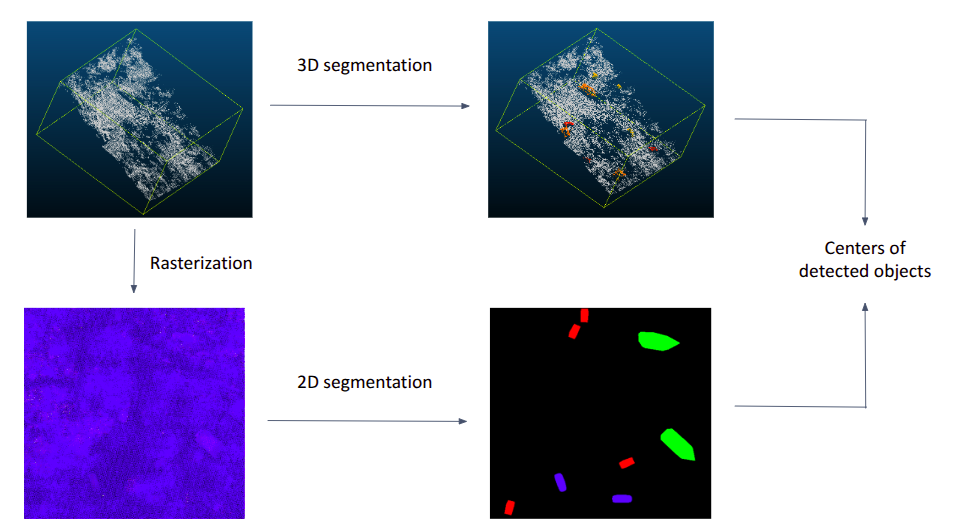
Automatic target recognition pipeline for discrete-return LiDAR point clouds.
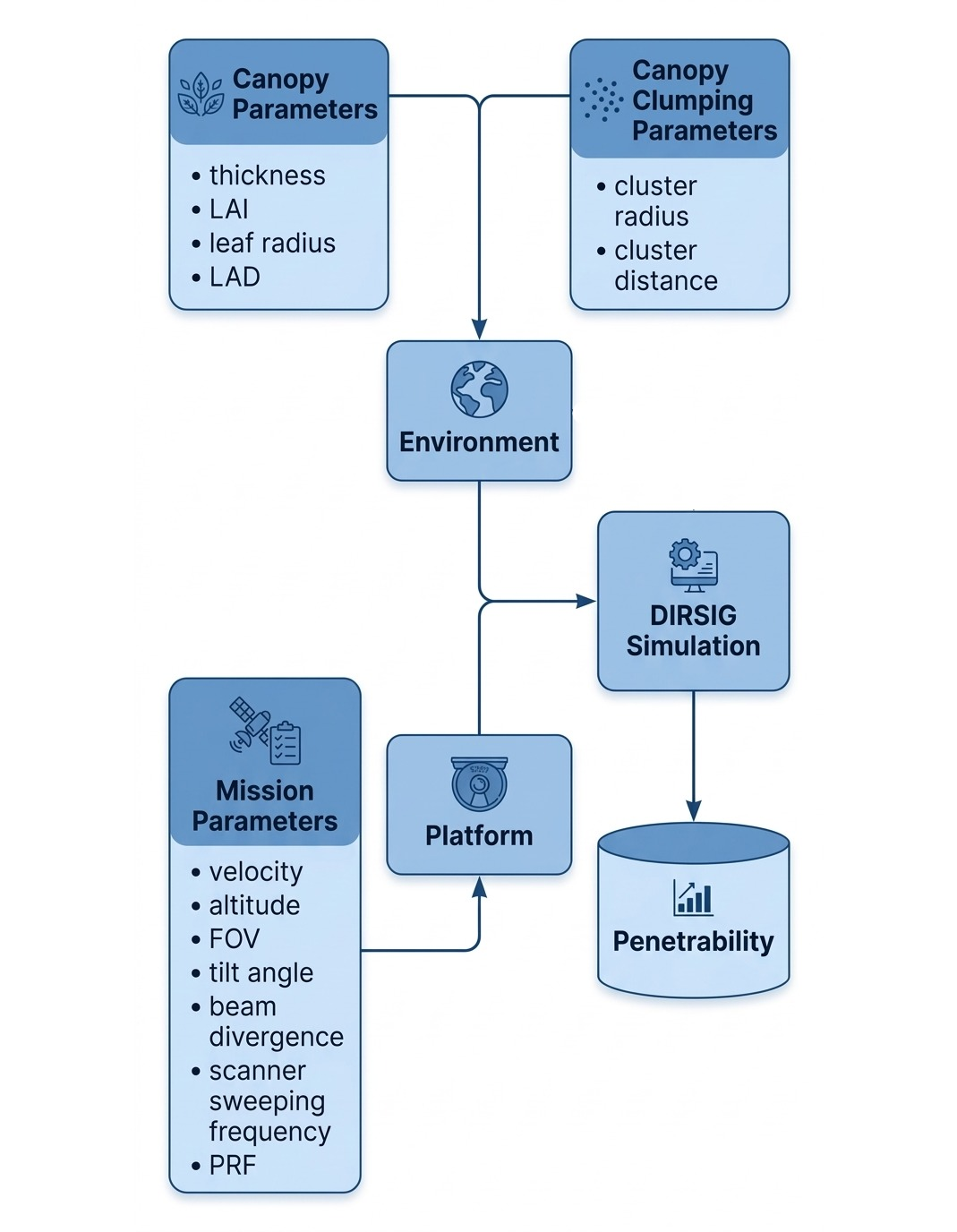
Physics-based simulation pipeline used to investigate interactions between canopy structure and LiDAR mission parameters.
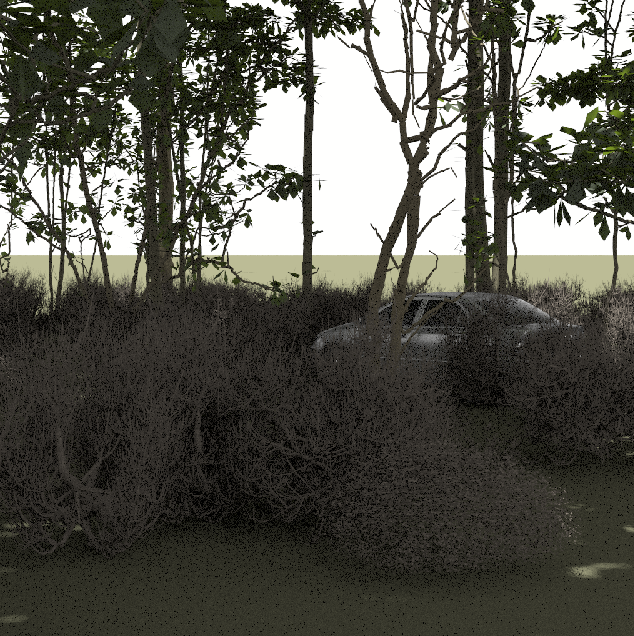
Inside view from the scene in DIRSIG used to generate full waveform datasets.