Grower Ready Drone Tutorial Case Study: Vineyard Pruning Weight
Principal Investigator(s)
Rob Chancia
Research Team Members
Terry Bates (Cornell University)
Project Description
In vineyard management terms, vine crop load is the ratio of the crop size relative to vine size, often measured as yield to pruning weight ratio (Y:PW). Vine size is estimated as the weight of dormant canes pruned after harvest to retain a desired number of bud nodes. Crop load data can aid a vineyard manager in realizing ideal vine balance of vegetative and reproductive growth. For Concord vineyards in the Lake Erie region, economics drive managers to target balanced vines with the largest possible yield (>6 tons/acre) with juice soluble solids in excess of 16° Brix by harvest (30 to 40 days post-veraison) while also maintaining vine size to ensure the next year’s crop potential. Figure 1 shows the relationship between pruning weight (PW) and yield (Y) in terms of crop load, with a target vine crop load range of 15 to 20 to meet vine balance goals for commercial production in an average season.
In practice, commercial producers do not measure PW or calculate crop load as manual PW mapping is too expensive. The trend is toward mechanized pruning to reduce cost at the expense of precise quantity and quality of retained nodes. A direct measure of vine size is possible with simple structural metrics like canopy coverage derived from drone imagery (see Figure 2). Measuring vine size with a drone would save on the labor costs to assess PW manually and allow for widespread spatial crop load management. A vine size map measured during veraison combined with a spatial yield map determined at harvest will allow for crop load management to guide precision pruning severity with mechanized pruners or manual pruning labor.
An issue of many past drone related efforts is that researchers operate science grade sensors and drones requiring advanced skill sets or expensive software. To make this technology more approachable for producers, a goal of this project is to explore inexpensive recreational drones, mission planning software, and image processing software applied to two commercial vineyards and two experimental vineyards. We will determine and then communicate to the grower community the certification requirements, equipment costs, software needs, potential revenue increase, and cost savings.
Figures and Images
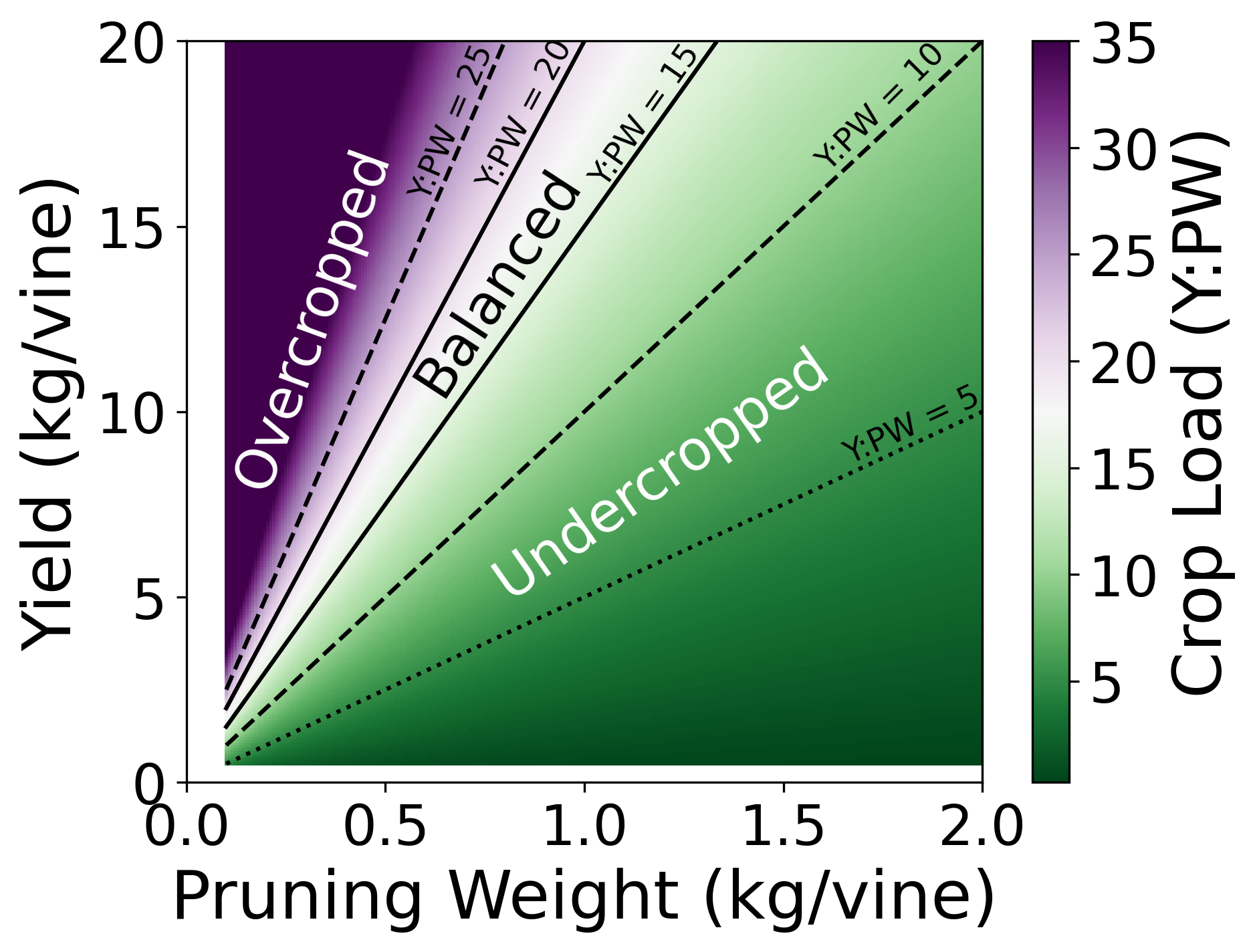
Concord crop load expressed as the ratio of yield and pruning weight (Y:PW). During an average season in the Lake Erie NY region, a crop load in the 15-20 range results in balanced vines with optimal yield reaching 16° Brix and a sustainable crop potential for next season.
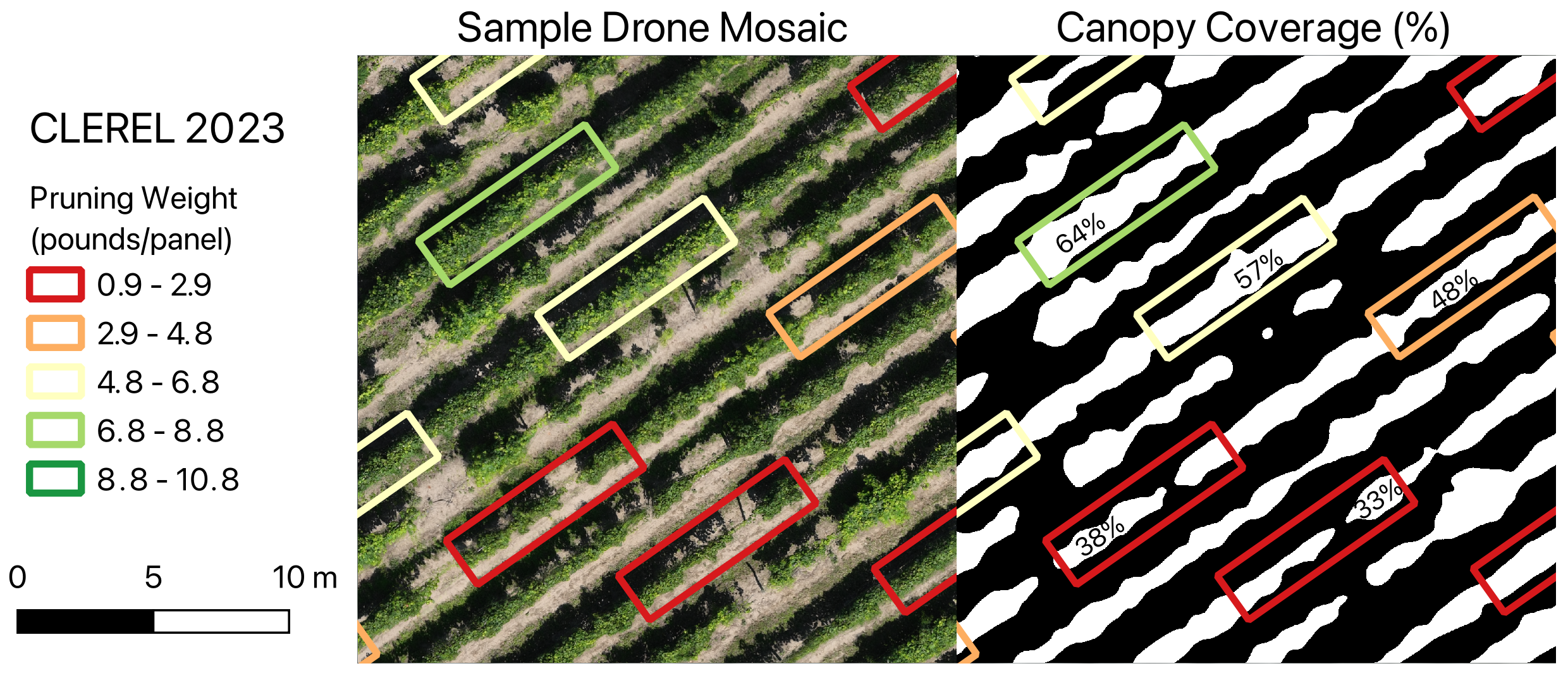
Sample drone image experiment taken over a Cornell Lake Erie Research & Extension Lab (CLEREL) study vineyard. Pruning weight was sampled in select panels (3 neighboring vines) across the vineyard block and compared with drone derived canopy coverage (percent area of vine canopy in each panel sized box). The weight per panel scales sensibly with canopy coverage.