The Influence of Canopy Structure and Foliar Chemistry on Remote Sensing Observations: Radiative Transfer Modeling to Understand Interactions of Light Within the Canopy and Inform Innovative Uses of Remote Sensing Data
Principal Investigator(s)
Jan van Aardt
Research Team Members
Kedar Patki (PhD Student)
Rob Wible (PhD Student)
Michael "Grady" Saunders
Keith Krause (Battelle)
Scott Ollinger (University of New Hampshire)
Andrew Ouimette (University of New Hampshire)
Jack Hastings (University of New Hampshire)
Project Description
The objectives of this project are to i) better understand the correlations between spectral reflectance and structural metrics and structure-trait cause-and-effect relationships; ii) propose a data fusion approach (LiDAR + hyperspectral) to trait prediction; and iii) apply the fusion approach to mitigate scaling issues (leaf-level, stand-level, forest-level). We are currently focusing our efforts towards understanding impact on spectral and structural metrics due to variation in leaf angle distributions (LAD). Leaf angle is a key factor in determining arrangement of leaves, and directly impacts forest structural metrics, such as leaf area index (LAI), which in turn is an important variable for a variety of ecological processes, such as photosynthesis and carbon cycling.
In previous research, we showed a quantitative comparison for several well-known vegetation indices (NDVI, PRI, OSAVI, and TCARI/OSAVI) over changes in underlying leaf angle distributions.
Solar zenith angle, defined as the angle between sun rays and the local vertical direction, is one of many factors that contribute to the radiometric signal arriving at sensor and can potentially confound the influence of leaf angle distributions on remote sensing derived metrics such as vegetation indices, LAI and canopy-level chlorophyll content. We show here the influence over some of the above-mentioned vegetation indices due to change in leaf angle distributions under varying solar zenith angle conditions. In DIRSIGTM simulations, we introduce this change by varying the time of day. In the histograms shown in figure 1, we observed that the trend of variation under different LADs is similar across different solar angles. We also observed that VI distributions remain very similar in spread and mean values between sunrise and sunset at the same angles.
Next steps include statistical modeling using classical ML methods known to work well for LAI and canopy chlorophyll estimation - SVR, PLS, and RF regression. We aim to show how the predictions from these models can also be impacted by changes in leaf angle distributions. Further, our goal is to incorporate structural information with DIRSIGTM LiDAR simulations for more robust LAI and chlorophyll predictions.
Figures and Images
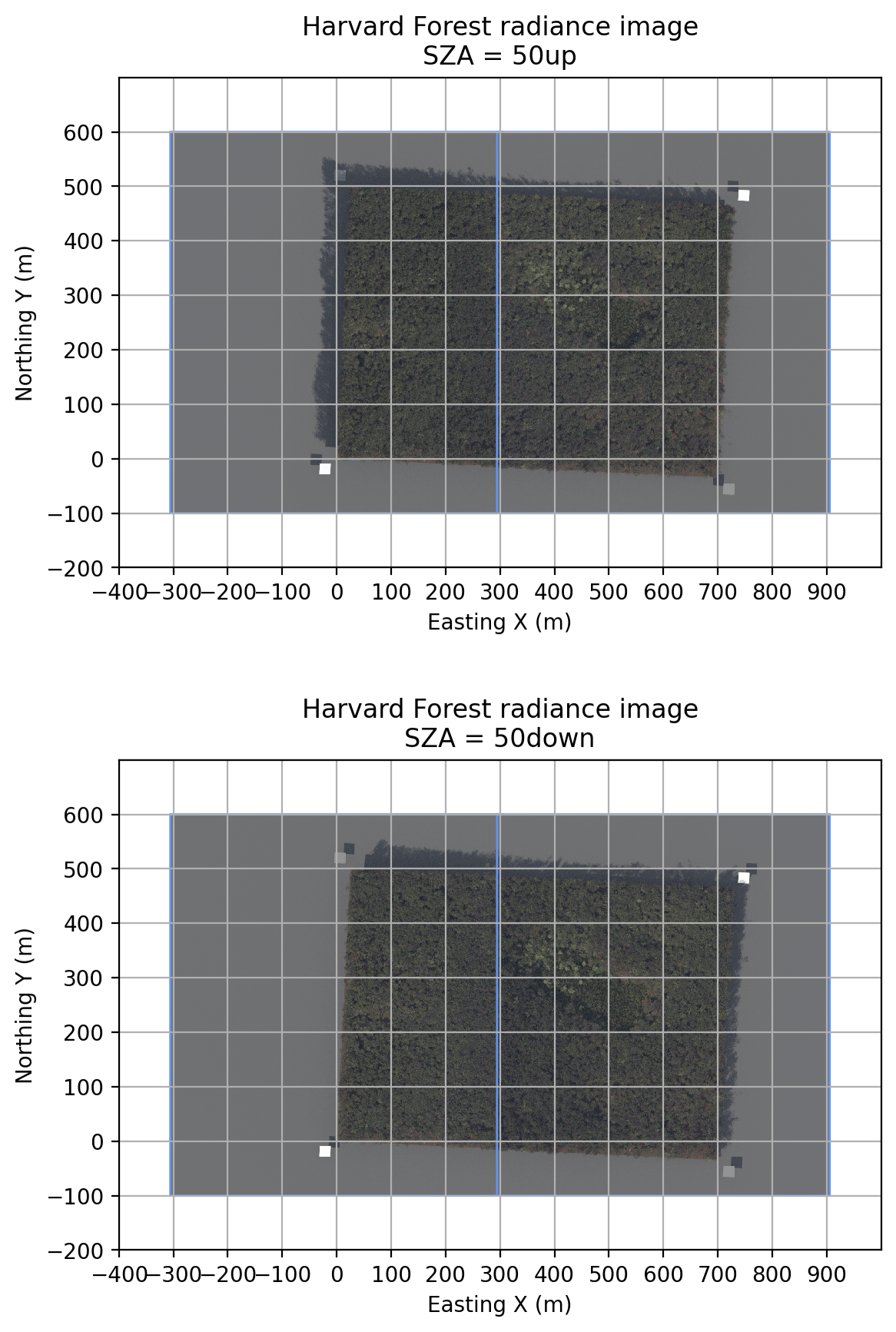
Example of solar angle variation (50 degrees at sunrise vs 50 degrees sunset) in DIRSIG Harvard Forest scene
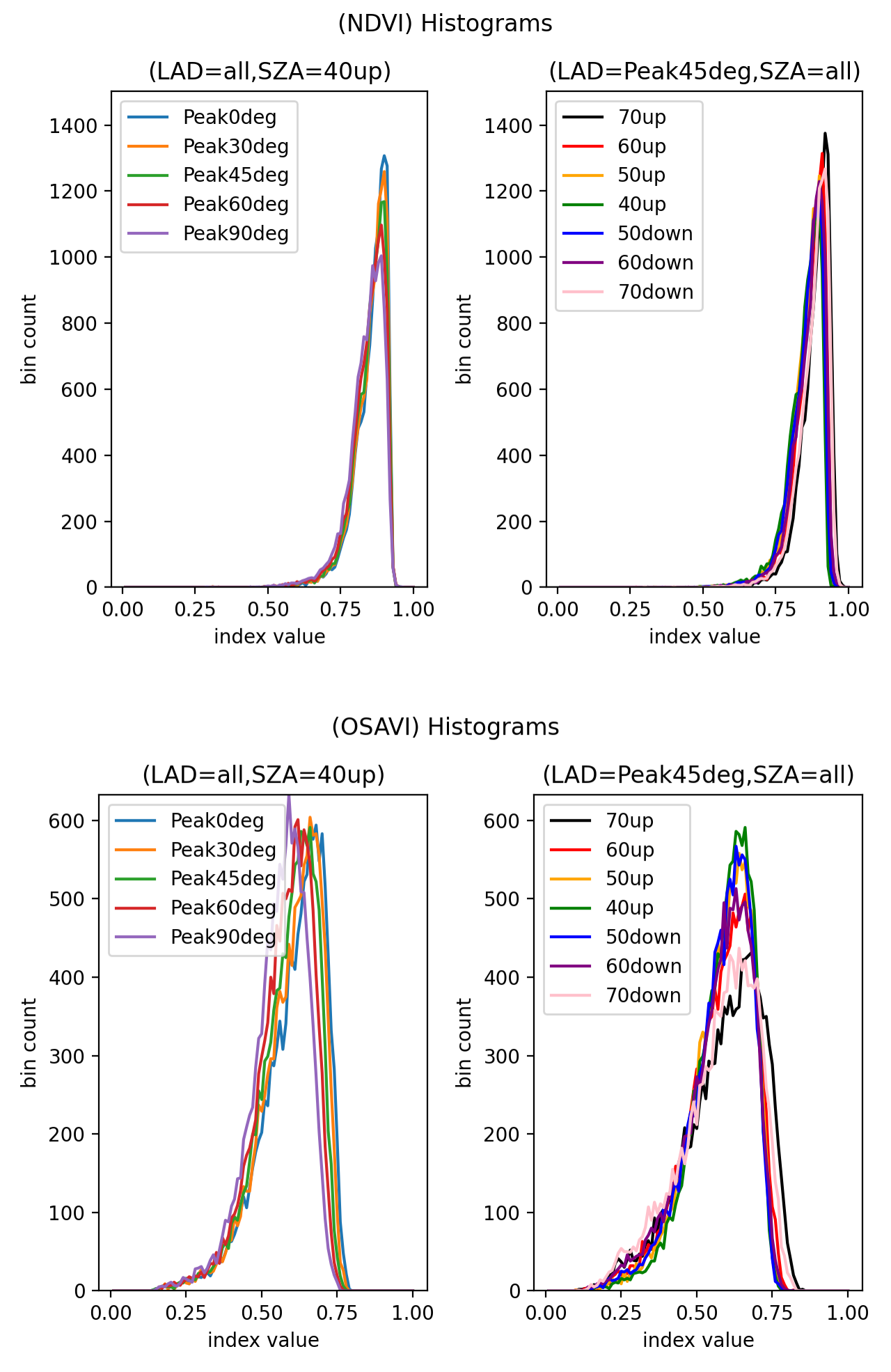
Influence on two vegetation indices (NDVI and OSAVI) due to LAD under different solar zenith angle conditions