L'Ralph In-Flight Instrument Characterization Support
Principal Investigator(s)
Matthew Montanaro
Project Description
The in-flight characterization and calibration of NASA's Lucy Ralph (L'Ralph) instrument is essential to a successful science mission. The L'Ralph instrument provides spectral image data of the Jupiter Trojan asteroids from visible to mid-infrared wavelengths from two focal planes sharing a common optical system. The Multispectral Visible Imaging Camera (MVIC) acquires high spatial and broadband multispectral images in the 0.4 to 0.9 micron region. The Linear Etalon Imaging Spectral Array (LEISA) provides high spectral resolution image data in the 1 to 3.8 micron spectral range. The Lucy observatory is currently in flight (phase E) after a successful launch in October 2021 and is in-route to the Jupiter Trojan swarms via multiple Earth Gravity Assists (EGAs). The overall objective of this work is to assist in the continuing characterization and radiometric calibration of the L'Ralph instrument through processing and analyses of in-flight image data. These image datasets are assessed for radiometric and spatial quality. Calibration algorithms are updated as needed to correct any artifacts or radiometric errors found during these image assessments.
The Lucy spacecraft continues its outbound cruise to the Jupiter Trojan asteroids and acquires in-flight calibration data several times per year. The PI has assisted in the data processing and analyses of these calibration images. Stellar scans by the LEISA instrument of the stars Arcturus and Antares were processed and compared to the known spectra of these stars to determine calibration gain adjustments to the instrument. The stellar scans were also used to determine the fine pointing characteristics of the instrument's scan mirror and the derived data were used to adjust imaging parameters for future acquisitions. Onboard filament acquisitions were used to check the previously developed de-fringing algorithm performance on in-flight data as the instrument temperatures stabilize to operational levels. Stray light in image data was also re-characterized as the spacecraft is now much further from the Sun (> 4 AU).
The PI completed the assigned tasks under this NASA contract in January 2025 and was awarded a new grant to continue the characterization support for the L'Ralph instrument through 2030.
Figures and Images
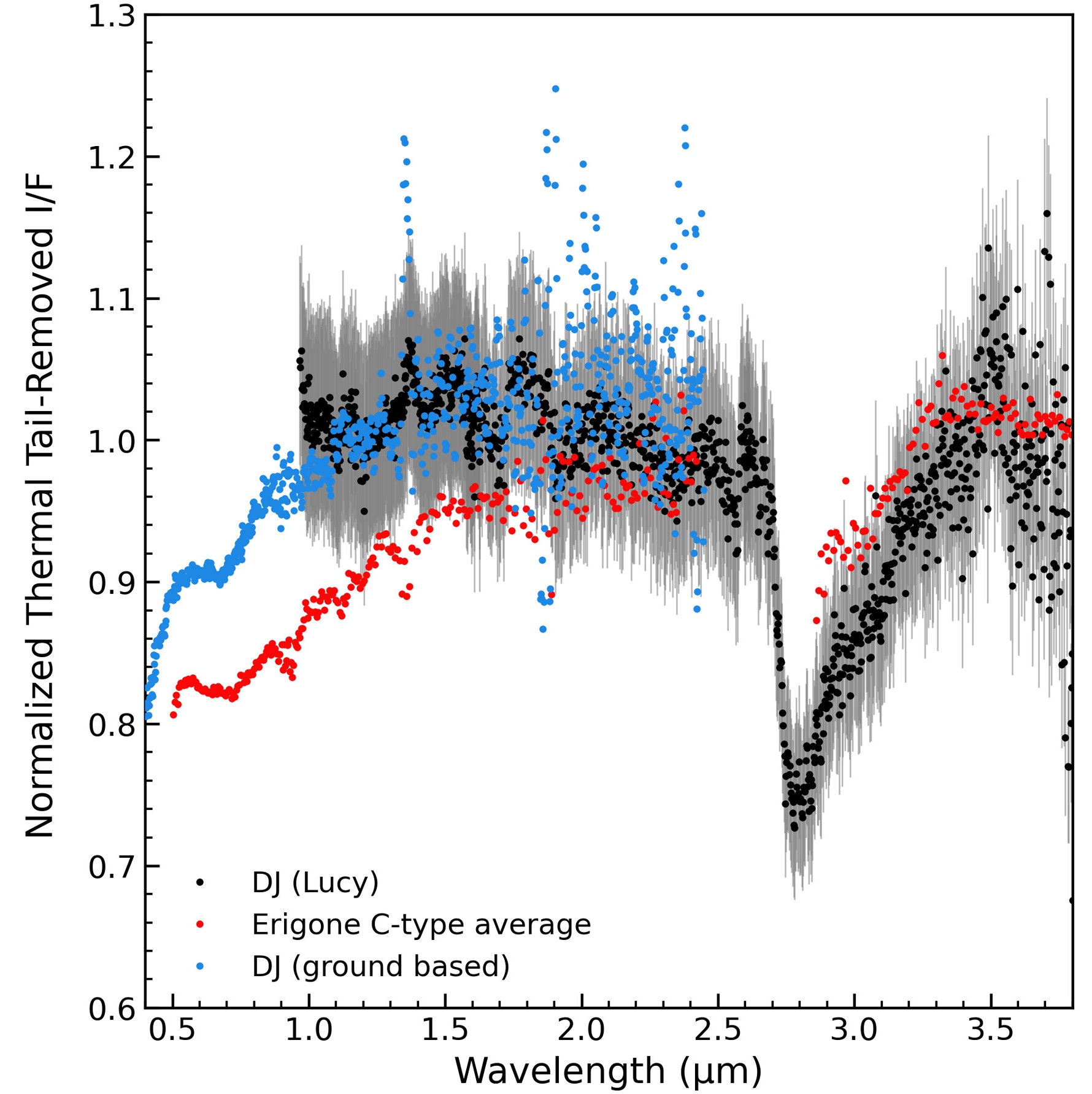
Retrieved spectrum of the main-belt asteroid, Donaldjohanson, acquired by the L’Ralph LEISA spectrometer during the close encounter by the Lucy spacecraft in April 2025. The LEISA spectrum (black dots) is compared with a spectrum acquired by ground-based assets (blue dots) and an average spectrum of other C-type asteroids (red dots). The large absorption feature at 2.8 microns is OH, representing hydrated materials on the asteroid. This image originally published in Marchi et al. 2026, Figure 5 (Science)