Radioisotope Thermoradiative Cell Power Generator
Principal Investigator(s)
Stephen Polly
Research Team Members
Seth Hubbard
Rob Chancia
Nikhil Pokharel
Ethan Haight
Brian O'Neill
Geoffrey Landis (NASA Glenn)
Anthony Iovinella (NASA Glenn)
Project Description
Power is essential to every space mission. In this NASA Innovative Advanced Concepts Phase II project we will continue to refine and demonstrate the feasibility of a revolutionary power source for missions to the outer planets utilizing a new paradigm in thermal power conversion, the thermoradiative cell (TRC). We predict this technology can enable a 25-fold increase in mass specific power density possible from radioisotope heat sources which currently utilize thermoelectric generators to supply power where use of photovoltaics is not possible. This new lightweight and efficient power source will enable system power on small platforms currently dependent on photovoltaic power, allowing the proliferation of small, nimble craft to environments where solar power is prohibitive. In particular, NASA is interested in micro-satellites for solar system exploration, but small lightweight power systems for the outer solar system remains an unsolved problem. We will solve this problem, and open the outer solar system to exploration by radically smaller spacecraft.
The Technology Innovation Thermoradiative Uranus Smallsat (TITUS) is a proposed smallsat technology demonstration concept mission to showcase an innovative power source utilizing thermal power conversion from a TRC (Figure 1). The proposed TRC has 3 times higher thermal to electrical power conversion efficiency than heritage MMRTG systems with a lower volume and higher mass specific power density. This makes a TRC particularly attractive for small-scale missions to the outer planets or other locations where low-light environments render solar power impractical. The mission would primarily serve as a proof-of-concept for TRC technology through a low-risk Smallsat companion to NASA’s nominal Uranus Orbiter & Probe (UOP) Mission. The primary objective for TITUS is to demonstrate TRC powering of a functional Smallsat in communication with the UOP while conducting supporting science measurements for a duration of 5 years or more. The conceptual design for the TITUS science package would complement UOP magnetospheric science during 15 additional orbits. By separating from the UOP, TITUS would achieve distinct spatial and temporal samplings of the complex magnetic field, radiation environment, and magnetopause of Uranus. The magnetosphere of Uranus is not well explored because Voyager 2, the only spacecraft to visit Uranus, spent only hours passing through the magnetosphere. Subsequent modeling also suggests that the lone flyby may have observed Uranus during an unusual period of solar activity. The TITUS observations would fill in the three-dimensional profiles of the interaction of the magnetic field with the solar wind. Likewise the TITUS spacecraft will fill in details on the radiation belts, with multiple passes through both Uranus’ electron and proton belts. The design was developed by the NASA Glenn Compass systems engineering team in coordination with Phase II of the NIAC program.
Although the design exercise focused on the mission of a smallsat for Uranus, the basic design could be adapted to nearly any mission required to operate in regions of space for which solar power is unavailable, including the outer planets and shadowed regions of the moon.
Figures and Images
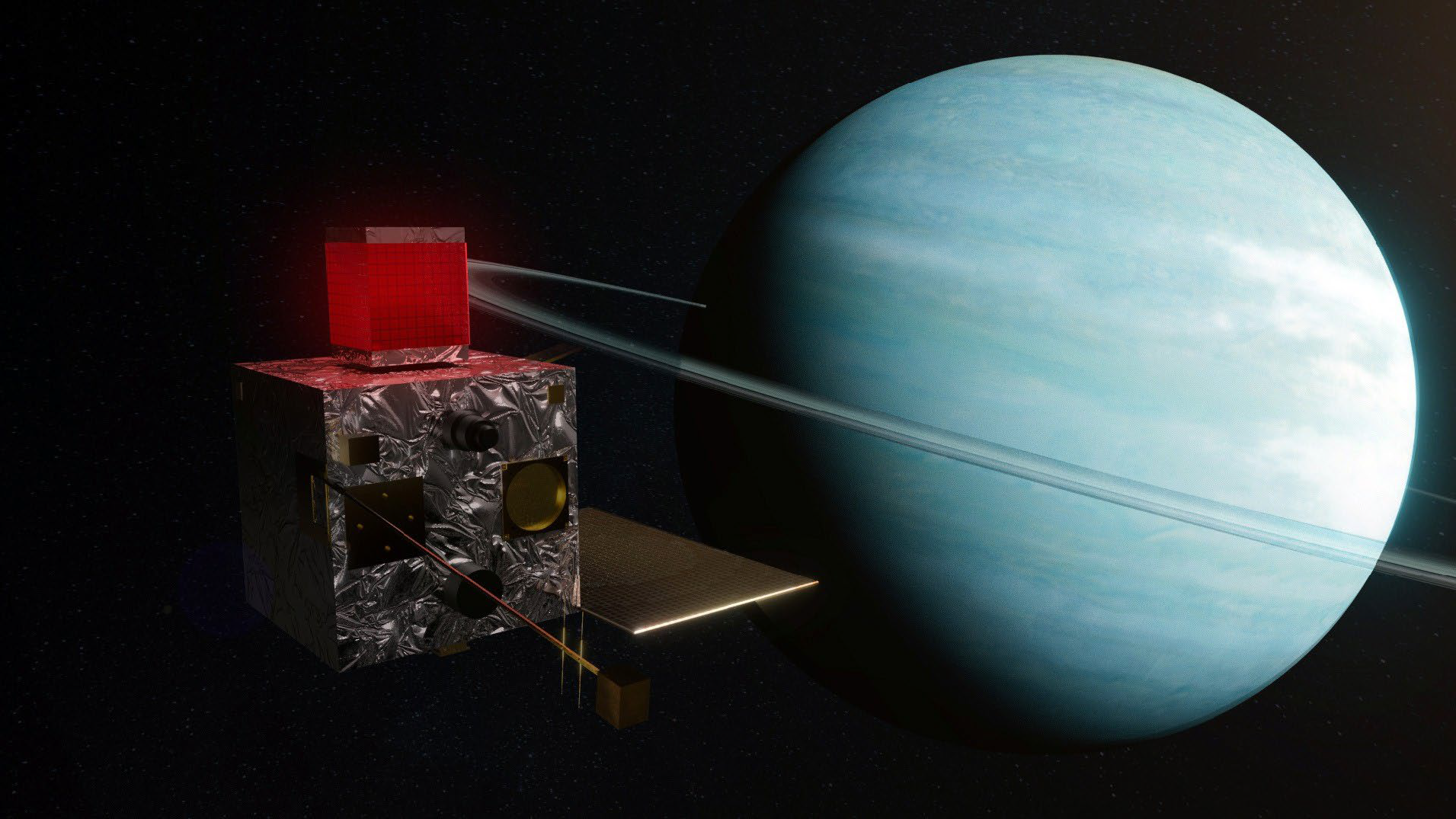
Artist’s conception of TITUS around Uranus.
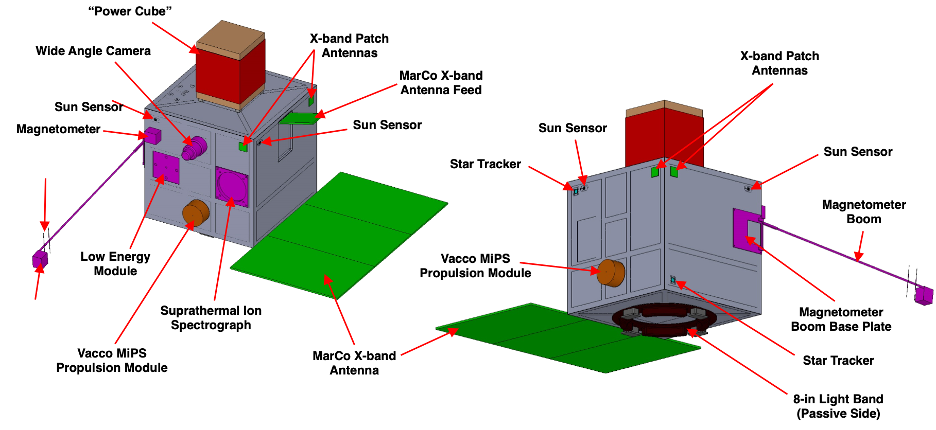
Schematic diagram of the TITUS smallsat with major components labeled. Label code: Magenta shows science instruments; green the deployed communications reflectarray, and red the power system.