Structure-Aware Segmentation for Post-Blast Rock Fragmentation Analysis
Principal Investigator(s)
Emmett Ientilucci
Research Team Members
Xuesong Liu (PhD Student)
Project Description
Rock fragmentation is a key indicator of blast performance because the size and distribution of blasted material directly affect excavation, loading, transportation, crushing, and downstream processing. Image-based fragmentation analysis offers a practical way to measure these outcomes, but reliable analysis depends on accurately separating individual fragments in complex muckpile imagery. Quarry scenes commonly contain thousands of irregular, densely packed fragments with touching boundaries, shadows, partial occlusions, fines, and large variations in scale. Even small boundary errors can merge neighboring fragments or divide a single fragment, substantially changing estimated fragment counts and particle size distributions.
This project develops computer vision methods for accurate and efficient post-blast rock fragmentation analysis. One component investigates training-free segmentation using the Segment Anything Model 2 (SAM2). The pipeline generates fragment masks from quarry imagery without requiring a site-specific labeled training set, then converts the segmented regions into estimates of fragment size and cumulative particle size distributions. These results are compared with outputs from commercial 3GSM fragmentation software to evaluate differences in the estimated proportions of fine and coarse material, the overall fragment size distribution, and total fragment counts.
A complementary component addresses the computational cost and boundary limitations of modern segmentation models through Structure-Aware Representation Distillation (SARD). Conventional knowledge distillation generally treats all image locations equally, even though fragment boundaries, junctions, and densely packed regions are more informative than uniform fragment interiors. SARD constructs a structure-importance map from teacher representations by combining boundary salience, structural complexity, and local feature variation. This map guides feature-space alignment between a large teacher model and a compact student model, encouraging the student to preserve fine geometric structure while maintaining global scene context.
Experiments on the RockFrag benchmark show that SARD improves a Swin-T student over a strong distillation baseline by 4.3 percentage points in mean intersection over union and 6.7 percentage points in boundary intersection over union. A ResNet-50 student distilled from a Swin-L teacher achieves up to 7.7 times fewer parameters and nine times higher inference throughput, with no additional inference overhead beyond the student network. This work was published at the 2026 IEEE/CVF Conference on Computer Vision and Pattern Recognition.
Together, the training-free and structure-aware approaches support a practical workflow for converting quarry imagery into reliable fragmentation measurements. The broader objective is to reduce dependence on extensive manual annotation while improving boundary accuracy, computational efficiency, and consistency across changing illumination, rock types, fragment densities, and site conditions.
Figures and Images
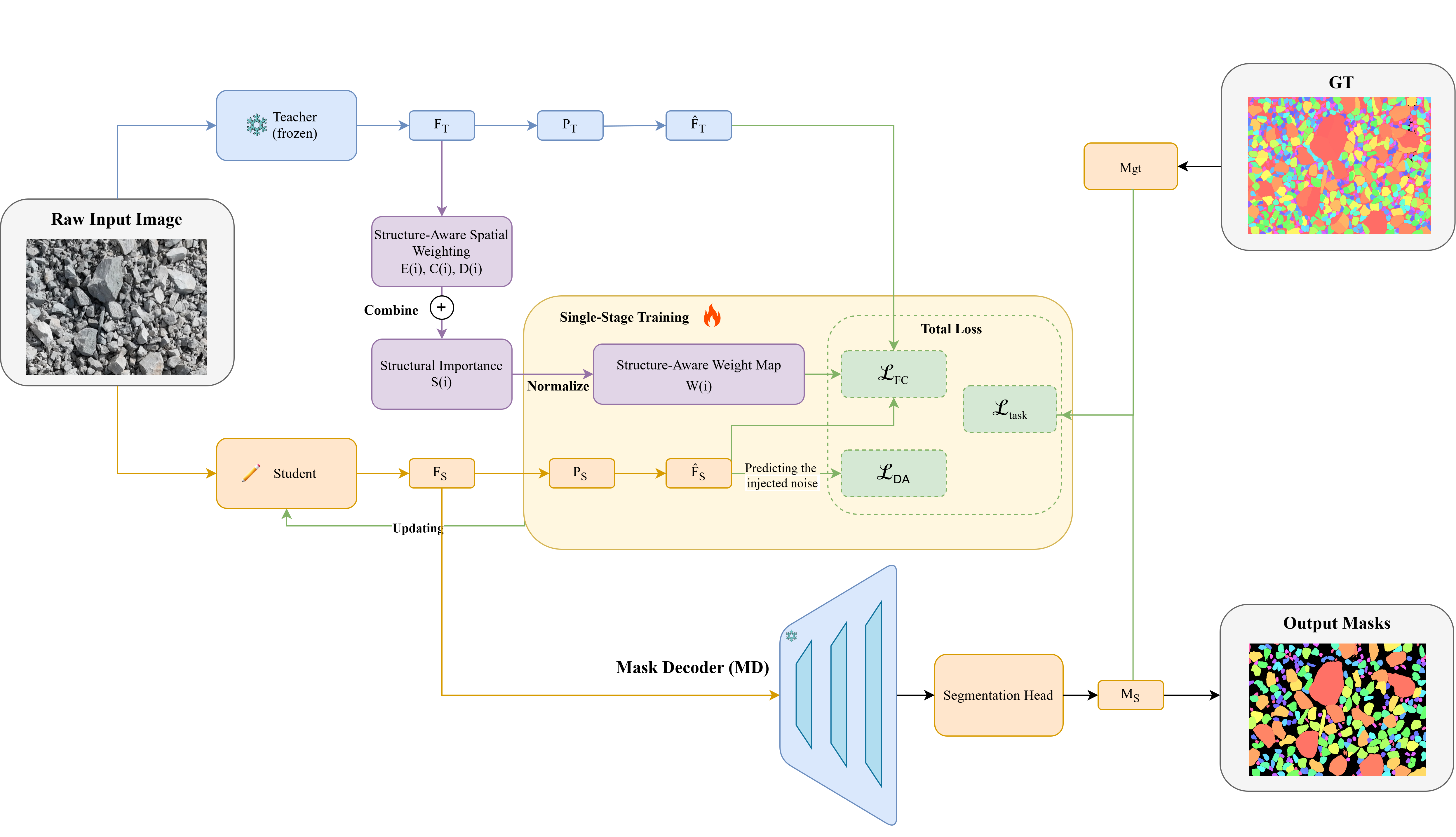
Overview of Structure-Aware Representation Distillation (SARD). A frozen teacher provides feature maps from which a structure-importance map is computed by combining boundary salience, structural complexity, and local feature variation. The resulting map guides feature-space distillation between the teacher and student, while a standard segmentation loss supervises the student when labeled data are available. At inference time, only the compact student network is required.