News
Don Figer
-
August 5, 2020

RIT student Justin Gallagher helps lead NASA-funded project to build single photon detectors
An RIT student is on a mission to help build detectors that could identify individual photons from distant, inhabitable planets. Justin Gallagher, a fifth-year student from Rochester, N.Y., pursuing his BS in physics and MS in astrophysical sciences and technology, is serving as project manager for a nearly $1 million grant funded by NASA to create a single photon sensing and number resolving detector for NASA missions.
-
August 3, 2020

RIT faculty gearing up to apply spring learnings to fall classes
The unexpected transition to remote learning during the spring semester challenged faculty across RIT to experiment, create, and deploy new methods of instruction to ensure student success. As the university gears up for in-person and online classes—or a combination of both—faculty members are applying a wide range of lessons learned from the spring to keep academic momentum moving forward in the fall.
-
June 23, 2020
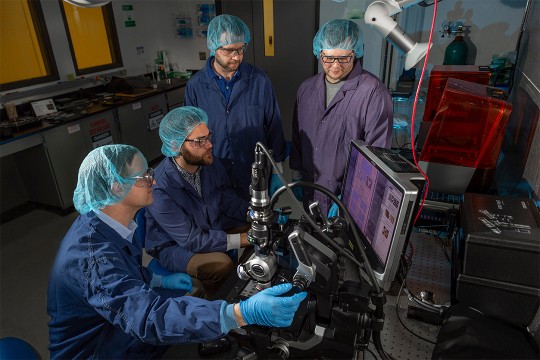
RIT launching virtual speaker series featuring global leaders in quantum and photonics
RIT is launching an online speaker series that will feature international pioneers in the advancement of photonics for quantum devices. The Virtual Photonics for Quantum Workshop begins June 23 and will feature new invited talks each weekday at 1 p.m. through Aug. 7.
-
March 4, 2020
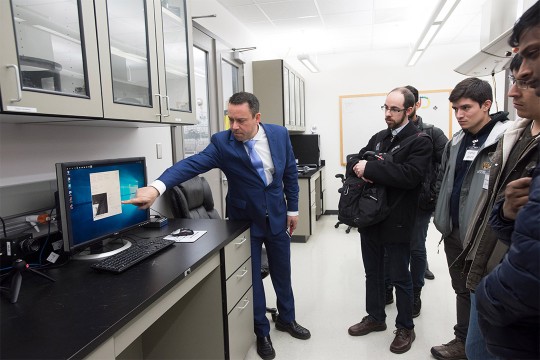
RIT to host workshop exploring the intersection of photonics and quantum technology
RIT will bring international pioneers in the advancement of photonics for quantum devices to campus this summer for a special workshop. The Photonics for Quantum Workshop 2 takes place June 23-25 at the RIT campus.
-
September 12, 2019
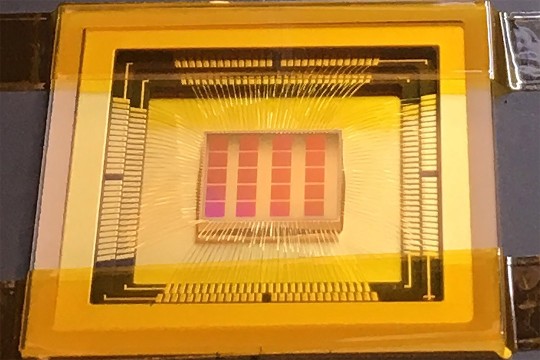
Scientists developing single photon detector to help search for habitable exoplanets
NASA is awarding a team of researchers from RIT and Dartmouth College a grant to develop a detector capable of sensing and counting single photons that could be crucial to future NASA astrophysics missions. The extremely sensitive detector would allow scientists to see the faintest observable objects in space, such as Earth-like planets around other stars.
-
August 7, 2019
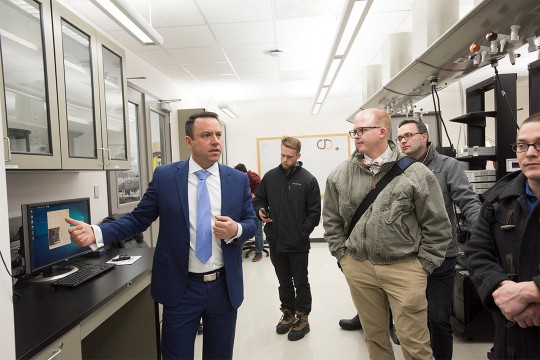
RIT awarded NSF funding to conceptualize Quantum Photonic Institute
The National Science Foundation awarded RIT a grant to conceptualize a new institute that would be at the forefront of quantum science and technology. RIT received $150,000 in funding from the NSF’s Quantum Leap Challenge Institutes program to create a plan for an institute that would expand quantum science and technology capabilities through quantum photonic integrated circuits.