School of Physics and Astronomy

There has never been a more exciting time to study the exciting discipline of physics, spanning the workings of the sub-atomic world to the ever-expanding universe.
Overview
The BS Physics Program in the School of Physics and Astronomy offers a comprehensive curriculum that provides a solid foundation in experimental, computational, and theoretical physics, emphasizing laboratory training and the development of analytical problem-solving skills. Physics majors gain strong preparation for employment in research, industry, and teaching, and for graduate study in physics and related fields. BS Physics students also find graduate placements in various professional programs such as in medical, law, and business schools.
At the graduate level, the School of Physics and Astronomy offers PhD and MS programs in both Astrophysical Sciences & Technology as well as Physics. The Astrophysical Sciences & Technology PhD offers extensive curricula and research opportunities spanning topics in stellar, galactic, and extragalactic astrophysics, as well as the fields of general relativity, gravitational wave astronomy, and instrument/detector development. The Physics PhD provides opportunities for in-depth research and study in areas such as atomic physics, biophysics, condensed matter and applied physics, as well as physics education research. Additionally, the School offers a general Physics MS Program that spans the various sub-disciplines in the field of physics, and provides both a research and a professional option to students.
50%
Of astrophysical sciences and technology doctoral students are women
11
Average number of undergraduate co-authors on peer-reviewed publications annually (2013-2018)
4
BS/MS accelerated 5-year dual degree programs offered
Undergraduate Programs
The undergraduate program in physics offers a broad curriculum preparing students for employment in research, industry, and teaching as well as excellent preparation for graduate school. The individualized research capstone component of the program provides our students with a competitive edge when seeking entry into preferred graduate programs and the job market.
Graduate Programs
Our graduate programs offer advanced training in physics and astronomy and provide opportunities spanning a wide variety of research and professional areas. Students in the MS Physics program can choose between either a research (i.e., thesis) option or a “professional” option. Students in the Astrophysical Sciences & Technology programs engage with RIT’s world-class research centers offering cutting-edge opportunities in gravitational waves, new advanced sensor technologies, and multi-wavelength astrophysics.
Latest News
-
October 6, 2026
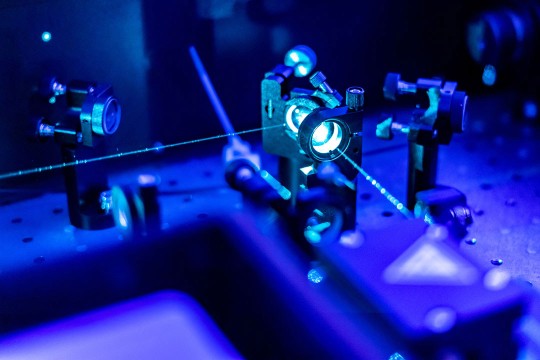
$31M UR-led NSF STELLAR Engine initiative names CEO
Rochester Business Journal reports that Sujatha Ramanujan has been named CEO of the STELLAR Engine, which brings RIT together with regional partners to advance next-generation laser technology, workforce development, and economic growth.
-
September 3, 2026

NASA’s Roman Space Telescope could find alien Earths—but not like you think
Scientific American interviewed Meridith Joyce, assistant professor of physics, about NASA's Nancy Grace Roman Space Telescope and its role in dating stars in the Milky Way galaxy.
-
August 25, 2026
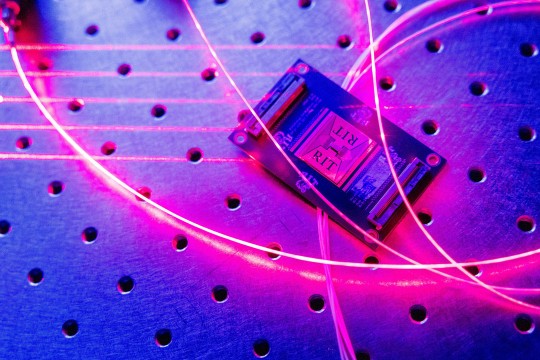
RIT part of NSF-funded Quantum Leap Challenge Institute
RIT is building its eminence in quantum research as part of a $37.5 million National Science Foundation (NSF) award for large-scale interdisciplinary research projects known as Quantum Leap Challenge Institutes.
Research
RIT faculty participating in the Center for Detectors are involved in the design and development of the next generation of instruments and technologies for astrophysics. We participate in a variety of ground-based, sub-orbital, and orbital programs designed to probe from our solar system and galactic neighborhood out to the most distant regions of our universe.
Research Active Faculty:


Physics research in condensed matter and materials encompasses theory and experiment. Theorists utilize electronic structure calculations, molecular dynamics simulations, and kinetic Monte Carlo modeling to study and design oxides, metals, and alloys at various length and time scales. Experimentalists are focused on the study of metals, oxides, surfaces, and magnetic systems through x-ray scattering techniques such as coherent scattering and surface diffraction, as well as imaging techniques such as atomic force microscopy.
Research Active Faculty:


Current research areas overlapping the disciplines of Physics and Engineering include such topics as optoelectronic and photovoltaic devices, surface and materials characterization, instrumentation for fundamental physics, complex fluids, and micro-fluidics. Research programs in the School of Physics and Astronomy, for example, aim to increase photovoltaic power conversion efficiency and/or reduce materials costs and consumption through the use of nanoscale and novel materials. Activities encompass materials synthesis by vapor phase epitaxy, device fabrication, material and device modeling, as well as characterization both at the electrical and materials level, and computational design of nano-materials for energy technologies, and complex fluids-structure interaction at the micro-scale for oil recovery.
Research Active Faculty:


RIT faculty participating in the Center for Computational Relativity and Gravitation and the Laboratory for Multi-wavelength Astrophysics conduct observational and theoretical research across a wide range of topics in multi-messenger and multi-wavelength astrophysics, utilizing a combination of observations spanning the electromagnetic spectrum, data from gravitational wave detectors, and supercomputer simulations. Current areas of research include numerical relativity and relativistic magnetohydrodynamics, gravitational wave data analysis, compact object binaries, accretion disks and jets, galaxy formation and evolution, large scale structure, active galactic nuclei, observational and experimental cosmology, early and late stages of stellar evolution, protoplanetary disks, planetary nebulae, the interstellar medium, supernovae, and pulsars. RIT is a member of the Large Synoptic Survey Telescope Corporation and faculty are involved in several major collaborations including the Laser Interferometer Gravitational Wave Observatory Scientific Collaboration, the NANOGrav Pulsar Timing Array Consortium, the Laser Interferometer Space Antenna, and the Cosmic Evolution Survey.
Research Active Faculty:


The Physics Education Research group combines physics disciplinary knowledge with cognitive science, psychology, instructional design and social science to study fundamental and applied topics in physics education. Core areas of study at RIT include: career preparation of physics majors, communication skills for scientists, identity, diversity and inclusion in physics, student epistemic framing while problem solving, educational technology development, and graduate school admissions and retention. Physics faculty are part of a larger discipline-based education research community at RIT which includes researchers in biology, chemistry, engineering, and computing. The group is distinguished by its collaborative structure that is consciously designed to maximize interactions across the disciplines.
Research Active Faculty:


Current optics research in RIT Physics consists of a combination of theory and experiments. Theorists are focused on characterizing silicon nano-photonic networks and exploring quantum sensing and mesoscopic quantum physics. Experimentalists are currently investigating problems in integrated photonics and imaging, including the quantification of entanglement for the purposes of computing, simulation, and secure communication.
Research Active Faculty:


Physics faculty engaged in research on the atomic and nanoscale structure and dynamics, at a variety of length and time scales, utilize and further develop x-ray, neutron, and laser light techniques and instrumentation. In addition to x-ray scattering/spectroscopy from surfaces and laser scattering from particulate or structured solutions performed at RIT, x-ray experiments are performed at national synchrotron facilities and neutron experiments take place using instruments at national spallation and reactor sources. RIT physics faculty are also developing a new spin-polarized neutron scattering technique and instrument in which the spin polarizations of sample target nuclei are selectively manipulated using nuclear magnetic resonance techniques.
Research Active Faculty:


Biological physics researchers at RIT are studying molecular interactions related to cataract disease and to the eye vitreous, using scattering techniques, nuclear magnetic resonance, confocal microrheology, and statistical thermodynamics modeling. Theorists are studying the roles of connectivity, structural and functional heterogeneities, and proximity to phase transitions in determining the robustness and adaptability of biological networks in cells and tissues, as well as networks of neurons. Such work can lead to design principles for bio-inspired, engineered systems. Soft matter researchers focus on understanding the physics of systems of many interacting bodies. Areas of research include using micro-fluidics and fluorescent optical imaging to study the complex fluids confined in solid phases where interactions are mediated by hydrodynamics, and using light and other scattering methods to study micellar and micro-emulsion systems. RIT physicists also study granular materials, collections of larger particles (sand, sugar, and coins) that interact primarily through contact forces.
Research Active Faculty:


Research Affiliates
Manasse Mbonye (RIT-Rwanda)
Eleanor Sayre (RIT-CASTLE)
Visiting Scholars
Fred Moolekamp


Featured Work and Profiles
-

RIT Physics Grad Finds his Focus in Precision Optics
From RIT physics labs to precision optics, Joey Root ’25 is using skills developed through coursework and research as he builds a career in optical manufacturing at Optimax Systems.
Read More about RIT Physics Grad Finds his Focus in Precision Optics -

From Personal Battle to Planetary Impact: Ph.D. Student Tackles Agricultural Plastics
Backed by a $15 million NSF grant, Katie Malarkey ’04 (physics), a sustainability Ph.D. student, quantifies the volume of plastics and tackles their end-of-life issues.
Read More about From Personal Battle to Planetary Impact: Ph.D. Student Tackles Agricultural Plastics -

Exploring the Potential of Virtual Reality for Analyzing Astronomical Data
Ryan Butler, a Ph.D. candidate in the Astrophysical Science and Technology program at RIT, is exploring the use of virtual reality to analyze astronomical data.
Read More about Exploring the Potential of Virtual Reality for Analyzing Astronomical Data -

From RIT and Cornell to Co-founder of Kanvas Biosciences
After studying physics at RIT and Cornell, Hao Shi ’13 now uses his quantitative skills as co-founder and CTO of Kanvas Biosciences, a company dedicated to developing innovative live biotherapeutics.
Read More about From RIT and Cornell to Co-founder of Kanvas Biosciences -

Explore Undergraduate Research, Discover a Passion, Land a Career
Tyler Godat ’16 chose RIT because of its reputation for undergraduate research, co-ops, and internships. Now, he is an optical measurements engineer at Corning.
Read More about Explore Undergraduate Research, Discover a Passion, Land a Career -

Squishing the Barriers of Physics
Four RIT faculty members are opening up soft matter physics, sometimes known as “squishy physics,” to a new generation of diverse scholars.
Read More about Squishing the Barriers of Physics
Would you like to donate to our school?
Your gift helps the university support students, attract great faculty members, and maintain leading-edge academic programs.